Oxystelma esculentum
(L. f.) R. Br. ex Schult.
Alpin's oxystelma, Rosy milkweed vine
iNaturalist· cc-by-nc
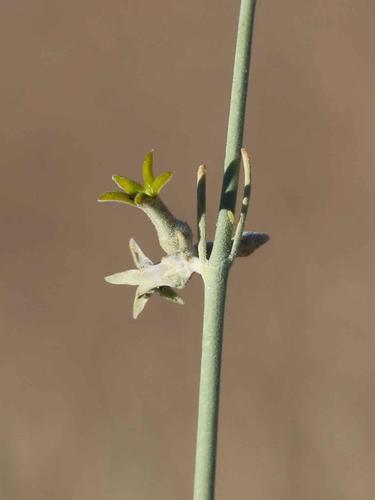
(c) Elavarasan M, some rights reserved (CC BY-NC), uploaded by Elavarasan M
iNaturalist· cc-by
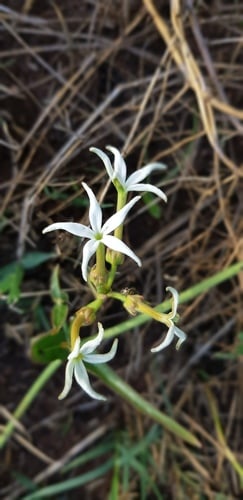
(c) Siva Naturewild, some rights reserved (CC BY)
Summary
Source: WikipediaOxystelma esculentum is a species of flowering plant native to China, South Asia, southeast Asia, northeastern Africa, and south-west Asia. The plant is used in traditional medicine and the fruit is eaten.
Description
A soft slender climber. The plant contains a white latex. The leaves are opposite and each pair is at right angles to the ones above and below it. The leaves are long and sword shaped. They are dark green with light green veins. They are 3.5-8 cm long by 4-10 mm wide. The leaf stalk is 3-12 mm long. The flowers occur as 2-3 together. They are 2-3 cm wide. The flowers are bell shaped. There are 5 triangular lobes. These are hairy at the edges. The flowers are white with reddish streaks inside. The fruit are many seeded dry fruit. They are oblong and curved. They are 4-7 cm long by 1.6 cm wide. The seeds are oval and flat.
Edible Uses
The shoots are eaten raw. The fruit are eaten mixed with seasoning or salt. The leaves are also edible.
Traditional Uses
The shoots are eaten raw. The fruit are eaten mixed with seasoning or salt.
This uses section is brief — help expand it
Distribution
A tropical plant. It grows on the Deccan in India. It grows naturally on stream banks. It grows up to an altitude of 900 metres. In Yunnan, China it grows between 800-1300 m altitude.
Where It Grows
Africa, Asia, Australia, Bangladesh, Cambodia, China, Egypt, Himalayas, India, Indochina, Indonesia, Iraq, Laos, Malaysia, Middle East, Myanmar, Nepal, North Africa, Pakistan, SE Asia, Sri Lanka, Thailand, Vietnam, NE Africa, SW Asia,
Cultivation
Plants can be grown from seeds or cuttings.
Notes
There are 4 Oxystelma species. Used in medicine.
Synonyms
Also Known As
Chamuuk plaa lot, Chamuuk-plah-lai-dong, Climbing milkweeds, Dudhejhar, Kiew khai, Sarkostema rambat, Yanglaguo
References (12)
- Dangol, D. R., 2002, Economic uses of forest plant resources in western Chitwan, Nepal. Banko Janakari, 12(2): 56-64
- Eiadthong, W., et al, 2010, Management of the Emerald Triangle Protected Forests Complex. Botanical Consultant Technical Report. p 51
- Flora of Pakistan.
- Hedrick, U.P., 1919, (Ed.), Sturtevant's edible plants of the world. p 458
- Jacquat, C., 1990, Plants from the Markets of Thailand. D.K. Book House p 87
Show all 12 references Hide references
- Jin, Chen et al, 1999, Ethnobotanical studies on Wild Edible Fruits in Southern Yunnan: Folk Names: Nutritional Value and Uses. Economic Botany 53(1) pp 2-14
- McMakin, P.D., 2000, Flowering Plants of Thailand. A Field Guide. White Lotus. p 88
- Pullaiah, Y., Krishnamurthy, K. V. & Bahadur, B., (Eds.), 2016, Ethnobotany of India, Volume 1: Eastern Ghats and Deccan.
- Singh, H.B., Arora R.K.,1978, Wild edible Plants of India. Indian Council of Agricultural Research, New Delhi. p 78
- Sukarya, D. G., (Ed.) 2013, 3,500 Plant Species of the Botanic Gardens of Indonesia. LIPI p 968 (As Sarcostemma esculentum)
- SWARUPANANDAN,
- WATT.