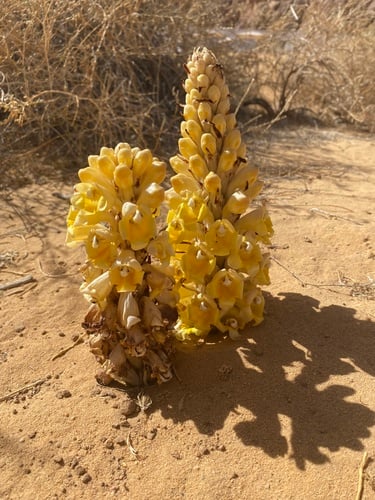
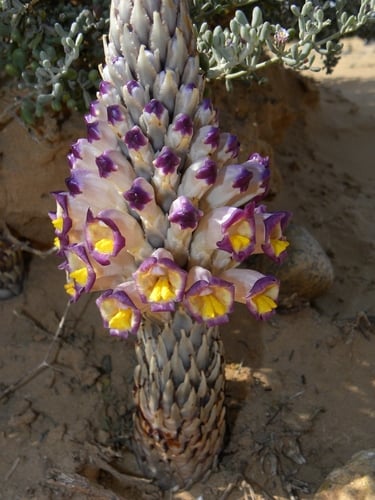
Orobanche californica
Cham. & Schltdl.
California broomrape
iNaturalist· cc-by-nc
(c) Duncan Bell, some rights reserved (CC BY-NC)
iNaturalist· cc-by-nc
(c) Duncan Bell, some rights reserved (CC BY-NC)
iNaturalist· cc-by-nc
(c) Duncan Bell, some rights reserved (CC BY-NC)
Summary
Source: WikipediaOrobanche californica, known by the common name California broomrape, is a species of broomrape. It is a parasitic plant growing attached to the roots of other plants, usually members of the Asteraceae.
Description
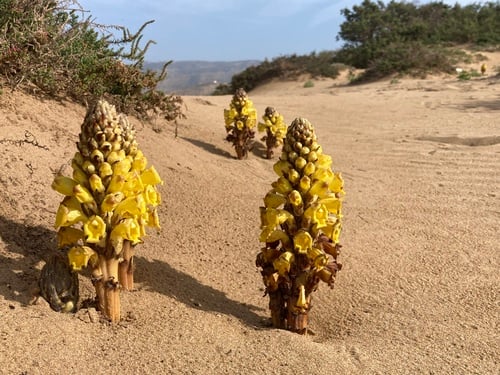
A parasitic plant. It usually grows attached to the roots of plants in the daisy family. It grows 35 cm tall. It does not have leaves or green colouring and takes its nutrients from the other plant. There can be one or several stems. They are purple and covered with hairs. There are several flowers in a group. The flowers are tube shaped and 5 cm long. They are pale pink or purple and the fruit is a capsule with very small seeds.
Edible Uses
The underground stems can be eaten raw or cooked. They have a succulent texture and are very thirst quenching.
Traditional Uses
The underground stems are chewed.
This uses section is brief — help expand it
Medicinal Uses
A decoction of the plant has been used to treat colds, pneumonia, and pulmonary complaints.
Distribution
It is a temperate plant.
Where It Grows
Canada, North America, USA,
Cultivation
We have very little information on this species and do not know if it will be hardy in Britain, but judging by its native range it should succeed outdoors at least in the milder areas of the country. It requires a well-drained soil and should succeed in sun or shade. A fully parasitic plant lacking in chlorophyll, it is entirely dependant upon its host plant for obtaining nutrient.
Propagation
No specific information is available for this species, but sowing seed in a greenhouse in a pot containing a host plant is suggested. Seed is probably best sown as soon as ripe where possible. It may also be feasible to sow seed in situ around a host plant.
Other Uses
None known.
Notes
There are about 140 Orobanche species.
References (3)
- Beckstrom-Sternberg, Stephen M., and James A. Duke. "The Foodplant Database." http://probe.nalusda.gov:8300/cgi-bin/browse/foodplantdb.(ACEDB version 4.0 - data version July 1994)
- Kermath, B. M., et al, 2014, Food Plants in the Americas: A survey of the domesticated, cultivated and wild plants used for Human food in North, Central and South America and the Caribbean. On line draft. p 591
- Plants for a Future database, The Field, Penpol, Lostwithiel, Cornwall, PL22 0NG, UK. http://www.scs.leeds.ac.uk/pfaf/