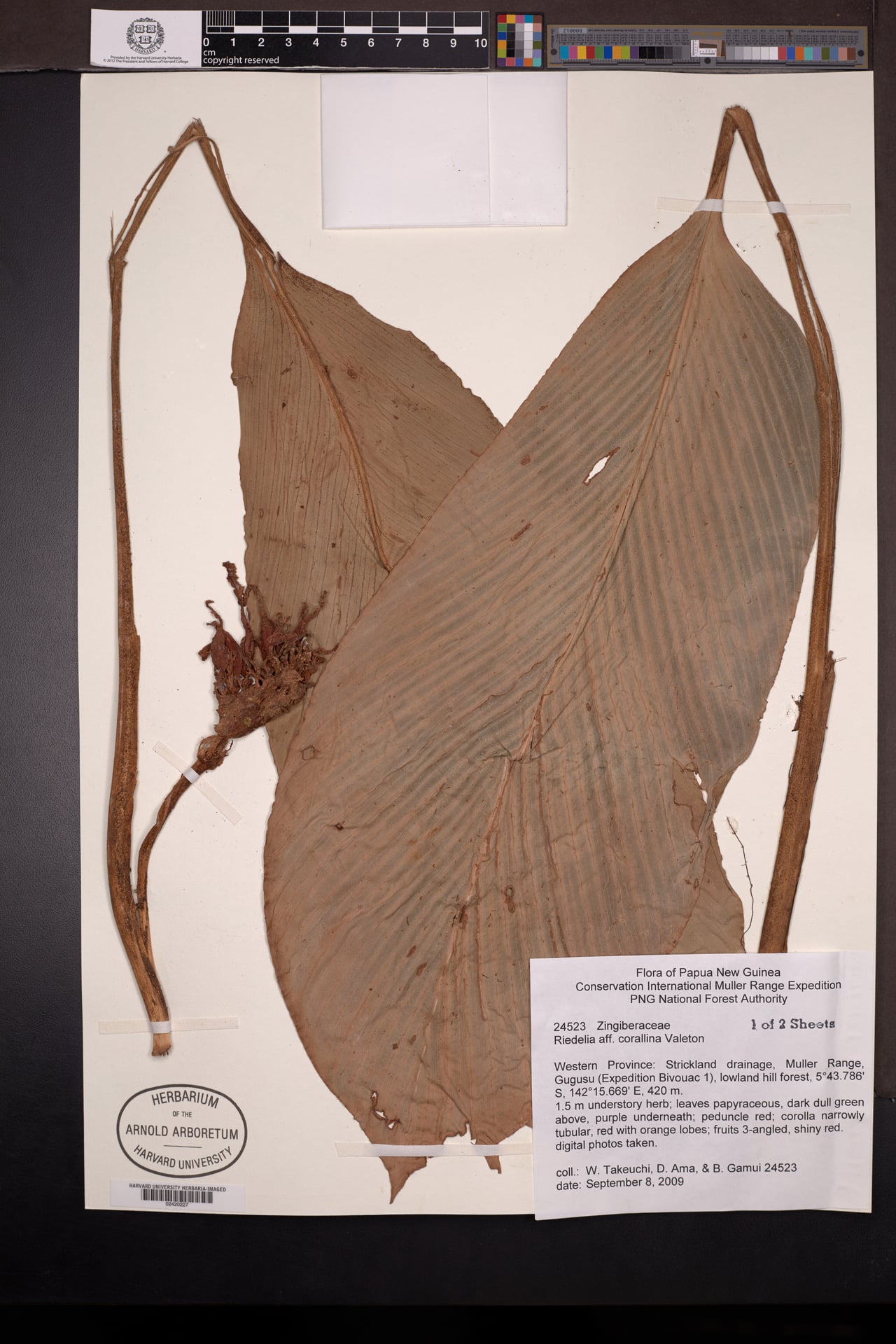
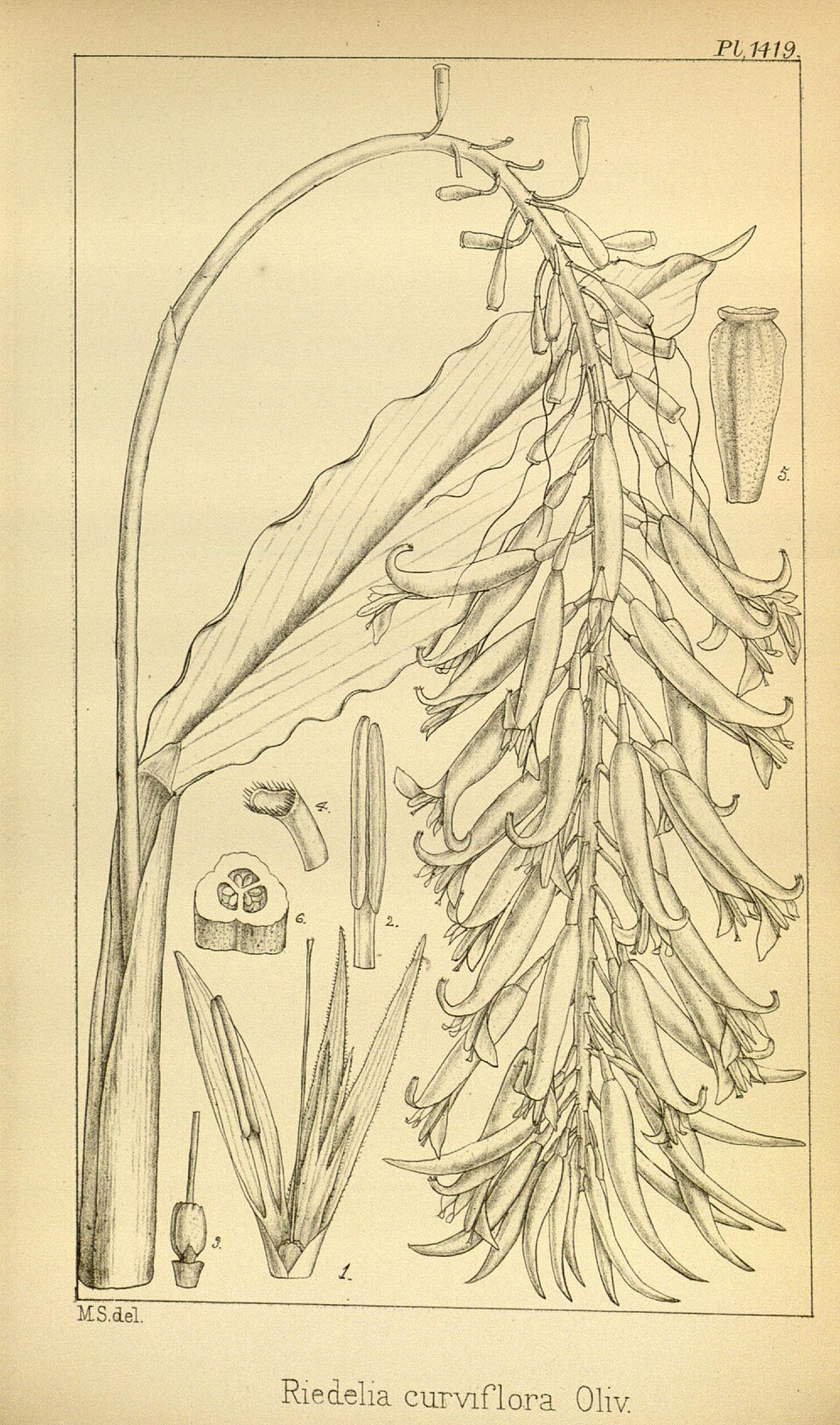
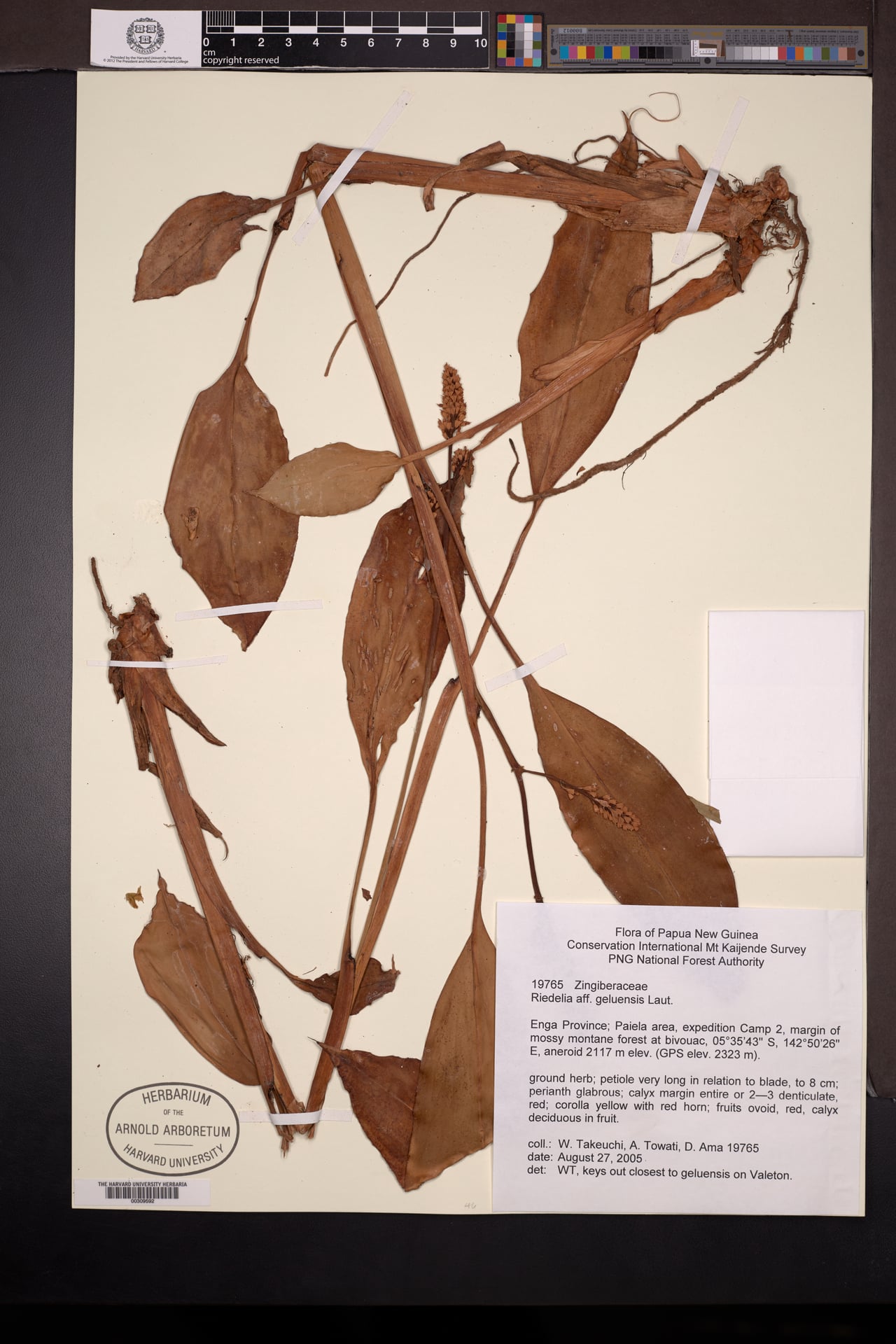
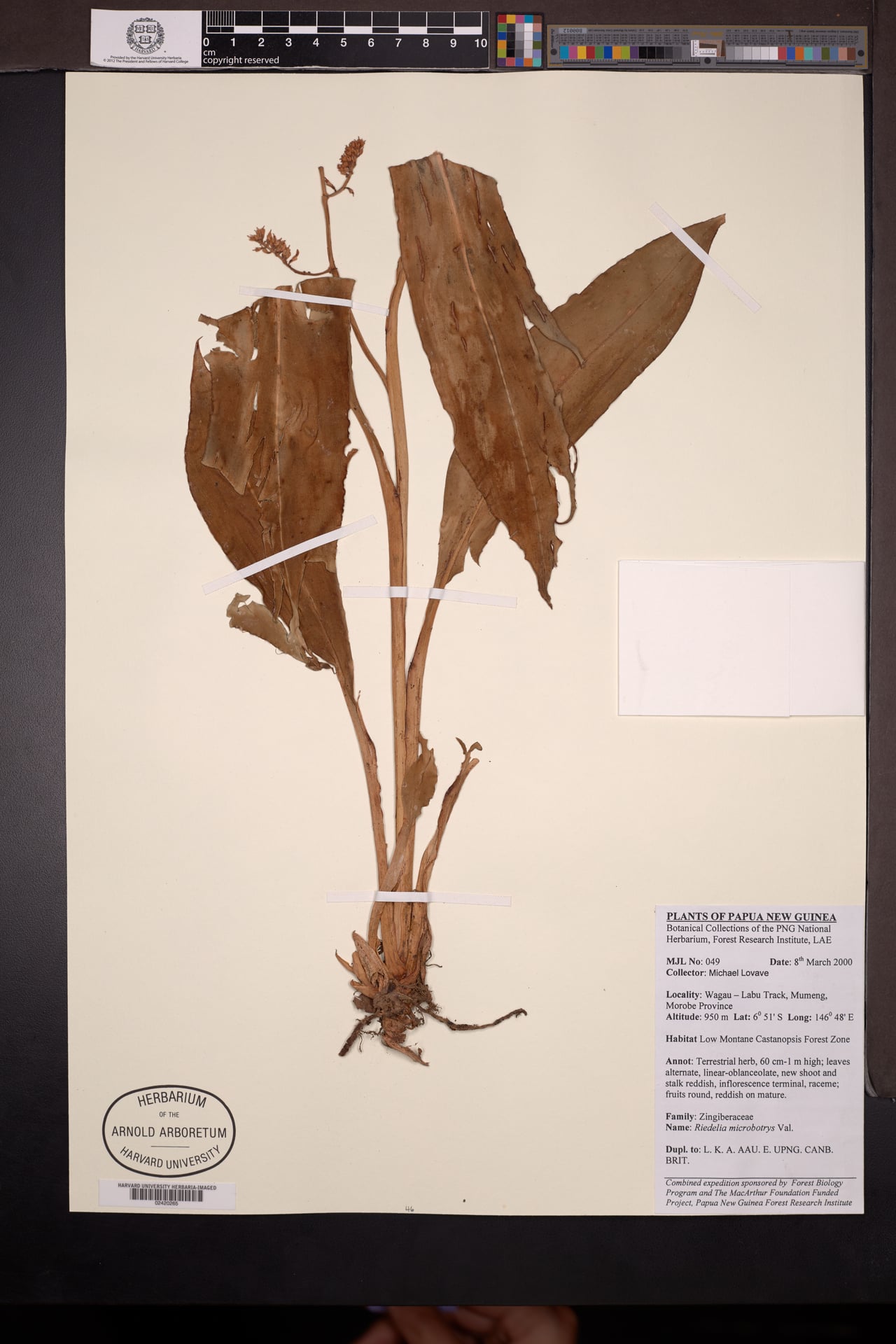
Meistera aculeata
(Roxb.) Skornick. & M. F. Newman
Malamalai, Milmilau
gbif· cc0
President and Fellows of Harvard College
Description
A plant in the ginger family. The leaves are long and on a long, leafy stalk up to 2-4 m tall. These leaves arise from an underground stem or rhizome. The leaves are long and narrow and sword shaped. Leaf blades can be 60-90 cm long by 6-16 cm wide. They are dark green and shiny above and dull whitish green underneath. It is not easy to see side veins in the leaf. The base of the leaf blade is like a broad wedge shape. The bottom of the leaf clings around the leaf stalk. Near the leaf sheath and blade is a small leafy structure 6-12 mm long. The flower is narrow with pink or brown bracts. These continue to hang on the flower. The fruit is a round cluster of tightly packed seed heads with spiky lumps over the surface. They have soft tender prickles. The fruit is green. The individual fruit capsules are 25 mm across by 30 mm long. The small individual flower stalks are 1-2 cm long.
Edible Uses
The fruit are typically cooked and the seeds eaten, though ripe seeds are sometimes eaten raw.
Traditional Uses
The fruit are cooked and the seeds eaten. Sometimes the seeds of ripe fruit are eaten raw.
This uses section is brief — help expand it
Distribution
A tropical plant. It grows wild in the tropical lowland rainforest up to about 800 m or 1000 m altitude.
Where It Grows
Andamans, Asia, India, Indonesia, Malaysia, Myanmar, Pacific, Papua New Guinea, PNG, Philippines, SE Asia, Thailand, Vietnam,
Cultivation
It grows wild from seed. Plants can be grown by division of the rhizome.
Production
Plants occur in primary and secondary forests in the tropics in Papua New Guinea and the Philippines.
Notes
There are about 150 Amomum species. They are mostly tropical.
Synonyms
Also Known As
Asabareng, Orom, Parahulu, Parahulu cardamom, Sil bange
References (12)
- Asiat. Res. 11:344. 1810 (As Amomum aculeatum)
- Bau, B. B. and Poulson, A. D., 2007, Ethnobotanical Notes on Gingers of the Huon Peninsula in Papua New Guinea. Gardens’ Bulletin Singapore 59 (1&2): 23-34. 2007 (As Amomum aculeatum)
- Borrell, O.W., 1989, An Annotated Checklist of the Flora of Kairiru Island, New Guinea. Marcellin College, Victoria Australia. p 42, 168 (As Amomum aculeatum)
- Droop, A.J. & Newman, M.F., 2014, A revision of Amomum (Zingiberaceae) in Sumatra Edinburgh Journal of Botany 71: 193-258.
- Ferns, Useful Tropical Plants (As Amomum aculeatum)
Show all 12 references Hide references
- French, B., 1986, Food Plants of Papua New Guinea, Asia Pacific Science Foundation p 309 (As Amomum aculeatum)
- Larsen, K., Ibrahim, H., Khaw, S.H., & Saw, L.G., 1999, Gingers of Peninsula Malaysia and Singapore. Natural History Publications (Borneo). p 70 (As Amomum aculeatum)
- Leach, G. J., 1988, Bush Food Plants of the Blackwater and Karawari Rivers Area, East Sepik Province, Papua New Guinea. Science in New Guinea 14(2). p 98 (As Amomum aculeatum)
- Peekel, P.G., 1984, (Translation E.E.Henty), Flora of the Bismarck Archipelago for Naturalists, Division of Botany, Lae, PNG. p 106, 105 (As Amomum aculeatum)
- Plants of Papua New Guinea LAE herbarium record (As Amomum aculeatum)
- Sukarya, D. G., (Ed.) 2013, 3,500 Plant Species of the Botanic Gardens of Indonesia. LIPI p 1059 (As Amomum aculeatum)
- World Checklist of Useful Plant Species 2020. Royal Botanic Gardens, Kew