Alternanthera ficoidea
(L.) P. Beauv.
Parrot Leaf
iNaturalist· cc-by-nc
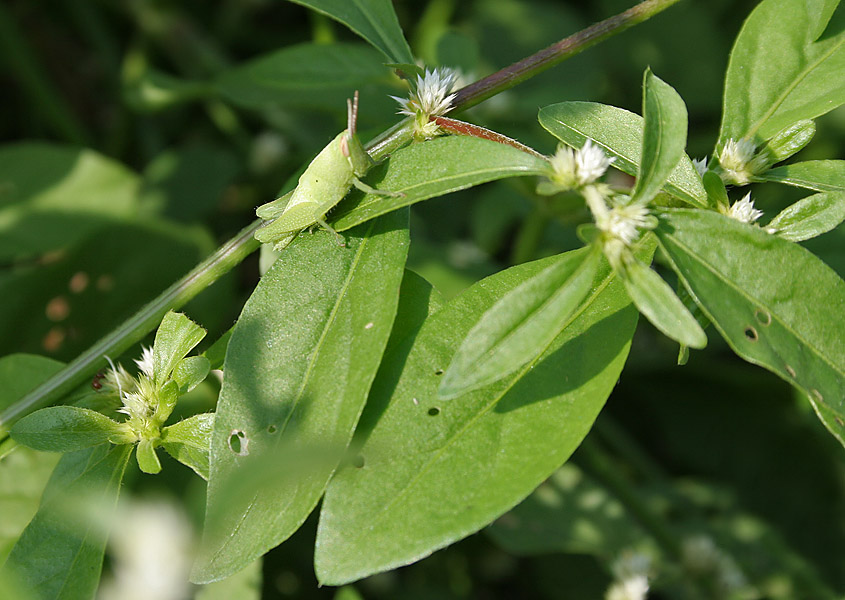
(c) Russell Cumming, some rights reserved (CC BY-NC), uploaded by Russell Cumming
iNaturalist· cc-by-nc
(c) Pedro G Coscarelli, some rights reserved (CC BY-NC), uploaded by Pedro G Coscarelli
iNaturalist· cc-by-nc
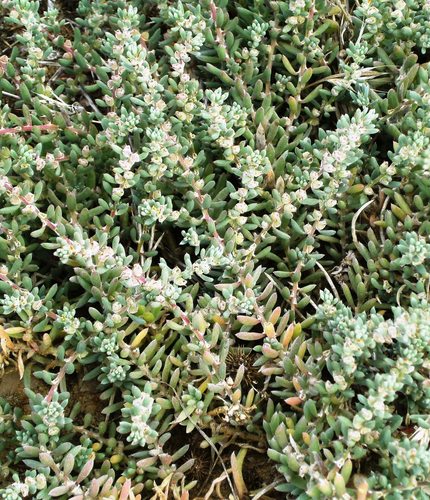
(c) Aditya Bari, some rights reserved (CC BY-NC), uploaded by Aditya Bari
Summary
Source: WikipediaAlternanthera ficoidea, also known as Joseph's coat, Parrot leaf, is a species of flowering plant in the family Amaranthaceae. It is native to the Caribbean and South America and occurs elsewhere in the tropics as an introduced species. It is considered invasive in Palau, the Philippines and Australia (Queensland). Propagation occurs via seeds.
Description
A spreading herb. It grows in water. It grows 20-30 cm high. The stems are branching. The leaves are narrow and 8 cm long by 1.5 cm wide. The leaf stalks are very short. The leaves are olive green above and reddish underneath. The stems and leaves are hairy. The flowers are in groups in the axils of leaves. They are in round white heads that occur singly. The fruit is dry. The seeds are black.
Edible Uses
Young leaves are eaten raw with rice, or boiled as a pot herb and cooked with fish or meat in stews.
Traditional Uses
The young leaves are eaten raw with rice. The young leaves are boiled as a pot herb. They are cooked with fish or meat in stews.
This uses section is brief — help expand it
Medicinal Uses
The plant might be useful as an antiviral agent.
Distribution
A tropical plant. It grows in tropical marshes. It is common in waste places. In Argentina it grows from sea level to 500 m above sea level.
Where It Grows
Africa, Argentina, Asia, Australia, Amazon, Brazil, Chile, Guyana, India, Indonesia, Pacific, Philippines, SE Asia, South America*,
Cultivation
Plants are grown by division or cuttings. It can only live for a few months when under water.
Propagation
Seed - Division. Quite easy, since the lower stems root into the ground.
Other Uses
Plants can be grown as ground cover. The densely matted growth makes it suitable to be used to protect soil against erosion.
Notes
There are 200 Alternanthera species.
Nutrition
| Part | Moisture | kJ | kcal | Protein | Vit A | Vit C | Iron | Zinc |
|---|---|---|---|---|---|---|---|---|
| Leaves | — | — | 4.1 | — | — | — | — | — |
Synonyms
Also Known As
Adaci punnaganti aalam, Bayam bang, Bayam merah, Lupog-lupog, Ponnanganni, Sanguinarea, Vellaponnankanni
References (15)
- Bircher, A. G. & Bircher, W. H., 2000, Encyclopedia of Fruit Trees and Edible Flowering Plants in Egypt and the Subtropics. AUC Press. p 21 (As Alternanthera amoena)
- Bodkin, F., 1991, Encyclopedia Botanica. Cornstalk publishing, p 72
- Brickell, C. (Ed.), 1999, The Royal Horticultural Society A-Z Encyclopedia of Garden Plants. Convent Garden Books. p 105
- Facciola, S., 1998, Cornucopia 2: a Source Book of Edible Plants. Kampong Publications, p 8
- Fl. Oware 2:66, t. 99, fig. 1. 1818, nom. cons. "ficoides" (Smith in Rees, Cycl. 39(2)(suppl.): Alternanthera no. 8. 1819)
Show all 15 references Hide references
- Grubben, G. J. H. and Denton, O. A. (eds), 2004, Plant Resources of Tropical Africa 2. Vegetables. PROTA, Wageningen, Netherlands. p 559 (As Alternanthera tenella)
- Kohila, A. & Kensa, V. M., 2019, Survey of Wild Edible Plants of Dhanakarkulam Panchayath, Tirunelveli District, Tamil Nadu, India. Kong. Res. J. 6(2): 20-27, 2019
- Kuhnlein, H. V., et al, 2009, Indigenous Peoples' food systems. FAO Rome p 191 (As Alternanthera tenella)
- Lamberton, K (Ed.), 2004, The Australian gardening encyclodepia. Murdoch Books, NSW Australia. p 161
- Lugod, G.C. and de Padua L.S., 1979, Wild Food Plants in the Philippines. Vol. 1. Univ. of Philippines Los Banos. p 11
- Martin, F.W. & Ruberte, R.M., 1979, Edible Leaves of the Tropics. Antillian College Press, Mayaguez, Puerto Rico. p 173
- Ochse,
- Ramachandran, V. S., 2007, Wild edible plants of the Anamalais, Coimbatore district, western Ghats, Tamil Nadu. Indian Journal or Traditional Knowledge. 6(1) pp 173-176 (As Alternanthera tenella)
- Slocum, P.D. & Robinson, P., 1999, Water Gardening. Water Lilies and Lotuses. Timber Press. p 71
- Terra, G.J.A., 1973, Tropical Vegetables. Communication 54e Royal Tropical Institute, Amsterdam, p 20