Vachellia erioloba
(E. Meyer) P.J.H. Hurter
Camel thorn
iNaturalist· cc-by-nc
(c) Luc Strydom, some rights reserved (CC BY-NC), uploaded by Luc Strydom
iNaturalist· cc-by-nc-sa
(c) David Hoare, some rights reserved (CC BY-NC-SA), uploaded by David Hoare
iNaturalist· cc-by-nc
(c) riana60, some rights reserved (CC BY-NC), uploaded by riana60
Summary
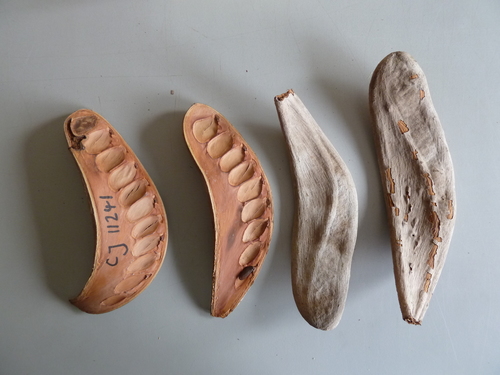
Source: WikipediaVachellia erioloba, the camel thorn, also known as the giraffe thorn, mokala tree, or Kameeldoring in Afrikaans, still more commonly known as Acacia erioloba, is a tree of southern Africa in the family Fabaceae. Its preferred habitat is the deep dry sandy soils in parts of South Africa, Botswana, the western areas of Zimbabwe and Namibia. It is also native to Angola, south-west Mozambique, Zambia and Eswatini. The tree was first described by Ernst Heinrich Friedrich Meyer and Johann Franz Drège in 1836. The camel thorn is a protected tree in South Africa. The tree can grow up to 20 metres high. It is slow-growing, very hardy to drought and fairly frost-resistant. The light-grey colored thorns reflect sunlight, and the bipinnate leaves close when it is hot. The wood is dark reddish-brown in colour and extremely dense and strong. It is good for fires, which leads to widespread clearing of dead trees and the felling of healthy trees. It produces ear-shaped pods, favoured by many herbivores including cattle. The seeds can be roasted and used as a substitute for coffee beans. The name 'camel thorn' refers to the fact that giraffe (kameelperd in Afrikaans) commonly feed on the leaves with their specially-adapted tongue and lips that can avoid the thorns. The scientific name 'erioloba' means "wooly lobe", a reference to the ear-shaped pods. It is commonly associated with the long running PBS wildlife program Nature, as the tree is used in the title sequence and program logo.
Description
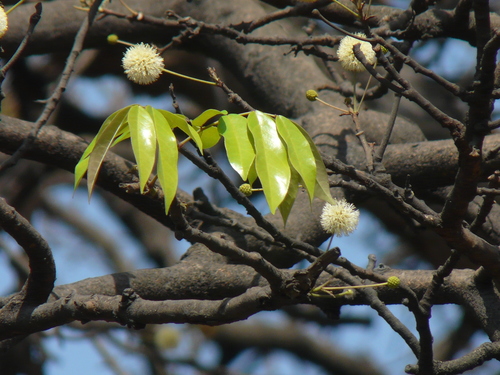
A shrub or tree. It varies greatly. It can be a spiny shrub 2 m high or a tree 16 m high. It can have a wide spreading crown. The bark is dark brown and deeply furrowed. The spines are 6 cm long. Often they have a swollen base. The leaves are compound. They have 2-5 pairs of leaf stalks with 8-15 pairs of leaflets on each. The flowers are bright golden yellow balls. The fruit is a thickened, short flat pod. It is 11 cm long by 4.7 cm wide. The seeds are dark reddish-brown.
Edible Uses
The gum (43% protein) is eaten despite an acrid taste. Roasted seeds serve as a coffee substitute. The fruit pulp is eaten, especially by children, particularly as a famine food.
Traditional Uses
The gum is eaten. It has an acrid taste. The roasted seed can be used as a substitute for coffee. The fruit pulp is eaten as a famine food.
This uses section is brief — help expand it
Medicinal Uses
The gum obtained from the tree is used as a cure for gonorrhoea. The bark is burned, crushed and then used for relieving headache. The pods are ground into a powder to treat ear infections. The roots are used as a cough remedy and to treat tuberculosis. The fresh fine roots are chewed to relieve strong pain anywhere in the body, including toothache, or are taken to combat severe diseases.
Known Hazards
The prussic acid that is sometimes present in the pods and foliage may poison animals.
Distribution
It is a subtropical plant. It grows in dry woodland and arid stony areas. It grows in hot arid places. It can tolerate dry conditions and frost. It grows in areas with an annual rainfall between 40-900 mm. It grows between 120-1,675 m above sea level. It suits hardiness zones 9-11.
Where It Grows
Africa, Angola, Botswana, Central Africa, East Africa, Israel, Mediterranean, Middle East, Mozambique, Namibia, South Africa, Southern Africa, Zambia, Zimbabwe,
Cultivation
Plants can be grown from seeds. The seeds are put into boiling water and soaked for 24 hours. They are then dried and planted 2 cm deep. It has a long taproot so is difficult to transplant. Plants need watering when young.
Propagation
Seed - pre-soak for 12 hours in warm water prior to sowing. Scarification can also help to improve germination rates. Germination rates are often poor for this species, but they can be improved by planting seeds (together with the dung) that have passed through the guts of grazing animals. This is because bruchid larvae that normally infest seeds are usually killed during their passage through the gut of a herbivore. It is best to sow the seeds singly in containers and transplanted the seedlings as quickly as possible since the taproot develops rapidly. Seedlings should be planted out when 46 cm or more in height and should be watered for the first few months, after which they become drought resistant. Seeds retain their viability for many years even at room temperature. Bruchid larvae within the seed continue to be active after the seed has been extracted and stored. The adults or larvae of some species emerge and may even re-enter the exit holes to lay eggs or to produce a 2nd generation of larvae that feed on the seed. Storage at temperatures near freezing point reduces bruchid beetle activity, and subzero temperatures of -20-30 deg. C may kill the larvae without damaging the seed.
Other Uses
Tannins are obtained from the bark. A gum, called 'Cape Gum', is obtained from the trunk. Of good quality, it is sometimes traded. The roots (the bark is separated from the root) are used as a substitute for reeds to make flutes. The dark brown, shiny seeds are a popular element in traditional necklaces. The fibrous inner bark can be used to make excellent rope. The dark, red-brown wood is extremely hard, strong and durable with a dark purple heartwood. It is resistant to borers and termites, and has been used for poles, especially for the centre posts for houses, mine props, wagon building, utensils and even machine bearings (though the machinery needs to be kept well oiled). It is used for the construction of enclosures in southern Africa. The tree is a source of firewood for much of the arid Kalahari region in southern Africa. It exudes a characteristic, cinnamon-like smell as it burns. The tree has a deep, spreading root system and has been planted to help in the stabilization of sand dune and combat soil erosion. The flowers are a good source of nectar for honeybees.
Production
The plants are slow growing.
Other Information
The fruit pulp is occasionally eaten especially by children.
Notes
There are about 1,350 Acacia species. Over 1,000 occur in Australia. The gum is 43% protein. Also as Mimosaceae.
Nutrition
| Part | Moisture | kJ | kcal | Protein | Vit A | Vit C | Iron | Zinc |
|---|---|---|---|---|---|---|---|---|
| Seeds | 8 | 1380 | 330 | 25.8 | — | — | 4.9 | 3.5 |
| Gum | 13.9 | 1308 | 313 | 6.8 | — | — | 10.4 | 0.3 |
| Gum | — | — | — | — | — | — | — | — |
Synonyms
Also Known As
Buungasiya, Ganab, Kameeldoring, Mogotlho
References (27)
- Etherington, K., & Imwold, D., (Eds), 2001, Botanica's Trees & Shrubs. The illustrated A-Z of over 8500 trees and shrubs. Random House, Australia. p 52 (As Acacia erioloba)
- E. H. F. Meyer & J. F. Drege, Comm. pl. Afr. austr. 171. 1836 (As Acacia erioloba)
- Fowler, D. G., 2007, Zambian Plants: Their Vernacular Names and Uses. Kew. p 32 (As Acacia erioloba)
- Fox, F. W. & Young, M. E. N., 1982, Food from the Veld. Delta Books. p 198 (As Acacia erioloba)
- ILDIS Legumes of the World http:www;ildis.org/Legume/Web (As Acacia erioloba)
Show all 27 references Hide references
- Joffe, P., 2007, Creative Gardening with Indigenous Plants. A South African Guide. Briza. p 119 (As Acacia erioloba)
- Mannheimer, C. A. & Curtis. B.A. (eds), 2009, Le Roux and Muller's Field Guide to the Trees and Shrubs of Namibia. Windhoek: Macmillan Education Namibia. p 92 (As Acacia erioloba)
- Palgrave, K.C., 1996, Trees of Southern Africa. Struik Publishers. p 235 (As Acacia erioloba)
- Pennock, A., et al, Australian Dry-zone Acacias for Human Food: Proceedings of a Workshop. (As Acacia erioloba)
- Peters, C. R., O'Brien, E. M., and Drummond, R.B., 1992, Edible Wild plants of Sub-saharan Africa. Kew. p 126 (As Acacia erioloba)
- Plowes, N. J. & Taylor, F. W., 1997, The Processing of Indigenous Fruits and other Wildfoods of Southern Africa. in Smartt, L. & Haq. (Eds) Domestication, Production and Utilization of New Crops. ICUC p 184 (As Acacia erioloba)
- Rodin, 1985, (As Acacia erioloba)
- Roodt, V., 1998, Trees & Shrubs of the Okavango Delta. Medicinal Uses and Nutritional value. The Shell Field Guide Series: Part 1. Shell Botswana. p 157 (As Acacia erioloba)
- Royal Botanic Gardens, Kew (1999). Survey of Economic Plants for Arid and Semi-Arid Lands (SEPASAL) database. Published on the Internet; http://www.rbgkew.org.uk/ceb/sepasal/internet [Accessed 26th April 2011 (As Acacia erioloba)
- Ruiters-Welcome, A. K., 2019, Food plants of southern Africa. Ph.D. thesis. Univ. of Johannesburg p 61
- Sprent, J. I., et al, 2009, African legumes: a vital but under-utilized resource. Journal of Experimental Botany. Vol. 61 No. 5 pp. 1257-1265 (As Acacia erioloba)
- Storrs, A. E. C., 1995 reprint, Know Your Trees. Some Common Trees found in Zambia, Forestry Division. p 43 (As Acacia erioloba)
- Tanaka, 1980, (As Acacia erioloba)
- Story, 1958, (As Acacia erioloba)
- Van Damme, P et al, 1922, Plant Uses by the Topnaar of the Kuiseb Valley Namib Desert. Afrika Focus Vol. 8(3-4):223-252 (As Acacia erioloba)
- van Wyk, B, van Wyk, P, and van Wyk B., 2000, Photographic guide to Trees of Southern Africa. Briza. p 30 (As Acacia erioloba)
- Van Wyk, Br. and van Wyk P., 2009, Field Guide to Trees of Southern Africa. Struik Nature. p 492 (As Acacia erioloba)
- van Wyk, B-E., 2011, The potential of South African plants in the development of new food and beverage products. South African Journal of Botany 77 (2011) 857–868 (As Acacia erioloba)
- van Wyk, Ben-Erik, 2019, The diversity and multiple uses of southern African legumes. Australian Systematic Botany, 2019, 32, 519–546
- Venter, F & J., 2009, Making the most of Indigenous Trees. Briza. p 18 (As Acacia erioloba)
- Welcome, A. K. & Van Wyk, B.-E., 2019, An inventory and analysis of the food plants of southern Africa. South African Journal of Botany 122 (2019) 136–179
- www.worldagroforestrycentre.org/sea/products/afdbases/af (As Acacia erioloba)