Hippophae rhamnoides
L.
Sea Buckthorn
iNaturalist· cc-by-nc
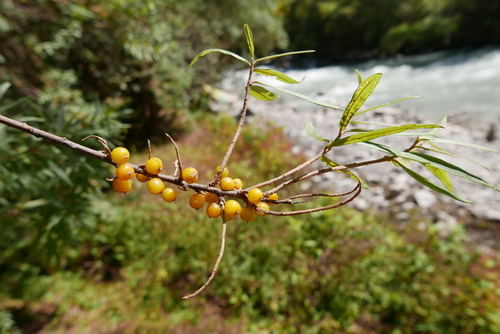
(c) blagotrav, some rights reserved (CC BY-NC)
iNaturalist· cc-by-nc
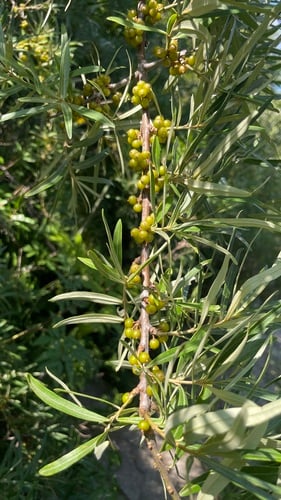
(c) ryatova_natalya, some rights reserved (CC BY-NC), uploaded by ryatova_natalya
iNaturalist· cc-by-nc
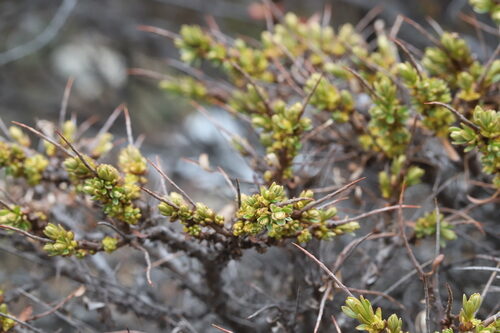
(c) Giovanni Carraro, some rights reserved (CC BY-NC), uploaded by Giovanni Carraro
Summary
Source: WikipediaMedium-growing deciduous shrub reaching 6m tall by 2.5m wide. Hardy to UK zone 3, not frost tender. Flowers appear in April with seeds ripening September to October. Dioecious species requiring both male and female plants for seed production; wind-pollinated and not self-fertile. Nitrogen-fixing and noted for attracting wildlife. Tolerates light sandy, medium loamy, and heavy clay soils, including poor soils and drought. Grows in mildly acidic, neutral, and mildly alkaline pH. Requires full sun and prefers dry to wet conditions. Tolerates maritime exposure.
Description
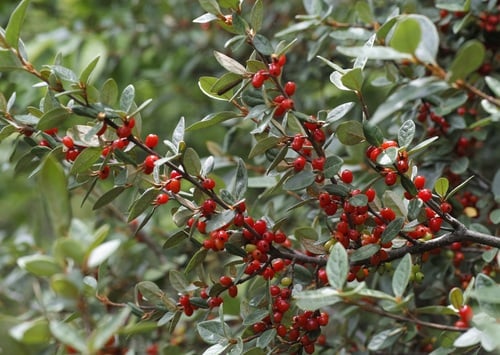
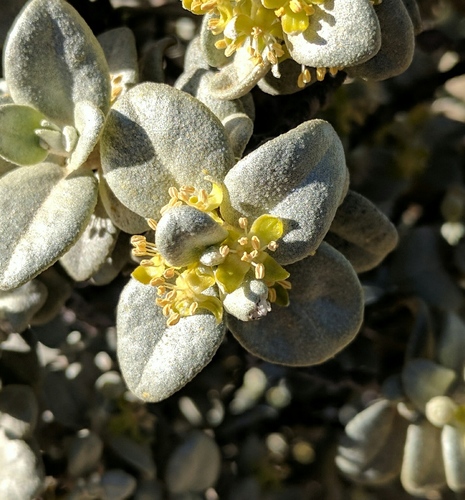
A shrub or small tree which loses its leaves. It grows to 6 m high. It has a bushy arching habit. The twigs often become thorns. The leaves are alternate and without teeth. The leaves are very narrow and grey-green. They are paler underneath. They are 7.5 cm long. They have short stalks and droop from spiny twigs. Male and female flowers grow on separate bushes. The flowers are small and yellow or green. They grow in clusters. They appear before the leaves. The fruit are bright orange berries. They occur in dense clusters on the shoots of female plants. Both male and female plants must be grown together to get fruit. The fruit are edible.
Edible Uses
The fruit can be eaten raw or cooked. It contains 120mg of vitamin C per 100g and is also very rich in vitamin A, though its acidity makes it too sharp for most adults when raw — most children, however, seem to enjoy it. The fruit is about 6–8mm in diameter and is very freely borne along the stems. It is excellent for juice, which is high in vitamins and has an attractive aroma, and is increasingly used in mixed fruit juice blends for its reputed health benefits. Some species and cultivars (not specified) yield fruit containing up to 9.2% oil. The fruit is ripe from late September and generally hangs on the plant all winter unless taken by birds. It becomes less acid after a frost or when cooked, though the taste and quality of frosted berries deteriorates quickly, so it is best harvested before frosts occur.
Traditional Uses
The fruit are made into preserves and pickles. They are acid tasting. They are also eaten with milk and cheese or made into sauces, jams, marmalade, syrup and jelly. They are also eaten raw. The fruit are used for juice. The leaves are used for tea.
Medicinal Uses
The twigs and leaves contain 4–5% tannin and are astringent and vermifuge. An oil produced from the tender branches and leaves — distinct from the fruit oil, with yields of around 3% — is used as an ointment for burns. A high-quality medicinal oil from the fruit treats cardiac disorders and is said to be particularly effective on the skin for burns, eczema, and radiation injury; it is also taken internally for stomach and intestinal diseases. The fruit itself is astringent and used as a tonic. Freshly pressed juice is used to treat colds, febrile conditions, and exhaustion. The fruit is exceptionally rich in vitamins A, C, and E, flavonoids, other bio-active compounds, and essential fatty acids. It is being investigated for its potential to reduce cancer incidence and halt or reverse tumour growth. The juice is also a component of vitamin-rich medicaments and cosmetic preparations such as face creams and toothpastes. A decoction of the fruit has been used as a wash for skin irritation and eruptions.
Known Hazards
Some reports suggest that the fruit is poisonous, whilst it may be very acid it is most definitely not poisonous. Avoid during pregnancy.
Distribution
It is a temperate plant. It is native to Asia and Europe. It grows near the coast and along riverbanks and in sandy woods. A cool climate plant. They are salt resistant. It needs plenty of light. It grows by the sea. It can tolerate drought. In the Indian Himalayas it grows between 3,300-4,000 m above sea level. It suits hardiness zones 2-9. In Sichuan and Yunnan.
Where It Grows
Afghanistan, Armenia, Asia, Australia, Austria, Azerbaijan, Balkans, Belarus, Belgium, Britain, Bulgaria, Canada, Caucasus, Central Asia, China*, Czech, Denmark, Europe, Finland, France, Georgia, Germany, Greece, Himalayas, Hungary, India, Iran, Ireland, Italy, Kazakhstan, Kyrgyzstan, Lithuania, Mediterranean, Middle East, Moldova, Mongolia, Nepal, Netherlands, North America, Northeastern India, Norway, NW India, Pakistan, Poland, Romania, Russia, Scandinavia, Sikkim, Slovakia, Slovenia, Spain, Sweden, Switzerland, Tibet, Tajikistan, Turkey, Türkiye, Turkmenistan, Ukraine, USA, Uzbekistan, Yugoslavia,
Cultivation
Succeeds in most soils, including poor ones, so long as they are not too dry. Grows well by water and in fairly wet soils. Established plants are very drought resistant. Requires a sunny position, seedlings failing to grow in a shady position and mature shrubs quickly dying if overshadowed by taller plants. Does well in very sandy soils. Very tolerant of maritime exposure. Plants are fairly slow growing. Although usually found near the coast in the wild, they thrive when grown inland and are hardy to about -25°c. A very ornamental plant, it is occasionally cultivated, especially in N. Europe, for its edible fruit, there are some named varieties. 'Leikora' is a free-fruiting form, developed for its ornamental value. Members of this genus are attracting considerable interest from breeding institutes for their nutrient-rich fruits that can promote the general health of the body (see edible and medicinal uses below). This species has a symbiotic relationship with certain soil bacteria, these bacteria form nodules on the roots and fix atmospheric nitrogen. Some of this nitrogen is utilized by the growing plant but some can also be used by other plants growing nearby. Plants produce abundant suckers, especially when grown on sandy soils. Dioecious. Male and female plants must be grown if seed is required. The sexes of plants cannot be distinguished before flowering, but on flowering plants the buds of male plants in winter are conical and conspicuous whilst female buds are smaller and rounded. Plants in this genus are notably resistant to honey fungus. A clumping plant, forming a colony from shoots away from the crown but with a limited spread. In garden design, as well as the above-ground architecture of a plant, root structure considerations help in choosing plants that work together for their optimal soil requirements including nutrients and water. The berries are typically harvested in late summer to early autumn depending on the specific species and local climate. Sea Buckthorn generally flowers in spring depending on the species and environmental conditions. Sea Buckthorn is a moderately fast-growing plant, typically reaching maturity in 3 to 5 years. It can grow to heights of 1 to 3 meters (3 to 10 feet) and can be quite hardy in various soil conditions, thriving in sandy and poor soils.
Propagation
Sow seed in spring in a sunny position in a cold frame. Germination is usually quick and reliable, though 3 months of cold stratification may improve the rate. Alternatively, sow in a cold frame as soon as seed ripens in autumn. Prick seedlings into individual pots when large enough to handle and grow on in a greenhouse through their first winter. Plant out in late spring. In spring, male seedlings have very prominent axillary buds, while females are smooth and clear at this time. Cuttings of half-ripe wood taken in June/July in a frame are possible but difficult, and represent the easiest method of vegetative propagation. Cuttings of mature wood in autumn are also difficult — take them at the end of autumn or in early spring before buds burst, store in sand and peat until April, cut into 7–9cm lengths, and root in a plastic tent with bottom heat; rooting should occur within 2 months. Division of suckers in winter can be planted directly into permanent positions and usually establishes well. Layering in autumn is also possible.
Other Uses
Sea Buckthorn is a nitrogen-fixing plant valuable in agroforestry for improving soil fertility, controlling erosion, providing windbreaks, and ground cover. It is highly tolerant of maritime exposure and can serve as a shelter hedge, though it dislikes heavy trimming. Its dense thorns make it a quickly impenetrable barrier. The extensive, suckering root system binds soil effectively, particularly on sandy ground, making it useful for conservation schemes. Its fast growth in exposed conditions and nitrogen-fixing ability make it an excellent pioneer species for re-establishing woodland; being very light-demanding, it is naturally shaded out as trees mature. The seeds contain 12–13% of a slow-drying oil. The vitamin-rich fruit juice is used in face masks and other cosmetic preparations. A yellow dye is obtained from the fruit, and also from the stems, roots, and foliage. A blackish-brown dye comes from the young leaves and shoots. The wood is tough, hard, very durable, and fine-grained, used for fine carpentry and turning. It is also used for fuel and charcoal. The berries provide food for birds and small mammals, and the dense, thorny branches offer shelter and nesting sites for birds. The foliage and leaf litter create overwintering habitat for invertebrates.
Production
In Sikkim fruit are available March to April.
Other Information
The fruit are eaten especially by children. It has become a cultivated commercial crop. It is sold in local markets.
Notes
There are about 8 Hippophae species. Chemical composition: rich in Vitamins B1, B2, C, E, and K, niacinimide, pantothenic acid and carotenoids. Serotonin (5- hydroxy-tryptamine) extract possesses antitumor properties. The fruit contain 135-608 mg Vit C per 100 g. It probably has anticancer properties.
Nutrition
| Part | Moisture | kJ | kcal | Protein | Vit A | Vit C | Iron | Zinc |
|---|---|---|---|---|---|---|---|---|
| Fruit | 813 | 198 | 12.1 | — | — | 116 | — | — |
| Fruit | 372 | 89 | 1.4 | — | — | — | — | — |
| Fruit - dry wt | — | — | 4.1 | — | — | — | — | — |
Synonyms
Also Known As
Catina, Chakanda, Cherkar, Chharuras, Chuma, Dhurchuk, Homoktovis, Kalabisa, Katsvi, La xiong a xi, Navadni rakitovec, Niechak, Obliyepikha, Sallowthorn, Sea berry, Sermang, Sgajizi, Siberian pineapple, Sirma, Star bu, Tarwa chuk, Tasru, Tindved, Tsarap, Tserkar, Tsermang, Tshogs skyur, Xiaoguoshaji, Zhu
References (72)
- Afzal, S., et al, 2009, Ethno-botanical Studies from Northern Pakistan. J. Ayub Med Coll Abbottabad 21(1)
- Altschul, S.V.R., 1973, Drugs and Foods from Little-known Plants. Notes in Harvard University Herbaria. Harvard Univ. Press. Massachusetts. no. 3003
- Ambasta, S.P. (Ed.), 2000, The Useful Plants of India. CSIR India. p 267
- Arora, R. K., 2014, Diversity in Underutilized Plant Species - An Asia-Pacific Perspective. Bioversity International. p 74
- Battacharyya, A., 1991, Ethnobotanical Observations in the Ladakh Region of Northern Jammu and Kashmir State, India. Economic Botany, Vol. 45, No. 3, pp. 305-308
Show all 72 references Hide references
- BAKER,
- Bodkin, F., 1991, Encyclopedia Botanica. Cornstalk publishing, p 560
- Boesi, A., 2014, Traditional knowledge of wild food plants in a few Tibetan communities. Journal of Ethnobiology and Ethnomedicine 10:75
- Bremness, L., 1994, Herbs. Collins Eyewitness Handbooks. Harper Collins. p 107
- Brickell, C. (Ed.), 1999, The Royal Horticultural Society A-Z Encyclopedia of Garden Plants. Convent Garden Books. p 524
- Brown, D., 2002, The Royal Horticultural Society encyclopedia of Herbs and their uses. DK Books. p 235
- Bussman, R. W., et al, 2021, Unity in diversity—food plants and fungi of Sakartvelo (Republic of Georgia), Caucasus. Journal of Ethnobiology and Ethnomedicine (2021) 17:72 p 9
- Chen, W., et al, 2021, Wild plants used by the Lhoba people in Douyu Village, characterized by high mountains and valleys, in southeastern Tibet, China. Journal of Ethnobiology and Ethnomedicine (2021) 17:46
- "Chinese Nutrition Journal", 2002, Vol 23(8) p 298 (As Hippophae rhamneidas)
- Coombes, A.J., 2000, Trees. Dorling Kindersley Handbooks. p 140
- Cundall, P., (ed.), 2004, Gardening Australia: flora: the gardener's bible. ABC Books. p 706
- DARLINGTON & AMMAL,
- Denes, A., et al, 2012, Wild plants used for food by Hungarian ethnic groups living in the Carpathian Basin. Acta Societatis Botanicorum Poloniae 81 (4): 381-396
- Dobriyal, M. J. R. & Dobriyal, R., 2014, Non Wood Forest Produce an Option for Ethnic Food and Nutritional Security in India. Int. J. of Usuf. Mngt. 15(1):17-37
- Dorjey, K., et al, 2012, Ethnobotanical observations in Trans-Himalayan Region of Ladakh. Journal of Plant Development Sciences Vol. 4 (4): 459-464.
- Dorjey, K., 2015, Exploration of Plant based Traditional Knowledge from Sham region of Ladakh (J. & K.), India. Journal of Plant Development Sciences Vol. 7 (5) : 429-433.
- Dzhangaliev, A. D., et al, 2003, The Wild Fruit and Nut Plants of Kazakhstan, Horticultural Reviews, Vol. 29. pp 305-371
- Etherington, K., & Imwold, D., (Eds), 2001, Botanica's Trees & Shrubs. The illustrated A-Z of over 8500 trees and shrubs. Random House, Australia. p 383
- Facciola, S., 1998, Cornucopia 2: a Source Book of Edible Plants. Kampong Publications, p 93
- Farrar, J.L., 1995, Trees of the Northern United States and Canada. Iowa State University press/Ames p 407
- Flowerdew, B., 2000, Complete Fruit Book. Kyle Cathie Ltd., London. p 189
- Geng, Y., et al, 2016, Traditional knowledge and its transmission of wild edibles used by the Naxi in Baidi Village, northwest Yunnan province. Journal of Ethnobiology and Ethnomedicine. 12:10
- Girard, N. J., 2020, Sustainable Foraging of Wild Edible Plants in Norway. A Biocultural Approach. M. Sc. thesis Norwegian University. p 130
- GUPTA,
- Hakkinen, S. H., et al, 1999, Content of the Flavonols Quercetin, Myricetin, and Kaemferol in 25 Edible Berries. Journal of Agricultural and Food Chemistry. 47: 2274-2279
- Harris, E & J., 1983, Field Guide to the Trees and Shrubs of Britain. Reader's Digest. p 121
- Hedrick, U.P., 1919, (Ed.), Sturtevant's edible plants of the world. p 346
- Heywood, V.H., Brummitt, R.K., Culham, A., and Seberg, O. 2007, Flowering Plant Families of the World. Royal Botanical Gardens, Kew. p 135
- https://en.wikipedia.org/wiki/List of wild edible plants in Mongolian cuisine
- http://nordicfood lab/org/blog/2102/9/wild-edible-plants-an-overview
- Hu, Shiu-ying, 2005, Food Plants of China. The Chinese University Press. p 572
- INFOODS:FAO/INFOODS Databases
- Irving, M., 2009, The Forager Handbook, A Guide to the Edible Plants of Britain. Ebury Press p 280
- Jackes, D. A., Edible Forest Gardens
- Jia, X., et al, 2022, Ethnobotany of wild edible plants in multiethnic areas of the Gansu–Ningxia–Inner Mongolia junction zone. Journal of Ethnobiology and Ethnomedicine 18:53
- Johansson, A., Laakso, P. and Kallio, H., 1997, Characterization of seed oils of wild, edible Finnish berries. Food Chemistry 204:300-307
- John, L., & Stevenson, V., 1979, The Complete Book of Fruit. Angus & Robertson p 265
- Kang, Y., et al, 2012, Wild food plants and wild edible fungi in two valleys on the Qinling Mountains (Shaanxi, central China) Journal of Ethnobiology and Ethnomedicine; 9:26
- Kang, Y., et al, 2014, Wild food plants used by the Tibetans of Gongba Valley (Zouqu country, Gansu, China) Journal of Ethnobiology and Ethnomedicine 10:20
- Kaul, M.K. et al, 1985, Ethno-botanic studies in North-West and Trans-Himalaya - contribution to the wild food plants of Ladakh. J.Econo. Tax. Bot. Vol. 6 No. 3 pp 523-527
- Khojimatov, O. K. et al, 2015, Some wild growing plants in traditional foods of Uzbekistan. Journal of Ethnic Foods. 2 (2015) 25-28
- Kiple, K.F. & Ornelas, K.C., (eds), 2000, The Cambridge World History of Food. CUP p 434, 1849
- Kremer, B.P., 1995, Shrubs in the Wild and in Gardens. Barrons. p 104
- Kunshan, Shi, Non-wood forest products in Asia. FAO Corporate Document Repository
- Łuczaj, L., et al, 2013, Wild edible plants of Belarus: from Rostafiński’s questionnaire of 1883 to the present. Journal of Ethnobiology and Ethnomedicine 2013, 9:21
- Lyle, S., 2006, Discovering fruit and nuts. Land Links. p 241
- Maghradze, D. et al, 2012, Minor and Underutilized Fruits in Georgia and Their Wild Relatives. In Acta Horticulturae Number 948 p 41-47
- Manju, S., and Sundriyal, R. C., 2001, Wild Edible Plants of the Sikkim Humalaya: Nutritive Values of Selected Species. Economic Botany 55(3): 377-390
- Musayev, M. K. et al, 2012, Biological and Economical Characteristics of Sea-Buckthorn Varieties of Azerbaijan. In Acta Horticulturae Number 948 p 67-70
- Plants for a Future database, The Field, Penpol, Lostwithiel, Cornwall, PL22 0NG, UK. http://www.scs.leeds.ac.uk/pfaf/
- Rana, J.C. et al, 2011, Genetic resources of wild edible plants and their uses among tribal communities of cold arid regions of India. Genetic Resources and Crop Evolution. 59:135-149
- Rawat, G.S., & Pangtey, Y.P.S., 1987, A Contribution to the Ethnobotany of Alpine Regions of Kumaon. J. Econ. Tax. Bot. Vol. 11 No. 1 pp 139-147
- Schuler, S., (Ed.), 1977, Simon & Schuster's Guide to Trees. Simon & Schuster. No. 127
- Singh, H.B., Arora R.K.,1978, Wild edible Plants of India. Indian Council of Agricultural Research, New Delhi. p 65
- Sp. pl. 2:1023. 1753
- Sulamain, N., et al, 2023, The Importance of Becoming Tamed: Wild Food Plants as Possible Novel Crops in Selected Food-Insecure Regions. Horticulturae 2023, 9, 171.
- Sundriyal, M., et al, 2004, Dietary Use of Wild Plant Resources in the Sikkim Himalaya, India. Economic Botany 58(4) pp 626-638
- Ulian, T., et al, 2020, Unlocking plant resources to support food security and promote sustainable agriculture. Plants, People, Planet. 2020;2:421–445.
- USDA, ARS, National Genetic Resources Program. Germplasm Resources Information Network - (GRIN). [Online Database] National Germplasm Resources Laboratory, Beltsville, Maryland. Available: www.ars-grin.gov/cgi-bin/npgs/html/econ.pl (10 April 2000)
- van Wyk, B., 2005, Food Plants of the World. An illustrated guide. Timber press. p 237
- Vari, A., et al, 2020, Berries, greens, and medicinal herbs—mapping and assessing wild plants as an ecosystem service in Transylvania (Romania). Journal of Ethnobiology and Ethnomedicine (2020) 16:13
- Wiersema, J. H. & Leon, B., 2013, World Economic Plants. A Standard Reference CRC Press. 2nd Ed. p 351
- World Checklist of Useful Plant Species 2020. Royal Botanic Gardens, Kew
- www.worldagroforestrycentre.org/sea/products/afdbases/af/asp/SpeciesInfo.asp?SpID=18027
- Yasukawa, K., Medicinal and Edible Plants as Cancer Preventive Agents. Drug Discovery Research in Pharmacognosy. p185 www.intechopen.com
- Young, J., (Ed.), 2001, Botanica's Pocket Trees and Shrubs. Random House. p 444
- Zhang, Y. et al, 2020, Characteristics and utilization of plant diversity and resources in Central Asia. Regional Sustainability. Elsevier. p 6