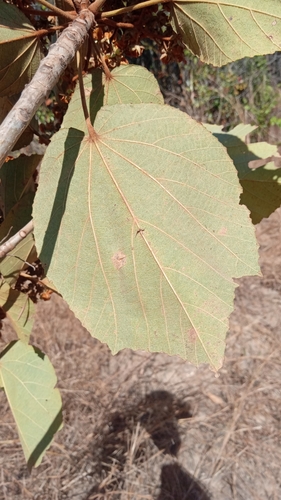
Hibiscus heterophyllus
Vent.
Native rosella, Australian native Sorrel
iNaturalist· cc0
no rights reserved
iNaturalist· cc0
no rights reserved
iNaturalist· cc-by-nc
(c) Taylor, some rights reserved (CC BY-NC)
Summary
Source: WikipediaHibiscus heterophyllus, commonly known as native rosella or toilet paper bush, is a flowering plant in the family Malvaceae. It a shrub or small tree with white, pale pink or yellow flowers with a dark red centre and grows in New South Wales and Queensland.
Description
A tall shrub or small tree. It grows 3-6 m tall. It can spread to 2-5 m wide. The stems are prickly. The leaves are dark green and narrow. They can be undivided or have 3 deeply divided lobes. Leaves are 5-20 cm long by 10 cm wide. The flowers are large. They occur singly. They are 15 cm across and mostly white. The fruit is a densely hairy oval capsule. It is 2 cm long.
Edible Uses
Leaves and young shoots can be eaten raw or cooked. They have a pleasantly acidic flavour that mellows when boiled, making them an excellent spinach substitute. Flowers and flower buds are also edible raw or cooked, with a very mild flavour. The roots of young plants are edible but highly fibrous, with a mucilaginous texture and little flavour.
Traditional Uses
The roots and shoots of young plants are eaten raw. They are also cooked. The flowers are used as a garnish. The calyces are used in cooking like rosella. They can be used for jam. CAUTION: As it has been reported as causing kidney problems it should only be eaten in small amounts.
Medicinal Uses
None known.
Known Hazards
The plant is often used as a food in Australia, and is a main species in the Australian Bush Food Industry, but there is also a report of kidney damage after drinking tea made from the leaves. The hairs on the seed capsules can cause severe skin irritation to sensitive people, and need to be handled with care.
Distribution
It grows in warm temperate places. It can grow in the subtropics. It needs well drained soil. It occurs in moist places in tall open forest. It can stand light frost. In tropical Queensland it grows from sea level to 800 m altitude. It suits hardiness zones 10-12.
Where It Grows
Asia, Australia*, Britain, Europe, Myanmar, SE Asia,
Cultivation
Prefers a well-drained humus rich fertile soil in full sun. Suitable for waterside plantings. This species is not very hardy in Britain, it is unlikely to succeed outdoors even in the mildest areas of the country. However, it might be possible to grow it as a half-hardy annual, to flower in its first year from seed.
Propagation
Sow seed in early spring in a warm greenhouse; germination is usually fairly rapid. Prick seedlings into individual pots when large enough to handle. For annual cultivation, plant out into permanent positions in early summer, protecting with a frame or cloche until established. For perennial cultivation, grow on in the greenhouse through the first year and plant out in early summer of the following year. Half-ripe cuttings taken in July or August can be rooted in a frame, overwintered in a warm greenhouse, and planted out after the last expected frosts.
Other Uses
A tough fibre extracted from the stems is used for making nets and similar items.
Production
Plants are fast growing.
Notes
There are about 220 Hibiscus species.
Nutrition
| Part | Moisture | kJ | kcal | Protein | Vit A | Vit C | Iron | Zinc |
|---|---|---|---|---|---|---|---|---|
| Flower | 85.7 | 204 | 49 | 1.4 | — | 1 | — | — |
| Carpels | 86.7 | — | — | 1.4 | — | — | 1.8 | — |
Synonyms
Also Known As
Batham, Dtharang-gange, Green Kurrajong, Queensland Sorrel, Toilet Paper Bush
References (37)
- Anon., 2003, Native Plants for the Fitzroy basin. Society for Growing Australian Plants Inc. (Rockhampton Branch) p 60
- Bodkin, F., 1991, Encyclopedia Botanica. Cornstalk publishing, p 557
- Bonney, N., 1997, Economic Native Trees and Shrubs for South Australia. Greening Australia (SA) inc. Campbelltown SA 5074 p 168
- Bonney, N., 2012, Edible Wild Native Plants for Southern Australia. p 110
- Cherikoff V. & Isaacs, J., The Bush Food Handbook. How to gather, grow, process and cook Australian Wild Foods. Ti Tree Press, Australia p 195
Show all 37 references Hide references
- Cooper, W. and Cooper, W., 2004, Fruits of the Australian Tropical Rainforest. Nokomis Editions, Victoria, Australia. p 277
- Cribb, A.B. & J.W., 1976, Wild Food in Australia, Fontana. p 107
- Cronin, L., 1989, The Concise Australian Flora. Reed. p 94
- Cundall, P., (ed.), 2004, Gardening Australia: flora: the gardener's bible. ABC Books. p 701
- Elliot, W.R., & Jones, D.L., 1990, Encyclopedia of Australian Plants suitable for cultivation. Vol 5. Lothian. p 358
- Etherington, K., & Imwold, D., (Eds), 2001, Botanica's Trees & Shrubs. The illustrated A-Z of over 8500 trees and shrubs. Random House, Australia. p 378
- Facciola, S., 1998, Cornucopia 2: a Source Book of Edible Plants. Kampong Publications, p 147
- Greig, D., 1996, Flowering Natives for Home Gardens. Angus & Robertson. p 227
- Grieg, D., 2002, A photographic guide to Wildflowers of South-eastern Australia. New Holland. p 59
- Hibbert, M., 2002, The Aussie Plant Finder 2002, Florilegium. p 139
- Holliday, I., 1979, A Field Guide to Australian Native Shrubs. Rigby. p 116
- Jard. Malmaison 2: ad t. 103. 1805
- Lazarides, M. & Hince, B., 1993, Handbook of Economic Plants of Australia, CSIRO. p 132
- Lim, T. K., 2015, Edible Medicinal and Non Medicinal Plants. Volume 9, Modified Stems, Roots, Bulbs. Springer p 46
- Lord, E.E., & Willis, J.H., 1999, Shrubs and Trees for Australian gardens. Lothian. p 174
- Low, T., 1991, Wild Food Plants of Australia. Australian Nature FieldGuide, Angus & Robertson. p 144
- Low, T., 1992, Bush Tucker. Australia’s Wild Food Harvest. Angus & Robertson. p 128
- Lyle, S., 2006, Discovering fruit and nuts. Land Links. p 240
- Maiden, JH, 1889, The Useful Native Plants of Australia. Compendium. Melbourne. Reprinted 1975.
- Melzer, R. & Plumb, J., 2011, Plants of Capricornia. Belgamba, Rockhampton. p 169
- Molyneux, B. and Forrester, S., 1997, The Austraflora A-Z of Australian Plants. Reed. p 124
- Nicholson, N & H., 1994, Australian Rainforest Plants 4, Terania Rainforest Publishing. NSW. p 40
- Pearson, S. & A., 1992, Rainforest Plants of Eastern Australia. Kangaroo Press p 124
- Plants for a Future database, The Field, Penpol, Lostwithiel, Cornwall, PL22 0NG, UK. http://www.scs.leeds.ac.uk/pfaf/
- Robins, J., 1996, Wild Lime. Cooking from the Bush food garden. Allen & Unwin p 40
- Ryan, M. (Ed.), 2003, Wild Plants of Greater Brisbane. Queensland Museum. p 175
- Scarth-Johnson, V., 2000, National Treasures. Flowering Plants of Cooktown and Northern Australia. Vera Scarth-Johnson Gallery Association. Cooktown, Australia. p 87
- Smith, K., 1998. Growing Uncommon Fruits and Vegetables. New Holland. p 101
- Townsend, K., 1994, Across the Top. Gardening with Australian Plants in the tropics. Society for Growing Australian Plants, Townsville Branch Inc. p 255
- Williams, J.B., Harden, G.J., and McDonald, W.J.F., 1984, Trees and shrubs in rainforests of New South Wales and Southern Queensland. Univ. of New England, Armidale. p 57
- Williams, K.A.W., 1999, Native Plants of Queensland Volume 4. Keith A.W. Williams North Ipswich, Australia. p 228
- www.ceres.org.au/bushfoodcatalogue