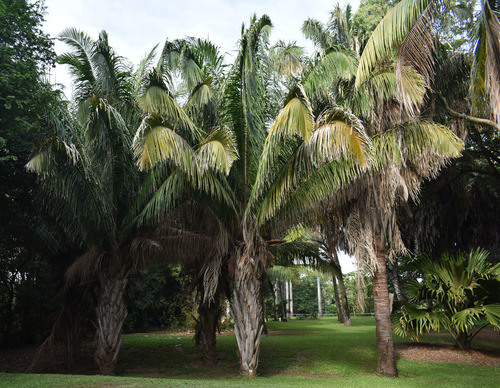
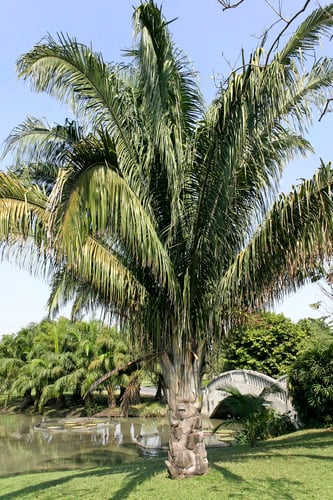
Heterospathe negrosensis
Becc.
Black sagisi palm
gbif· cc0
President and Fellows of Harvard College
gbif· cc0
President and Fellows of Harvard College
gbif· cc0
President and Fellows of Harvard College
Description
A small palm 3 to 5 m high. The stem is 4 to 5 cm across. The leaflets are 35 to 40 cm long and 2 to 2.5 cm wide. Their secondary nerves are rather distinct. The leaflets are dark green. The flower stalk has flowers along a central axis and is twice branched. The fruit are oval and narrow above almost to a point. They are 9 to 11 mm long and 5 mm thick. The seed is oval and pointed.
Edible Uses
The palm heart (cabbage) is cooked and eaten, as is the edible bud.
Traditional Uses
The bud is cooked and eaten.
This uses section is brief — help expand it
Distribution
It is a tropical plant. It grows naturally in shady rainforest. They are widely distributed throughout the Philippines.
Where It Grows
Asia, Australia, Indonesia, Pacific, Philippines*, SE Asia,
Cultivation
Plants are grown from seed. Seed take 1-2 months to germinate.
Notes
There are about 32 Heterospathe species.
Also Known As
Palem sagisi hitam, Saluai
References (6)
- Jones, D.L., 1994, Palms throughout the World. Smithtonian Institution, Washington. p 222
- Jones, D.L., 2000, Palms of Australia 3rd edition. Reed/New Holland. p 161
- Monsalud, M.R., Tongacan, A.L., Lopez, F.R., & Lagrimas, M.Q., 1966, Edible Wild Plants in Philippine Forests. Philippine Journal of Science. p 526
- Riffle, R.L. & Craft, P., 2003, An Encyclopedia of Cultivated Palms. Timber Press. p 349
- Sukarya, D. G., (Ed.) 2013, 3,500 Plant Species of the Botanic Gardens of Indonesia. LIPI p 780
Show all 6 references Hide references
- World Checklist of Useful Plant Species 2020. Royal Botanic Gardens, Kew