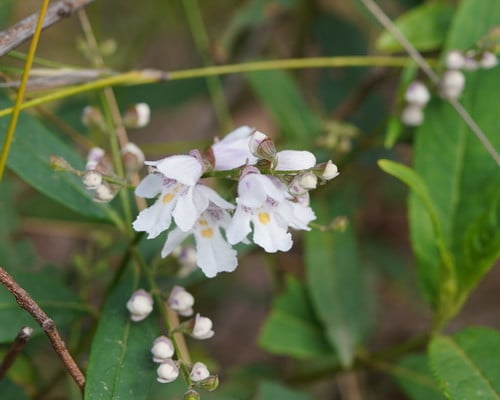
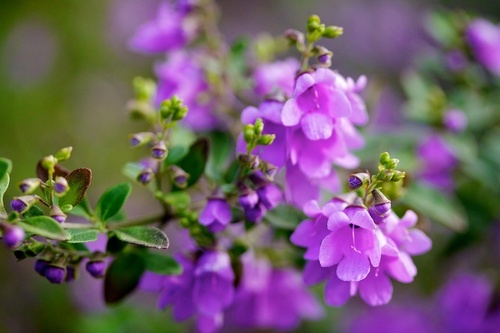
Haumaniastrum caeruleum
(Oliv.) P. A. Duvign. & Plancke
Taga
iNaturalist· cc-by-nc
(c) AMADOU BAHLEMAN FARID, some rights reserved (CC BY-NC), uploaded by AMADOU BAHLEMAN FARID
iNaturalist· cc-by-nc
(c) AMADOU BAHLEMAN FARID, some rights reserved (CC BY-NC)
Description
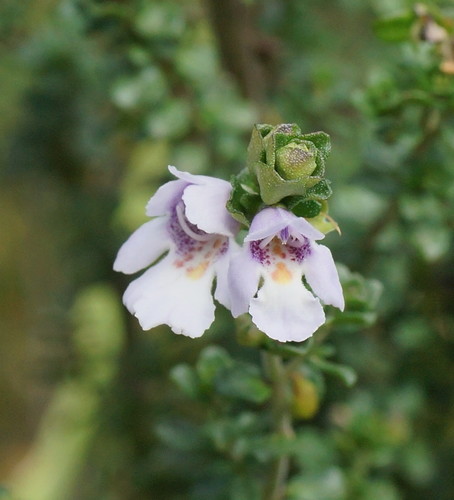
A herb. It is stout and erect. It keeps growing from year to year. It is often bushy and has soft hairs. It grows 1 m high. The stems have 4 angles. There can be several stems from a woody rootstock. The leaves are opposite or in rings of 3-4. The leaf blade in narrowly oval and 2-10 cm long by about 1 cm wide. The base is wedge shaped and it tapers to the tip. The flowers are in a rounded head. The flowers are pale violet. The bracts are usually white. The fruit is made up of 4 nutlets. These are about 1 mm long. The plant varies a lot.
Edible Uses
The leaves are cooked and eaten as a vegetable. The ash of the plant is used as a vegetable salt. It is a minor vegetable reasonably commonly used in Benin.
Traditional Uses
The leaves are cooked and eaten as a vegetable. The ash of the plant is used as a vegetable salt.
This uses section is brief — help expand it
Medicinal Uses
The powdered leaves are put in water to sponge a person with high fever. The leaves are used to treat headache.
Distribution
A tropical plant. It grows in damp savannah. It grows between 200-2,100 m above sea level.
Where It Grows
Africa, Angola, Benin, Burkina Faso, Central Africa, East Africa, Ghana, Guinea, Guinée, Guinea-Bissau, Kenya, Malawi, Nigeria, Senegal, Sierra Leone, Sudan, West Africa, Zambia, Zimbabwe,
Cultivation
The plant can sometimes be a weed within its native range.
Other Uses
Mixed with oil, the leaves are used as a perfume.
Other Information
It is a minor vegetable. It is reasonably commonly used in Benin.
Notes
There are 35 Haumaniastrum species.
Synonyms
References (6)
- Abbiw, D.K., 1990, Useful Plants of Ghana. West African uses of wild and cultivated plants. Intermediate Technology Publications and the Royal Botanic Gardens, Kew. p 41 (As Haumaniastrum lilacinum)
- Avouhou, H. T., et al, 2012, Ethnobotanical Factors Influencing the Use and Management of Wild Edible Plants in Agricultural Environments in Benin. Ethnobotany Research & Applications Vol 10:571-592
- Burkill, H. M., 1985, The useful plants of west tropical Africa, Vol. 4. Kew. (As Haumaniastrum lilacinum)
- Grubben, G. J. H. and Denton, O. A. (eds), 2004, Plant Resources of Tropical Africa 2. Vegetables. PROTA, Wageningen, Netherlands. p 310
- Jardin, C., 1970, List of Foods Used In Africa, FAO Nutrition Information Document Series No 2.p 79 (As Haumaniastrum lilacinum)
Show all 6 references Hide references
- World Checklist of Useful Plant Species 2020. Royal Botanic Gardens, Kew