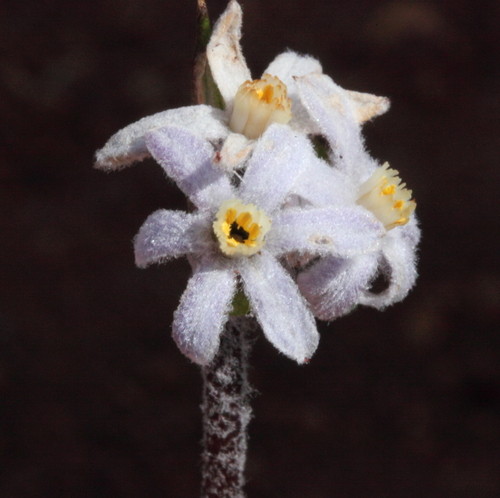
Haemodorum corymbosum
Vahl.
Bloodroot
iNaturalist· cc-by-nc
(c) Dion Maple, some rights reserved (CC BY-NC), uploaded by Dion Maple
iNaturalist· cc-by
(c) Thomas Mesaglio, some rights reserved (CC BY)
Summary
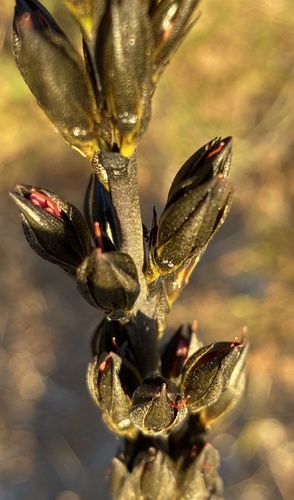
Source: WikipediaHaemodorum corymbosum, commonly known as the rush-leaf bloodroot, is a shrub native to southeastern Australia. Danish-Norwegian naturalist Martin Vahl described this species in his 1805 work Enumeratio Plantarum. It grows as a strappy herbaceous shrub 40–70 cm high, with three to four 40–75 cm long leaves arising from the base. These are narrow to terete and 1–1.5 mm in diameter. Its roots contain a bright red pigment. Flowering occurs over the warmer months (October to January) and is profuse only after bushfire. The brown-black flowers are 12–15 mm long and arranged in a corymb. Found in coastal areas from the Budawang Ranges to the vicinity of Gosford, with one inland population at Agnes Banks, Haemodorum corymbosum grows on sandy soils—occurring in swamps as well as sandstone ridges. It occurs with such woodland plants as Sydney red gum (Angophora costata), sydney peppermint (Eucalyptus piperita), scribbly gum (E. sclerophylla), saw banksia (Banksia serrata, and heathland plants such as dwarf apple (Angophora hispida), scrub she-oak (Allocasuarina distyla).
Description
A herb with keeps growing from year to year. The rootstock is a bulb. The plant grows to 1 m high. The leaves arise from the base of the plant. The leaves are smooth and narrow and slightly leathery. They have veins along them and are something like grass. The leaves are 45-74 cm long by 0.2-1 cm wide. They are a dull grey-green colour. They have a point at the tip and a V shaped with a sheath at the base. The flowers are a deep red colour. They are 0.5-1.2 cm long. The flowers occur at the end of long reddish stalks which come from the base of the plant. The fruit is a flattish round 3-lobed capsule. It is up to 1 cm across and red when ripe. It produces red juice when squeezed.
Edible Uses
The bulbs are roasted and eaten.
Traditional Uses
The bulbs are eaten after roasting.
This uses section is brief — help expand it
Distribution
A tropical plant. It grows naturally on shallow gravely soils.
Where It Grows
Australia*, Pacific, Papua New Guinea, PNG,
Production
It Australia, plants flower from November to March and fruit during the same period.
Notes
There are about 20 Haemodorum species. They are mostly in Australia.
Synonyms
References (10)
- Bindon, P., 1996, Useful Bush Plants. Western Australian Museum. p 154
- Bodkin, F., 1991, Encyclopedia Botanica. Cornstalk publishing, p 526
- Brock, J., 1993, Native Plants of Northern Australia, Reed. p 214
- Cherikoff V. & Isaacs, J., The Bush Food Handbook. How to gather, grow, process and cook Australian Wild Foods. Ti Tree Press, Australia p 195
- Cribb, A.B. & J.W., 1976, Wild Food in Australia, Fontana. p 150
Show all 10 references Hide references
- Elliot, W.R., & Jones, D.L., 1990, Encyclopedia of Australian Plants suitable for cultivation. Vol 5. p 183
- Heywood, V.H., Brummitt, R.K., Culham, A., and Seberg, O., 2007, Flowering Plant Families of the World. Royal Botanical Gardens, Kew. p 370
- Lazarides, M. & Hince, B., 1993, Handbook of Economic Plants of Australia, CSIRO. p 126
- Lim, T. K., 2015, Edible Medicinal and Non Medicinal Plants. Volume 9, Modified Stems, Roots, Bulbs. Springer p 45
- Sleumer, H., 1954, Flacourtiaceae in Flora Malesiana, Ser 1 Vol 5(1) p 112 ?