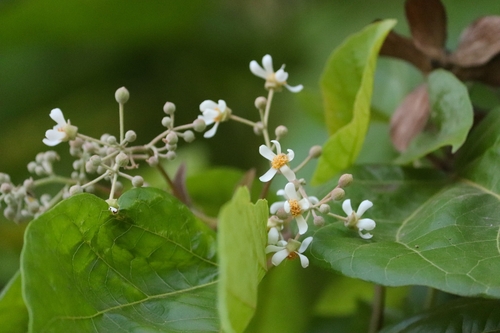
Grewia polygama
Roxb.
Wild currant, Emu berries
wikimedia· cc0
Wikimedia Commons - Kanhoba Ranchoddas Kirtikar and Baman Das Basu
Description
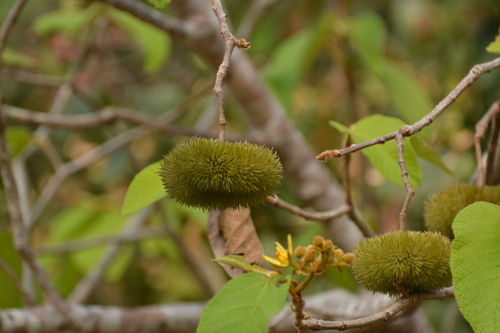
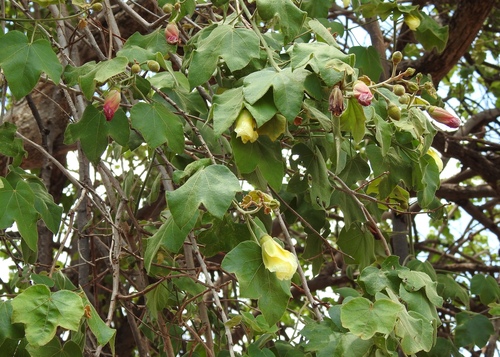
A shrub in the Malvaceae family growing 2 m high with yellow hairy branches, found in tropical regions and known as wild currant or emu berries.
This description is brief — help expand it
Edible Uses
The fruit are eaten.
Medicinal Uses
The leaves are soaked in water overnight, or maybe hot water is poured over them, and the liquid allowed to become cold. It forms a somewhat mucilaginous liquid and is said to be very efficacious as a remedy for diarrhoea and dysentery. I understand that in some parts of the North it is quite an article of trade, not only in North Queensland but in the Northern Territory and right over to the North-West of Western Australia. The unripe fruit is astringent and can be used in the treatment of diarrhoea and dysentery. The root is used in the treatment of diarrhoea and dysentery. The dried and powdered root is mixed into a paste and used as a dressing for wounds. It forms a hard surface over the area, acting as a plaster and protecting the damaged surface.
Distribution
A tropical plant.
Where It Grows
Asia, Australia, India, Indochina, SE Asia, Vietnam,
Propagation
Seed - we have no specific information for this species but seed of this genus is generally best sown as soon as it is ripe. Stored seed has a hard seedcoat and may benefit from scarification before sowing in order to speed up and improve germination. This can usually be done by pouring a small amount of nearly boiling water on the seeds (being careful not to cook them!), allowing the mix to cool somewhat and then leaving it in a warm place to soak for 12 - 24 hours. Sow the seeds in situ or in a nursery seedbed or trays - do not allow the compost to become dry. Germination and early growth are usually quite quick. Cuttings - best taken with a heel.
Other Uses
A good quality fibre used for making rope can be obtained from the bark The heartwood is pale brown, becoming grey-brown upon exposure; it is not well defined from the paler coloured sapwood. The texture is fine and even; the grain is straight or interlocked. The wood is moderately hard to hard, heavy. It is suitable for light to medium purposes under cover; these uses include veneer and plywood, tool handles, general utility furniture, flooring, cladding, wooden pallets, mouldings and possibly sport equipments.
Notes
There are about 200 Grewia species. They are mostly tropical. The fruit of most may be edible. These were in the Sparrmanniaceae and the Tiliaceae.
Synonyms
Also Known As
Coke taphai, Gara
References (4)
- Crawford, I. M., 1982, Traditional Aboriginal Plant Resources in the Kalumburu Area: Aspects in Ethno-economics. Records of the Western Australian Museum Supplement No. 15
- Lazarides, M. & Hince, B., 1993, Handbook of Economic Plants of Australia, CSIRO. p 125
- Pham-Hoang Ho, 1999, An Illustrated Flora of Vietnam. Nha Xuat Ban Tre. p 485
- Singh, H.B., Arora R.K.,1978, Wild edible Plants of India. Indian Council of Agricultural Research, New Delhi. p 62