Glycosmis trifoliata
(Blume) Sprengel
Pink lime
iNaturalist· cc-by-nc
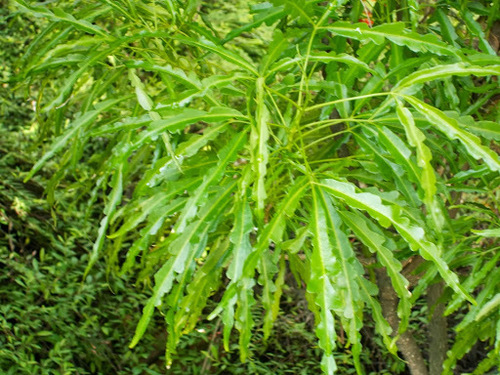
(c) kerrycoleman, some rights reserved (CC BY-NC), uploaded by kerrycoleman
iNaturalist· cc-by-nc
(c) kerrycoleman, some rights reserved (CC BY-NC), uploaded by kerrycoleman
Summary
Source: WikipediaGlycosmis trifoliata, the pink fruited limeberry, is a species of shrub or small tree in the family Rutaceae. Found in northern Australia, Papua New Guinea and Malesia. The habitat includes monsoon forest, beach scrub, vine thickets and drier rainforest areas.
Description
A small to medium shrub. It grows up to 5 m high. The young shoots are bright green and shiny. The stems are smooth and brown. The leaves are 10-25 cm long and divided along their length. There are 1-3 leaflets which are 8-12 cm long by 4-5 cm wide. The leaflets are oval and of thick texture. The edges can be wavy or irregular. The leaves are dark green above and dull beneath. The leaves have a smell when crushed. The flowers are densely packed together and grow on old wood. They hang down and have brown hairs. The flowers are about 0.3 cm across and white with a sweet scent. The fruit is a berry which is 0.5 cm across. It is pale pink when mature. Often the berry has 3 cells. There are 1 or 2 seeds.
Edible Uses
The ripe fruit, which are pinkish-red, are eaten fresh. The leaves are dried, ground to powder, and used to make a wine-like drink with rice and soybeans.
Traditional Uses
The fruit are eaten when ripe. They are pinkish red. The leaves are dried and ground to a powder and used to make a wine like drink using rice and soybeans.
Distribution
A tropical plant. It often grows naturally in coastal rainforests. In tropical Queensland it grows from sea level to 740 m altitude. It needs well drained soil. It grows in vine thickets behind coastal sand dunes. In Brisbane Botanical Gardens.
Where It Grows
Asia, Australia*, Indonesia, Pacific, Papua New Guinea, PNG, Philippines, SE Asia,
Cultivation
It can be grown from seed. The seed should be sown fresh. The seed may not germinate regularly.
Propagation
Seed - germinates readily if the flesh is removed prior to sowing.
Production
In Australia, plants flower from September to December (February to June) and fruit are mature May to July. It may have a wide flowering and fruiting season.
Notes
There are about 60 Glycosmis species.
Also Known As
Chan-kiue, Moolinyj, Mulindj, Mulinji
References (11)
- Cooper, W. and Cooper, W., 2004, Fruits of the Australian Tropical Rainforest. Nokomis Editions, Victoria, Australia. p 466
- Elliot, W.R., & Jones, D.L., 1992, Encyclopedia of Australian Plants suitable for cultivation. Vol 4. Lothian. p 372 (Drawing)
- Jackes, B.R., 2001, Plants of the Tropics. Rainforest to Heath. An Identification Guide. James Cook University. p 79
- Kenneally, K.E., Edinger, D. C., and Willing T., 1996, Broome and Beyond, Plants and People of the Dampier Peninsula, Kimberley, Western Australia. Department of Conservation and Land Management. p 177 (Photo)
- Norrington, L., & Campbell, C., 2001, Tropical Food Gardens. Bloomings Books. p 88
Show all 11 references Hide references
- Paczkowska, G . & Chapman, A.R., 2000, The Western Australian Flora. A Descriptive Calatogue. Western Australian Herbarium. p 522
- Smith, M & Kalotas, A. C., 1985, Bardi Plants: An Annotated List of Plants and Their Use by the Bardi Aborigines of Dampierland, in North-western Australia. Rec. West Aust. Mus. 1985, 12(3): 317-359
- Syst. veg. 4(2):162. 1827
- Townsend, K., 1994, Across the Top. Gardening with Australian Plants in the tropics. Society for Growing Australian Plants, Townsville Branch Inc. p 226
- Wheeler, J.R.(ed.), 1992, Flora of the Kimberley Region. CALM, Western Australian Herbarium, p 670, 672 (Drawing)
- Yunupinu Banjgul, Laklak Yunupinu-Marika, et al. 1995, Rirratjinu Ethnobotany: Aboriginal Plant Use from Yirrkala, Arnhem Land, Australia. Northern Territory Botanical Bulletin No 21. Parks and Wildlife Commission of the Northern Territory. p 44