Allantoma lineata
(Martius ex Berg.) Miers
Skittle Nut
iNaturalist· cc-by-nc
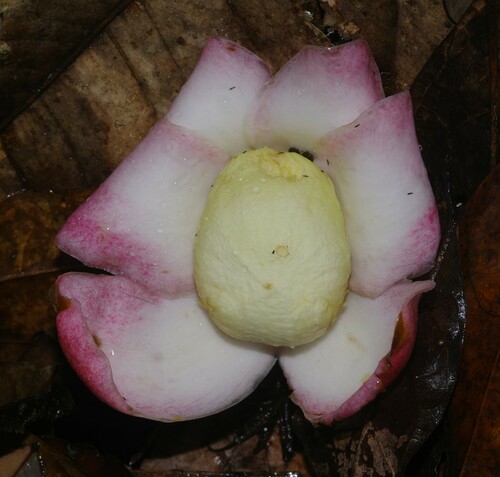
(c) esa_bt, some rights reserved (CC BY-NC)
wikimedia· cc0
Wikimedia Commons - Martius C., Eichler A.G., Urban I., Flora Brasiliensis, vol. 14(1): fasicule 18,2, t. 77 (1858)
Summary
Source: WikipediaAllantoma lineata (Portuguese common name: Seru) is a timber tree, typical of Amazon rainforest vegetation. It is native to Amazonas State in Venezuela, and also to Amazonas and Pará States in Brazil.
Description
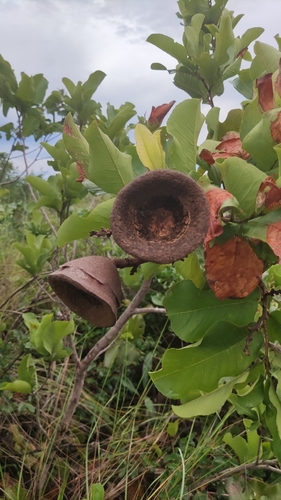
A medium sized tree. It grows about 10 m tall. The leaves are narrow or sword shaped and 10-29 cm long by 5-11 cm wide. The edges can be wavy. The fruit is a capsule with a lid. It is cylinder shaped and 7-18 cm long by 4-6 cm wide. It has irregular cracks on the outside. The lid opening is 5-12 cm long. The seeds are long and narrow. They are 5-6 cm long.
Edible Uses
The seeds are eaten.
Traditional Uses
The seeds are eaten.
This uses section is brief — help expand it
Distribution
A tropical plant. It grows near the edges of rivers in the Amazon in Venezuela.
Where It Grows
Amazon, Brazil, Guyana, South America, Venezuela,
Cultivation
Plants are grown from seeds. The seeds are collected from ripe fruit off the tree then dried in the sun to enable the seeds to be removed. Seeds need to be planted fresh, preferably in light shade. Seedlings emerge in 40-50 days.
Propagation
Seed - best sown as soon as it is ripe in a partially shaded position in individual containers - placing three or four seeds in each container. A low germination rate can be expected, with the seed sprouting within 40 - 50 days.
Other Uses
The wood is medium-textured, straight-grained, slightly lustrous, moderately heavy, hard, with moderate mechanical properties and moderately durable. It is used in internal construction for purposes such as boards and battens, cupboards and valences; it is also used for making boxes. A fast-growing pioneer species that succeeds in wet conditions and also provides an edible seed; it can be used in reforestation projects for restoring woodland and establishing woodland gardens.
Production
Plants grow rapidly.
Nutrition
| Part | Moisture | kJ | kcal | Protein | Vit A | Vit C | Iron | Zinc |
|---|---|---|---|---|---|---|---|---|
| Seeds | 26.8 | — | — | 10 | — | — | 5 | 5.4 |
Synonyms
Also Known As
Ceru, Cheru, Churu, Tabari, Xuru
References (10)
- Andrade, E. H. A. et al, 1999, Seed Composition of Amazonian Lecythidaceae Species: Part 3 in the Series ‘‘Studies of Edible Amazonian Plants’’. Journal of Food Composition and Analysis 12:37-51
- Bircher, A. G. & Bircher, W. H., 2000, Encyclopedia of Fruit Trees and Edible Flowering Plants in Egypt and the Subtropics. AUC Press. p 18 (Also as Allantoma torulosa)
- Cavalcante, P.B. 1991. Frutas comestíveis da Amazônia. Edições CEJUP.
- Grandtner, M. M. & Chevrette, J., 2013, Dictionary of Trees, Volume 2: South America: Nomenclature, Taxonomy and Ecology. Academic Press p 23
- Kew Plants of the World On line
Show all 10 references Hide references
- Lorenzi, H., 2009, Brazilian Trees. A Guide to the Identification and Cultivation of Brazilian Native Trees. Instituto Plantarum de Estuados da Flora Ltda. Vol. 3 p 185
- Mabberley, D.J. 1990. The plant-book: a portable dictionary of the higher plants. Cambridge University Press. NY.
- Menninger, E.A., 1977, Edible Nuts of the World. Horticultural Books. Florida p 35
- Paz, F. S., et al, 2021, Edible Fruit Plant Species in the Amazon Forest Rely Mostly on Bees and Beetles as Pollinators. Journal of Economic Entomology, XX(XX), 2021, 1–13
- Prance, G. T. and Scott A. Mori, 1979 Lecythidaceae: Part I: The Actinomorphic-Flowered New World Lecythidaceae (Asteranthos, Gustavia, Grias, Allantoma, & Cariniana): Flora Neotropica, Vol. 21, No. 1, Lecythidaceae: pp. 212 (Drawing) p 214