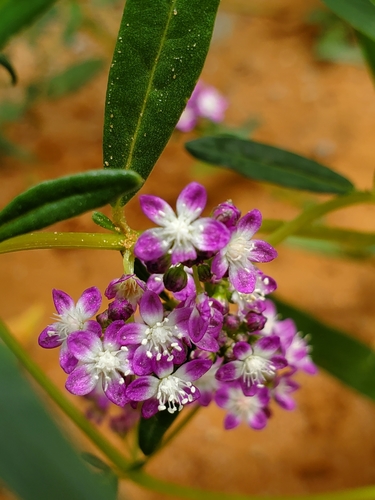
Gisekia pharnaceoides
L.
Oldmaid
iNaturalist· cc-by-nc
(c) Tony Benn, some rights reserved (CC BY-NC), uploaded by Tony Benn
iNaturalist· cc-by-sa
(c) Nicola van Berkel, some rights reserved (CC BY-SA), uploaded by Nicola van Berkel
iNaturalist· cc-by-nc
(c) Tony Benn, some rights reserved (CC BY-NC), uploaded by Tony Benn
Description
A herb. It lays along the ground. It keeps growing from year to year. It is 20-50 cm long. It grows out from a central spot. The leaves have white dots. The leaves are leathery and shiny with a groove down the middle. The leaf blade is 1-2.5 cm long by 4-10 mm wide. The leaves are in pairs opposite one another or in rings. The flowers are in dense groups without stalks. There are 5-20 flowers. The flowers are green. They can also be pink or purple with a white centre. The seeds are black and smooth and with very small pits.
Edible Uses
The leaves are eaten as greens and used as a potherb, particularly when food is scarce. They can be dried and stored, and are sometimes used as a flavoring or spice. The seeds are also edible.
Traditional Uses
The leaves are eaten as greens. They are a potherb when food is scarce. They can be dried and stored. They are sometimes used as a flavouring or spice. Caution: Because it contains poisonous substances it should only ever be eaten in small amounts.
Medicinal Uses
The whole plant is eaten as a general strength restorative, e.g. after miscarriage. The cooked green leaves are eaten to treat asthma The plant is considered to be a purgative in some areas, whilst in others it is taken to cure diarrhoea. It is used as a taenicide, but the plant should be consumed with great caution. The leaves are rubbed on swellings and the stem, pounded in butter, is placed on aching muscles. The sap of the plant is used against warts. The roots are made into a chest medicine. The seeds probably possess anthelmintic properties. Several phenolic acids have been identified in the vegetative parts, including p-OH-benzoic acid, caffeic acid, p-coumaric acid and vanillic acid. Ferulic and sinapic acids were absent, although these are usually present in the Aizoaceae. The tannin-like principles α- and β-gisekia have been found in the seed. Tannins are present in the whole plant.
Known Hazards
Contains poisonous substances and should only be eaten in small amounts.
Distribution
It grows in open sandy places often near the sea. It grows in the tropics and subtropics. It grows in dry sandy places. It grows between 230-2,440 m above sea level. It can grow in arid places.
Where It Grows
Afghanistan, Africa*, Algeria, America, Angola, Asia, Benin, Botswana, Burkina Faso, Burundi, Cameroon, Central Africa, Chad, China, Congo, Côte d'Ivoire, East Africa, Egypt, Eswatini, Ethiopia, Ghana, India, Indochina, Iran, Ivory Coast, Kenya, Madagascar, Malawi, Mali, Mediterranean, Middle East, Mozambique, Myanmar, Namibia, Niger, Nigeria, North Africa, North America, Oman, Pakistan, Sahel, Saudi Arabia, SE Asia, Senegal, Somalia, South Africa, Southern Africa, Sri Lanka, Sudan, Swaziland, Tanzania, Thailand, Togo, Tunisia, Uganda, United Arab Emirates, UAE, USA, Vietnam, West Africa, Yemen, Zambia, Zimbabwe,
Cultivation
Succeeds in the drier areas of tropical and subtropical climates.
Other Information
It is only an occasional vegetable. It has low palatability.
Notes
There are about 8 Gisekia species. There is only one genus in the family Gisekiaceae. It is also put in the family Aizoaceae.
Synonyms
Also Known As
Balu-ka-sag, Co let, Dedman, Gangala, Hingala, Isaka dasari kura, Isaka-dantu-kura, Isaka-dasari-kura, Jangli sag, Ji su cao, Manal-keera, Manal-keerai, Masondroso, Morang, Mwana-ngira, Numnelli keeray, Omindjulu, Sareli, Valuka, Walu-chi-bhaji
References (34)
- Al-Sodany, Y. M., et al, 2013, Medicinal Plants in Saudi Arabia: I. Sarrwat Mountains at Taif, KSA. Academic Journal of Plant Sciences 6 (4): 134-145
- Ambasta, S.P. (Ed.), 2000, The Useful Plants of India. CSIR India. p 236
- Arinathan, V., et al, 2007, Wild edibles used by Palliyars of the western Ghats, Tamil Nadu. Indian Journal of Traditional Knowledge. 6(1) pp 163-168
- Burkill, H. M., 1985, The useful plants of west tropical Africa, Vol. 1. Kew.
- Fowler, D. G., 2007, Zambian Plants: Their Vernacular Names and Uses. Kew. p 81
Show all 34 references Hide references
- GAMMIE,
- Grivetti, L. E., 1980, Agricultural development: present and potential role of edible wild plants. Part 2: Sub-Saharan Africa, Report to the Department of State Agency for International Development. p 49
- Grubben, G. J. H. and Denton, O. A. (eds), 2004, Plant Resources of Tropical Africa 2. Vegetables. PROTA, Wageningen, Netherlands. p 300
- Heywood, V.H., Brummitt, R.K., Culham, A., and Seberg, O. 2007, Flowering Plant Families of the World. Royal Botanical Gardens, Kew. p 157
- Jardin, C., 1970, List of Foods Used In Africa, FAO Nutrition Information Document Series No 2.p 79
- Karim, F. M. & Dakheel, A, J., 2006, Salt-tolerant plants of the United Arab Emirates. 2006. International Center for Biosaline Agriculture, Dubai, UAE. p 126
- Long, C., 2005, Swaziland's Flora - siSwati names and Uses http://www.sntc.org.sz/flora/
- Lu De-quan, Hartmann,H.E.K., Molluginaceae. Flora of China.
- Majeed, M., et al, 2021, Gathered Wild Food Plants among Diverse Religious Groups in Jhelum District, Punjab, Pakistan. Foods 2021, 10, 594.
- Martin, F.W. & Ruberte, R.M., 1979, Edible Leaves of the Tropics. Antillian College Press, Mayaguez, Puerto Rico. p 211
- Peters, C. R., O'Brien, E. M., and Drummond, R.B., 1992, Edible Wild plants of Sub-saharan Africa. Kew. p 46
- Pham-Hoang Ho, 1999, An Illustrated Flora of Vietnam. Nha Xuat Ban Tre. p 718
- Rajkalkshmi, P. et al, 2001, Total carotenoid and beta-carotene contents of forest green leafy vegetables consumed by tribals of south India. Plant Foods for Human Nutrition 56:225-238
- Rodin, R.J., 1985, The Ethnobotany of the Kwanyama Ovambos, Missouri Botanical Garden. p
- Royal Botanic Gardens, Kew (1999). Survey of Economic Plants for Arid and Semi-Arid Lands (SEPASAL) database. Published on the Internet; http://www.rbgkew.org.uk/ceb/sepasal/internet [Accessed 16th April 2011]
- Ruiters-Welcome, A. K., 2019, Food plants of southern Africa. Ph.D. thesis. Univ. of Johannesburg p 64
- SAXENA,
- Seidemann J., 2005, World Spice Plants. Economic Usage, Botany, Taxonomy. Springer. p 166
- Shackleton, S. E., et al, 1998, Use and Trading of Wild Edible Herbs in the Central Lowveld Savanna Region, South Africa. Economic Botany, Vol. 52, No. 3, pp. 251-259
- SHANKARNARAYAN & SAXENA,
- SHORTT,
- Singh, H.B., Arora R.K.,1978, Wild edible Plants of India. Indian Council of Agricultural Research, New Delhi. p 26
- Sivakumar, A. & Murugesan, M., 2005, Ethnobotanical Studies of the wild edible plants used by the tribals of the Anaimalai Hills, the Western Ghats. Ancient Science of Life. XXV(2) Oct-Dec.
- Swaziland's Flora Database http://www.sntc.org.sz/flora
- Vernon, R., 1983, Field Guide to Important Arable Weeds of Zambia. Dept of Agriculture, Chilanga, Zambia. p 32
- WATT,
- Welcome, A. K. & Van Wyk, B.-E., 2019, An inventory and analysis of the food plants of southern Africa. South African Journal of Botany 122 (2019) 136–179
- World Checklist of Useful Plant Species 2020. Royal Botanic Gardens, Kew
- www.eFloras.org Flora of China