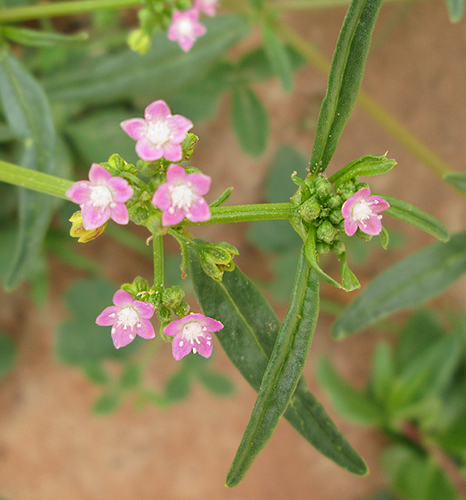
Gisekia africana
(Lour.) Kuntze
iNaturalist· cc-by-nc
(c) Lisa Schwarz, some rights reserved (CC BY-NC), uploaded by Lisa Schwarz
iNaturalist· cc-by-nc
(c) copper, some rights reserved (CC BY-NC), uploaded by copper
iNaturalist· cc-by-nc
(c) wynston_woodenberg, some rights reserved (CC BY-NC), uploaded by wynston_woodenberg
Description
A herb. It can be erect or lie along the ground. It can grow from seed each year or keep growing from year to year. It can grow 2 m high. The stems are soft. The leaves are 1-8 cm long by 2 cm wide. They vary in shape. The flowers are dark red. They grow in groups. The petals have pink tips and a white centre. The fruit are blackish and covered with warts.
Edible Uses
The seeds are eaten.
Traditional Uses
The seeds are eaten.
This uses section is brief — help expand it
Distribution
It is a subtropical plant. It grows in hot and arid areas with a marked dry season. The dry season can be 6-11 months. It grows in stony and sandy soils. It can grow in desert. It can grow in arid places.
Where It Grows
Africa, Asia, Botswana, East Africa, Eswatini, Indochina, Malawi, Mozambique, Namibia, SE Asia, South Africa, Southern Africa, Swaziland, Vietnam, Zambia, Zimbabwe,
Production
The seeds are collected by ants. They are then taken from the ant nests.
Synonyms
Also Known As
Kaitatsilabe, Lishereshere, Ombuija, Toabeb, Tri-son
References (3)
- Royal Botanic Gardens, Kew (1999). Survey of Economic Plants for Arid and Semi-Arid Lands (SEPASAL) database. Published on the Internet; http://www.rbgkew.org.uk/ceb/sepasal/internet [Accessed 16th April 2011]
- Sullivan, S., 1998, People plants and practice in drylands: Socio-political and ecological dimensions of resource-use by Damara farmers in north-west Namibia. Ph.D. Univ. College London.
- World Checklist of Useful Plant Species 2020. Royal Botanic Gardens, Kew