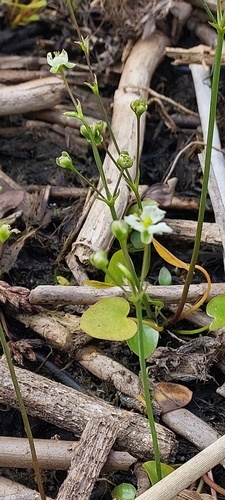
Alisma plantago-aquatica
L.
Water Plantain, Devil’s Spoons, Mad Dog Weed
iNaturalist· cc-by-nc
(c) Ольга Курякова, some rights reserved (CC BY-NC), uploaded by Ольга Курякова
iNaturalist· cc-by-nc
(c) Наталия Глушенкова, some rights reserved (CC BY-NC), uploaded by Наталия Глушенкова
iNaturalist· cc-by-nc
(c) אריה אוהד, some rights reserved (CC BY-NC), uploaded by אריה אוהד
Summary
Source: WikipediaAlisma plantago-aquatica, also known as European water-plantain, common water-plantain or mad-dog weed, is a perennial flowering aquatic plant widespread across most of Europe and Asia, and apparently spread elsewhere in both the Old and New World.
Description
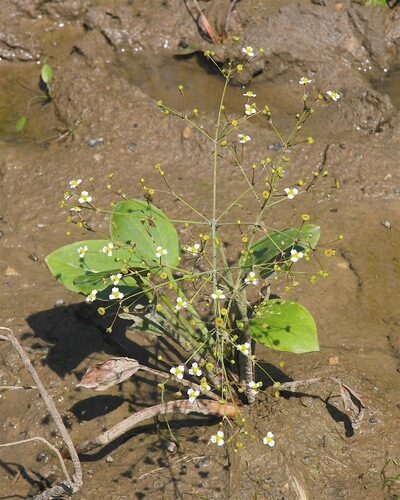
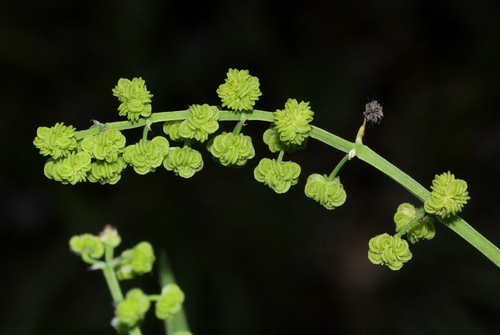
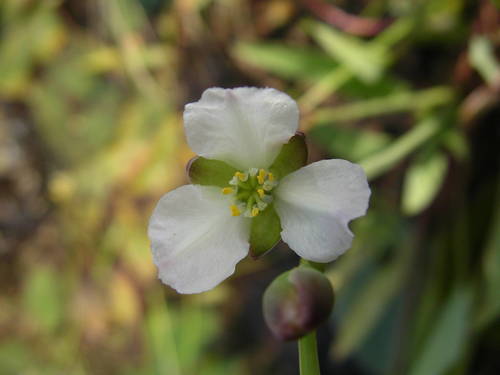
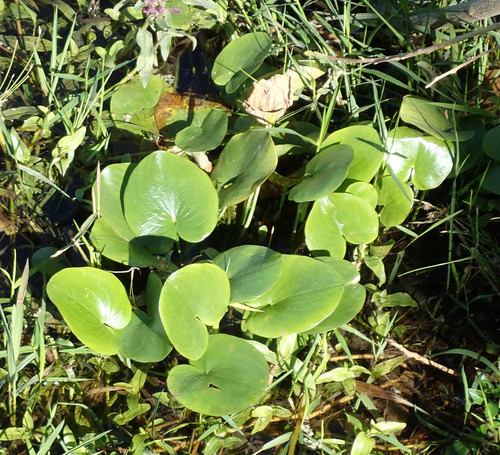
A perennial plant. It emerges from water. It forms tussocks or clumps. It grows up to 90-150 cm high and 45 cm across. Leaves form from the base. The leaf blades are 10-25 cm long and 7-10 cm wide. There are 7 veins which run along the leaf. The leaf stalk is 80 cm long. They are flattened on one side and have wings near the base. The flowers are in an open panicle. This is 60 cm long by 40 cm wide. The flowers are 1 cm across. The petals are pale pink. The fruit is one seeded. It is 2-2.5 mm long.
Edible Uses
The root is edible cooked and is rich in starch, but caution is required — it is acrid if not thoroughly dried or well cooked before eating. Leaves and petioles can also be eaten but must be thoroughly cooked, requiring long boiling; they have a salty flavour.
Traditional Uses
CAUTION: Fresh leaves are poisonous but this is removed by cooking or drying. The root is eaten after drying then cooking. The leaves and petioles are eaten after thorough cooking. The seeds are used for cereal and starchy preparations.
Medicinal Uses
The leaves are antibacterial, anticholesterolemic, diaphoretic, diuretic, hypoglycaemic, and hypotensive. They are used to treat cystitis, dysentery, renal calculus, and gravel. The fresh leaf is rubefacient, applied locally to bruises and swellings, and is used in the treatment of leprosy. Dried stem bases, eaten or grated and taken with water, treat digestive disorders including heartburn, cramps, and stomach flu. The powdered seed is astringent and used to treat bleeding; it is also said to promote sterility. The root contains an essential oil and is antibacterial, anticholesterolemic, diuretic, and hypotensive. It is said to lower blood pressure, cholesterol, and blood sugar, and has antibacterial action against Staphylococcus, Pneumococci, and Mycobacterium. The root is used to treat oliguria, oedema, nephritis, acute diarrhoea, cholesterolaemia, and fatty liver. It has historically been considered a cure for rabies, though this has not been substantiated. The whole plant is believed to promote conception. The root is harvested before flowering and dried for later use. A homeopathic remedy is also prepared from the fresh root.
Known Hazards
The rootstocks contain starch and can be boiled or soaked to remove bitterness before eating. Aquatic plants in general should be cooked before consumption to kill parasites. According to Flora of the U.S.S.R. (1934), "A powder prepared from dried roots is used in popular medicine as a cure for rabies and crushed leaves are used against mammary congestion; fresh leaves are employed in homeopathy. ... Since this species is often confounded or identified with others of the genus, the reported data may also refer to [A. orientale or A. lanceolatum]." A. plantago-aquatica is also known as mad-dog weed, as if it could be used to cure rabies, but should not be confused with Scutellaria lateriflora (mad-dog skullcap), which is also sometimes called mad-dog weed. Alisma orientale is sometimes treated as a variety of this species (A. plantago-aquatica var. orientale). The rhizomes of A. orientale have been used as a traditional Chinese medicine, ze xie. However, it may have serious side effects or even toxic effects such as hepatotoxicity in patients with chronic hepatitis B.
Distribution
It is a temperate plant. It grows in Northern temperate regions. It grows naturally in Britain in ditches, damp ground and shallow pond margins in water up to 15 cm deep. It grows in boggy conditions. Tasmania Herbarium.
Where It Grows
Afghanistan, Africa, Alaska, Albania, Argentina, Asia, Australia, Balkans, Bosnia, Botswana, Britain, Central Asia, Chile, China, East Africa, Egypt, Europe, Himalayas, Hungary, India, Indochina, Israel, Japan, Kazakhstan, Kyrgyzstan, Kenya, Luxembourg, Mediterranean, Middle East, Mongolia, Myanmar, Nepal, North Africa, North America, Northeastern India, Pakistan, Palestine, Russia, SE Asia, Slovenia, South America, South Sudan, Spain, Tajikistan, Tanzania, Tasmania, Thailand, Uganda, USA, Uzbekistan, Vietnam,
Cultivation
Plants can be grown from seed or by division of the plant. Fresh seed should be used and pots should be kept in water to keep the soil wet.
Propagation
Seed is best sown in a cold frame as soon as it is ripe. Stand the pot in approximately 3 cm of water to keep the soil consistently wet. Pot up seedlings once large enough to handle and overwinter in the cold frame, planting out in late spring. Division in spring or autumn is fairly easy and divisions can be planted directly into their permanent positions.
Other Uses
None known.
Other Information
It is a famine food. It is sold in local markets.
Notes
There are 10 Alisma species.
Synonyms
Also Known As
Ishing yempat, Kaothum, Trpotčasti porečnik
References (32)
- Ambasta S.P. (Ed.), 2000, The Useful Plants of India. CSIR India. p 27
- Badwar, R. R., & Fernandez, R. R., 2011, Edible Wild Plants of the Himachal Pradesh State by IHBT, Himalayas, Daya Publishing House,. Delhi, India
- Bhardwaj, J. & Seth, M. K., 2017, Edible wild plant resources of Bilaspur, Hamirpur and Una districts of Himachal Pradesh, India. International Journal of Botany Studies. Volume 2; Issue 6; p 09-17
- Bircher, A. G. & Bircher, W. H., 2000, Encyclopedia of Fruit Trees and Edible Flowering Plants in Egypt and the Subtropics. AUC Press. p 18
- Bodkin, F., 1991, Encyclopedia Botanica. Cornstalk publishing, p 64
Show all 32 references Hide references
- Brickell, C. (Ed.), 1999, The Royal Horticultural Society A-Z Encyclopedia of Garden Plants. Convent Garden Books. p 95
- Brown, D., 2002, The Royal Horticultural Society encyclopedia of Herbs and their uses. DK Books. p 110 (var. orientalis)
- Denes, A., et al, 2012, Wild plants used for food by Hungarian ethnic groups living inthe Carpathian Basin. Acta Societatis Botanicorum Poloniae 81 (4): 381-396
- Devi, O.S., P. Komor & D. Das, 2010, A checklist of traditional edible bio-resources from Ima markets of Imphal Valley, Manipur, India. Journal of Threatened Taxa 2(11): 1291-1296
- Devi, O. S., et al, 2021, Wild edible plants associated witht the people of Thoubal Khunou village and its migrated villagers. Int. J. Adv. Res. Biol. Sci. 8(9): 72-90
- Duke, J. A., 1992, Handbook of Edible Weeds. CRC Press. p 22 (As Alisma subcordatum)
- Elliot, W.R., & Jones, D.L., 1982, Encyclopedia of Australian Plants suitable for cultivation. Vol 2. Lothian. p 174
- Duke, J.A., 1992, Handbook of Edible Weeds. CRC Press. p 22
- Facciola, S., 1998, Cornucopia 2: a Source Book of Edible Plants. Kampong Publications, p 4
- Hastings Advance Community College, 2017, Uses for Native Plants of the Mornington Peninsula. 86pp. p 13
- Hedrick, U.P., 1919, (Ed.), Sturtevant's edible plants of the world. p 33
- Lazarides, M. & Hince, B., 1993, Handbook of Economic Plants of Australia, CSIRO. p 13
- Lim, T. K., 2015, Edible Medicinal and Non Medicinal Plants. Volume 9, Modified Stems, Roots, Bulbs. Springer p 3
- Meitei, L. R., et al, 2022, An ethnobotanical study on the wild edible plants used by forest dwellers in Yangoupokpi Lokchao Wildlife Sanctuary, Manipur, India. Ethnobotany Research and Application 23:15
- Plants for a Future database, The Field, Penpol, Lostwithiel, Cornwall, PL22 0NG, UK. http://www.scs.leeds.ac.uk/pfaf/
- READ,
- Redzic, S. J., 2006, Wild Edible Plants and their Traditional Use in the Human Nutrition in Bosnia-Herzegovina. Ecology of Food and Nutrition, 45:189-232
- Romanowski, N., 2007, Edible Water Gardens. Hyland House. p 103
- Sainty, G.R. & Jacobs, S.W.L., 1981, Waterplants of New South Wales. Water Resources Commission. NSW p 46
- Slocum, P.D. & Robinson, P., 1999, Water Gardening. Water Lilies and Lotuses. Timber Press. p 90
- Sp. pl. 1:342. 1753 "plantago Δ"
- Tasmanian Herbarium Vascular Plants list p 59
- UPHOF
- Urgamal, M., et al, 2014, Conspectus of the Vascular Plants of Mongolia. Mongolia Academy of Sciences Institute of Botany and National University of Mongolia Department of Biology. p 38
- Vermeulen, N, 1998, The Complete Encyclopedia of Herbs. Rebo Publishers. p 33
- Wild edible plants of Himachal Pradesh
- World Checklist of Useful Plant Species 2020. Royal Botanic Gardens, Kew