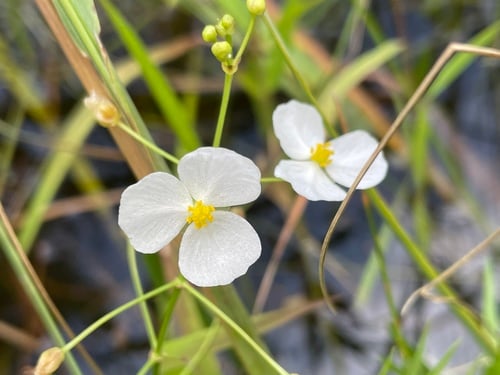
Alisma canaliculatum
A. Braun. & C. D. Bouché
iNaturalist· cc0
no rights reserved, uploaded by 葉子
iNaturalist· cc-by-nc
(c) Kinmatsu Lin, some rights reserved (CC BY-NC), uploaded by Kinmatsu Lin
iNaturalist· cc-by
(c) Илья Руденко, some rights reserved (CC BY), uploaded by Илья Руденко
Summary
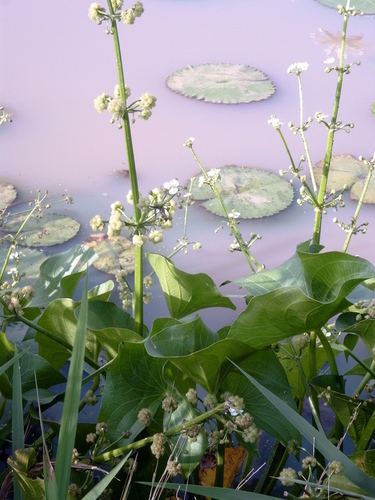
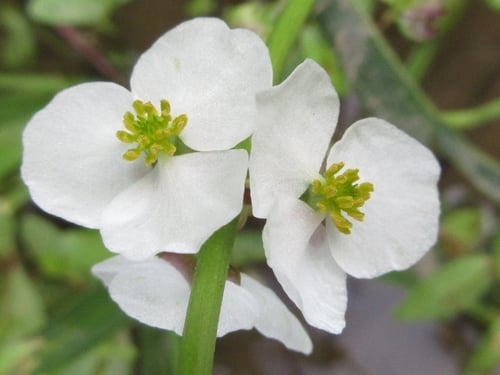
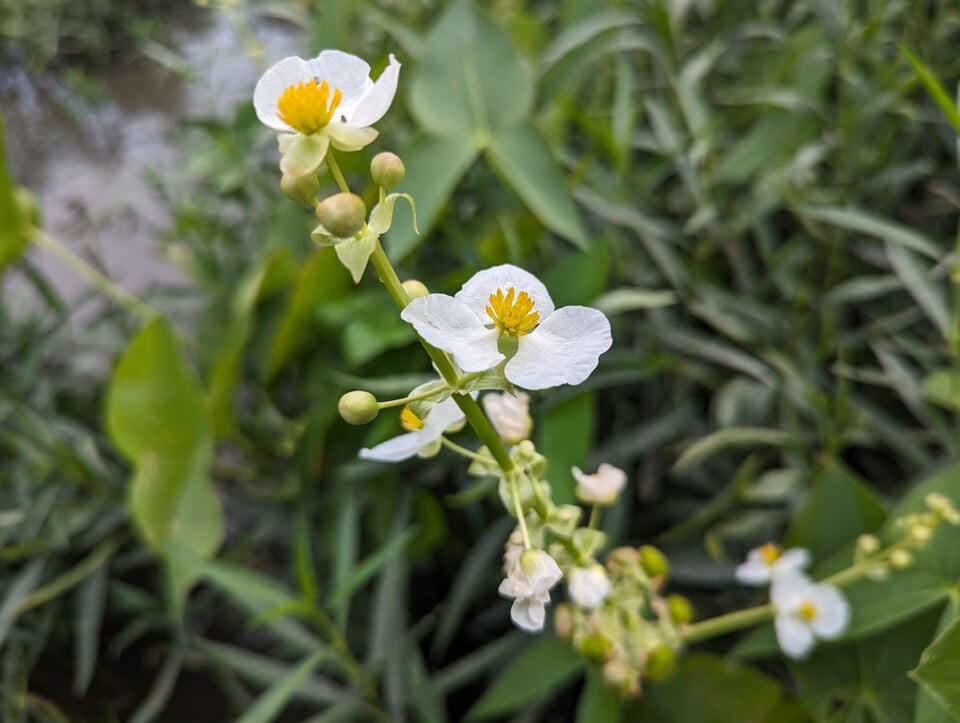
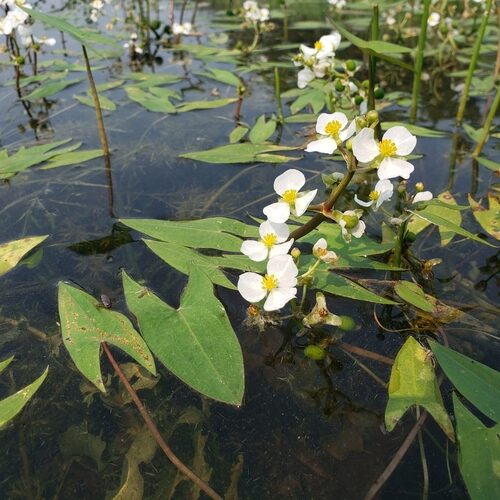
Source: WikipediaAlisma canaliculatum, commonly known as channelled water plantain, is a species of plants in the Alismataceae. It is native to Japan, Korea, the Ryukyu Islands, Taiwan, the Kuril Islands, and China (Anhui, Fujian, Guizhou, Henan, Hubei, Hunan, Jiangsu, Jiangxi, Shandong, Sichuan, Zhejiang). Alisma canaliculatum is a perennial herb with tubers up to 3 cm across. Leaves are lanceolate, up to 50 cm long. Flowers are white, borne in a branching panicle.
Description
A herb. It keeps growing from year to year. It grows up to 80 cm high. It develops tubes 1-3 cm across. The leaves have stalks 9-30 cm long. They are sword shaped and 6-45 cm long by 1-5 cm wide. The flowering groups are 35-65 cm long with 3-6 rings of 3-8 branches of flowers. They are white.
Edible Uses
Young plants can be cooked and used in soups. Some caution is advised regarding toxicity.
Traditional Uses
CAUTION; This plant probably contains poisons which are destroyed on cooking or drying. The young leaves are reported cooked and used in soups.
This uses section is brief — help expand it
Medicinal Uses
None known.
Known Hazards
Although no mention of toxicity has been seen for this plant, the fresh leaves and roots of the closely related A. plantago-aquatica are poisonous, though the toxins are destroyed by thoroughly cooking or drying the plant.
Distribution
It is a temperate plant. It grows on the edges of lakes and streams. It grows naturally in wet places all over Japan. It suits wet ground and water up to 25 cm deep.
Where It Grows
Asia, China, India, Japan, Korea, Taiwan,
Cultivation
Plants can be grown from seed or by division of the plant. Fresh seed should be used and pots should be kept in water to keep the soil wet.
Propagation
Seed is best sown in a cold frame as soon as it is ripe. Stand the pot in approximately 3 cm of water to keep the soil consistently wet. Pot up seedlings once large enough to handle and overwinter in the cold frame, planting out in late spring. Division can be done in spring or autumn and is fairly straightforward — divisions can be planted directly into their permanent positions.
Other Uses
None known.
Notes
There are 10 Alisma species.
Synonyms
References (2)
- Append. sp. nov. Hort. berol. 1867:4. 1867
- Plants for a Future database, The Field, Penpol, Lostwithiel, Cornwall, PL22 0NG, UK. http://www.scs.leeds.ac.uk/pfaf/