Genipa americana
L.
Genipa
iNaturalist· cc-by-nc-sa
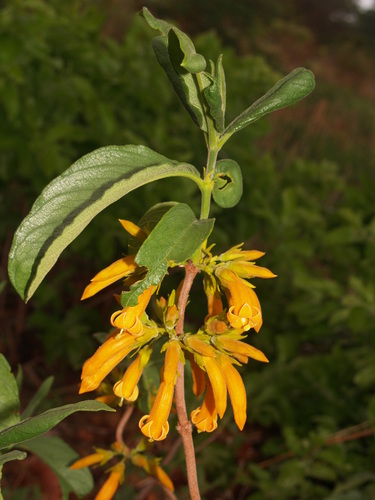
(c) Cody Hinchliff, some rights reserved (CC BY-NC-SA)
iNaturalist· cc-by-nc-sa
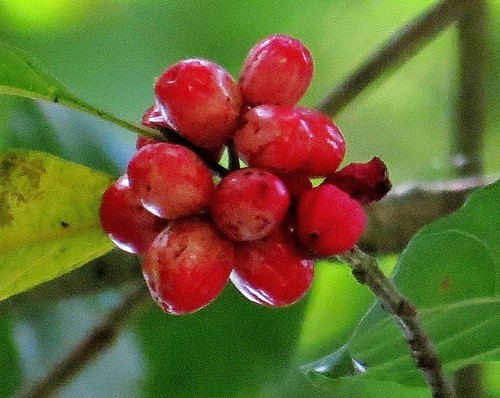
(c) Reinaldo Aguilar, some rights reserved (CC BY-NC-SA)
iNaturalist· cc-by-nc-sa
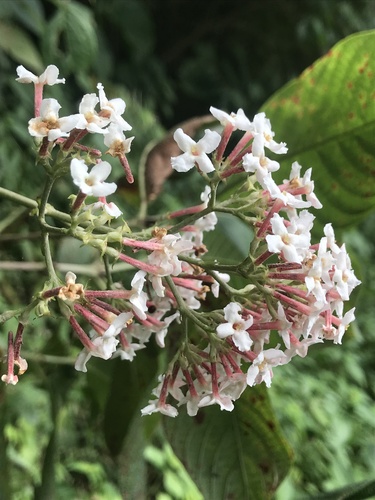
(c) Reinaldo Aguilar, some rights reserved (CC BY-NC-SA)
Summary
Source: WikipediaGenipa americana () is a species of trees in the family Rubiaceae. It is native to the tropical forests of North and South America, as well as the Caribbean.
Description
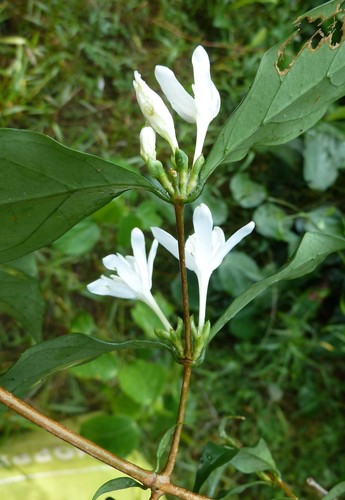
A medium sized tree. It grows to 10-15 m high. It can be 20 m high. The trunk is 30-80 cm across. The branches come out horizontal. The leaves are opposite. The leaves are near the end of the branches. They are oblong or sword shaped. The leaves are 35-50 cm long by 8-20 cm wide. The flowers are pale yellow with red centres. The fruit grow in clusters. The fruit are large and green. They are round or oval. They are 10-12 cm long by 7-9 cm wide. There are many seeds. They are 8 mm long by 5 mm across.
Edible Uses
The unripe fruit of G. americana yields a liquid used as a deep purple dye for tattoos, skin painting, insect repellent and food. This species is also cultivated for its edible fruits, which are eaten in preserves or made into drinks, jelly, or ice cream. The wood is reported to be resistant, strong, and easily worked; it is used in the making of utensils and in construction and carpentry.
Traditional Uses
Fruit are eaten fresh. They need to be over-ripe. They are acid so are more often used for preserves. They can be made into marmalade or drinks. The fruit are fermented to make an alcoholic drink. Caution: Alcohol is a cause of cancer.
Medicinal Uses
The fruit is diuretic, laxative, tonic, vermifuge. It is used in the treatment of anaemia and liver problems. The fruit juice is given as a diuretic while the fruit infusion is used as a cold remedy. The fruit is eaten as a remedy for jaundice and, when eaten in large quantities, acts as a vermifuge. The fruit is being tested for its antibiotic and antiseptic properties. The crushed green fruit and the bark decoction are applied on venereal sores and pharyngitis. The fruit and rasped bark are rubbed on black spots that sometimes develop on the skin. The bark is used to treat diarrhoea. A plaster made from the bark is used to treat ulcers. The bark exudes a whitish, sweetish gum when cut. This is diluted and used as an eyewash and is claimed to alleviate corneal opacities. A decoction of the root is strongly purgative. It is used in the treatment of gonorrhoea. The flower decoction and juice from the leaves is commonly given as a tonic and febrifuge. The pulverized seeds are emetic and caustic. The fruit and seed contain the terpene genipine as an active ingredient348]. The fruit contains malic acid, genipic acid and genipinic acid. The leaf contains geniposidinic acid, an iridoid glucoside. The seed contains caffeine.
Distribution
A tropical plant. It grows in the hot tropical lowlands. It is native to tropical America. It grows in rainfall of 1,500-4,500 mm per year. The temperatures are 22-30°C. It is common in swamp marshes. In Central America it grows from sea level to 1,000 m altitude. In Argentina it grows below 500 m above sea level.
Where It Grows
Amazon, Antilles, Argentina, Asia, Australia, Barbados, Belize, Bolivia, Brazil, Caribbean, Central America*, China, Colombia, Costa Rica, Cuba, Dominican Republic, East Africa, Ecuador, El Salvador, French Guiana, Grenada, Guadeloupe, Guatemala, Guianas, Guyana, Haiti, Hispaniola, Honduras, Indonesia, Malaysia, Mexico, Martinique, Mexico, Mozambique, Nicaragua, North America, Pacific, Panama, Paraguay, Peru, Philippines, Puerto Rico, SE Asia, South America, St. Lucia, St. Vincent and Grenadines, Suriname, Trinidad, Venezuela, Virgin Islands, West Indies*,
Cultivation
Plants are grown from seed. They can also be grown from large cuttings or by grafting. For seed the ripe fruit are harvested and the seeds removed and washed under running water. They are dried in the shade. Seeds only remain viable for 4 months. Seeds germinate in 25-45 days. Seedlings can be transplanted into the field after 7-9 months.
Propagation
Seed - it is not dormant and so pre-treatment is not necessary. However, soaking the seeds in running water for 1 - 2 days just prior to sowing will accelerate germination. Seed may be sown in light shade in a nursery seedbed. Germination rates are normally high with between 65 - 100% of the seed sprouting within 1 - 4 weeks. The seedlings are ready for pricking out about 20 days later. Initial growth rates are slow, taking about 12 months to attain a transplanting size of 20 - 40cm. Because of drought sensitivity the best way of establishment is to use containerised seedlings. Vegetative propagation by cuttings is also possible. Grafting is used for varieties with superior fruit quality.
Other Uses
A juice from the unripe fruit turns blue-black on contact with the skin. It is used as an indelible blue dye and has long been used by native people for tattooing and as a body paint. The dye is indelible on the skin for 15 - 20 days. A reddish paint can also be made by mixing this plant with Humiria balsamifera floribunda, Protium heptaphyllum and possibly Arrabidaea chica. This was a very common use and probably the main reason for the wide distribution of the species. The dye is also said to have insect-repellent properties. The bark is a source of tannins. A fibre obtained from the bark is used in making rough clothing. The heartwood is a very light, yellowish-brown, occasionally with a slight pinkish or purplish-blue overcast; the thick band of sapwood is cream-coloured to nearly white. The texture is fine; the grain straight to irregular, with growth rings marked by narrow darker bands forming an attractive striped figure. The wood is very hard, heavy, strong, flexible, though not very durable, being very susceptible to attacks by termites and pin-hole borers. The rate of air-seasoning is slow, and amount of degrade is minor. Machining characteristics are as follows: planing, shaping, turning, boring, and mortising are excellent; sanding and resistance to screw splitting are good. The wood is easy to work, it takes an excellent polish. A good quality and attractive wood, it is used for light construction, tool handles, furniture, cabinetwork, ship building, carving etc. The wood is used for fuel. The tree has a heavy leaf fall, which is important in improving the soil. It is occasionally planted as a live-hedge in grazing areas. The tree can be interplanted with temporary crops such as cassava or cotton in order to provide shade for the young trees.
Production
Plants grow at a moderate rate. They can be 2 m high in 2 years. A fruit is 200-400 g weight. The fruit is often harvested before it is completely mature then stored in the dark until it is ripe.
Notes
There are 7 Genipa species. The fruit sap blackens the skin. It has antioxidant properties.
Nutrition
| Part | Moisture | kJ | kcal | Protein | Vit A | Vit C | Iron | Zinc |
|---|---|---|---|---|---|---|---|---|
| Fruit | 80.1 | 298 | 71 | 0.8 | — | 8.9 | 0.6 | 1.9 |
| Fruit | 67.6 | — | 113 | 5.2 | — | — | 3.6 | — |