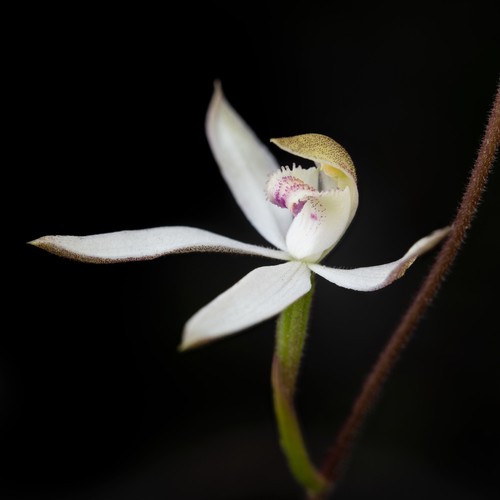
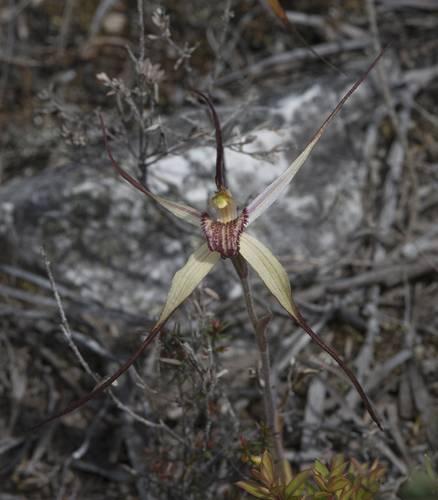
Gastrodia sesamoides
R.Br.
Potato orchid, Native potato, Cinnamon Bells
iNaturalist· cc-by-nc
(c) nick_clark, some rights reserved (CC BY-NC)
iNaturalist· cc-by-nc
(c) Melvin Xu, some rights reserved (CC BY-NC)
Summary
Source: WikipediaGastrodia sesamoides, commonly known as cinnamon bells or common potato orchid in Australia and as the pot-bellied orchid or cinnamon sticks in New Zealand, is a leafless, terrestrial saprophytic orchid in the family Orchidaceae. It has a thin, fleshy brown flowering stem and up to twenty five drooping, brownish, self-pollinating flowers that are white inside. Growing in a wide range of habitats, it is native to Australia and New Zealand.
Description
A slender leafless ground orchid. It grows attached to and feeding on other plants. The plant is leafless. The rhizome under the ground is irregular in shape. The tuber is 2-10 cm across. It is brown and fleshy. The flower stem is 30-80 cm long. It is erect and dark brown. It is fleshy and has several bracts sheathing it. There are 3-75 flowers. These are nodding on flower stalks 0.3-1 cm long. The flowers are 1.5-2 cm long and bell shaped. They are brown and white. They have a sweet scent.
Edible Uses
The root can be eaten raw or cooked. It resembles beetroot in flavour but is watery and insipid, and can be up to 15cm long and 4cm thick. The leaves are also eaten, as recorded among Australian Aborigines in Tasmania.
Traditional Uses
The tubers are eaten after roasting.
This uses section is brief — help expand it
Medicinal Uses
None known.
Distribution
It is a temperate plant. It is mainly in drier coastal regions. It grows in open forest and sheltered gullies in both lowland and highland regions. It is generally amongst roots of decayed trees and is partly a parasite on them.
Where It Grows
Australia*, New Zealand, South Africa, Southern Africa, Tasmania*,
Cultivation
We have very little information on this species and do not know if it will be hardy in Britain. A saprophytic herb, it is without green parts and is entirely dependant upon a fungus for its nutriment. This makes it very difficult to cultivate outside its native range. As well as its fungal host, it also requires a damp humus-rich soil in a sheltered woodland position. Orchids are, in general, shallow-rooting plants of well-drained low-fertility soils. Their symbiotic relationship with a fungus in the soil allows them to obtain sufficient nutrients and be able to compete successfully with other plants. They are very sensitive to the addition of fertilizers or fungicides since these can harm the symbiotic fungus and thus kill the orchid.
Propagation
Surface sow seed, preferably as soon as it is ripe, in a greenhouse without allowing the compost to dry out. The seed has a minute embryo surrounded by a single layer of protective cells with very little food reserve, and depends on a symbiotic relationship with a soil-dwelling fungus. Fungal hyphae invade the seed and enter the embryo cells; the orchid then digests the fungal tissue, which serves as its food supply until it can obtain nutrients from decaying material in the soil. To introduce the necessary fungus, use soil taken from around established plants, or sow the seed around an existing plant of the same species and grow the seedlings on until large enough to move. Division can be carried out in autumn, though the plant is very intolerant of root disturbance. When dividing or moving, keep a large ball of soil around the plant.
Other Uses
None known.
Production
Flowering is promoted by summer fires. It is a self pollinating plant.
Other Information
It has been an important traditional food in Tasmania.
Notes
There are about 20 Gastrodia species.
Nutrition
| Part | Moisture | kJ | kcal | Protein | Vit A | Vit C | Iron | Zinc |
|---|---|---|---|---|---|---|---|---|
| Tuber | 77.2 | 331 | 79 | 2.1 | — | — | 1.5 | 0.4 |
References (20)
- Bodkin, F., 1991, Encyclopedia Botanica. Cornstalk publishing, p 487
- Boyce, J., 2009, Van Diemen's land. Black Inc. p 115
- Cameron, M., (Ed.) 1981, A Guide to Flowers & Plants of Tasmania. Reed p 96
- Caton, J.M. & Hardwick, R. J., 2016, Field Guide to Useful Native Plants from Temperate Australia. Harbour Publishing House. p 288
- Cherikoff V. & Isaacs, J., The Bush Food Handbook. How to gather, grow, process and cook Australian Wild Foods. Ti Tree Press, Australia p 195
Show all 20 references Hide references
- Clarke, P. A., 2013, The Aboriginal Ethnobotany of the Adelaide Region, South Australia. Transactions of the Royal Society of South Australia. (2013), 137(1): 97-126
- Collier, P., 1992, Rainforest Plants of Tasmania. Plant Identikit. Society for growing Australian Plants. Tasmania. p 32
- Collier, P., 1993, Orchids of Tasmania. Plant Identikit. Society for growing Australian Plants. Tasmania. p 89
- Cribb, A.B. & J.W., 1976, Wild Food in Australia, Fontana. p 149
- Gott, B & Conran, J., 1991, Victorian Koorie Plants. PO Box 666 Hamilton, Victoria 3300, Australia. p 19
- Jones, D., Wapstra, H., Tonelli, P., and Harris S., 1999, The Orchids of Tasmania. Miegunyah Press, MUP, Victoria, Australia. p 149
- Lim, T. K., 2015, Edible Medicinal and Non Medicinal Plants. Volume 9, Modified Stems, Roots, Bulbs. Springer p 43
- Low, T., 1991, Wild Food Plants of Australia. Australian Nature FieldGuide, Angus & Robertson. p 108
- Low, T., 1992, Bush Tucker. Australia’s Wild Food Harvest. Angus & Robertson. p 122
- Minchin, R.F., Tasmanian Wildflowers. A Field Guide. Volume one. Regal Publications, Launceston p 32
- Plants for a Future database, The Field, Penpol, Lostwithiel, Cornwall, PL22 0NG, UK. http://www.scs.leeds.ac.uk/pfaf/
- Tasmanian Herbarium Vascular Plants list p 74
- Williams, K.A.W., 1999, Native Plants of Queensland Volume 4. Keith A.W. Williams North Ipswich, Australia. p 198
- Woolmore, E et al, 2002, King Island Flora: A Field Guide. p 96
- Zola, N., & Gott, B., 1992, Koorie Plants Koorie People. Koorie Heritage Trust. p 38