Gastrodia elata
Blume
Gastrodia tuber, Heaven hemp
iNaturalist· cc-by-nc
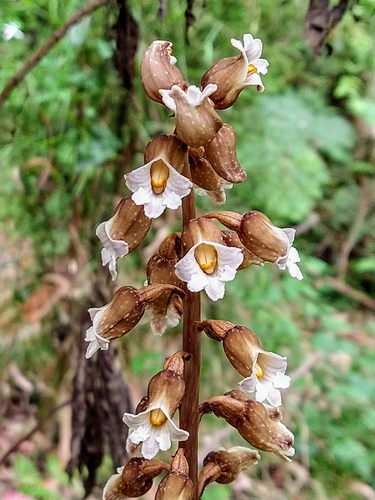
(c) Lijin Huang (紫楝), some rights reserved (CC BY-NC), uploaded by Lijin Huang (紫楝)
iNaturalist· cc-by-nc
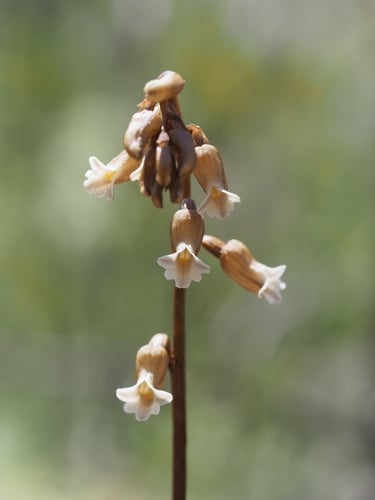
(c) Lijin Huang (紫楝), some rights reserved (CC BY-NC)
Summary
Source: WikipediaGastrodia elata is a mycoheterotrophic perennial herb in the family Orchidaceae. It is found in Nepal, Bhutan, India, Japan, Korea, Siberia, Taiwan, and China.
Description
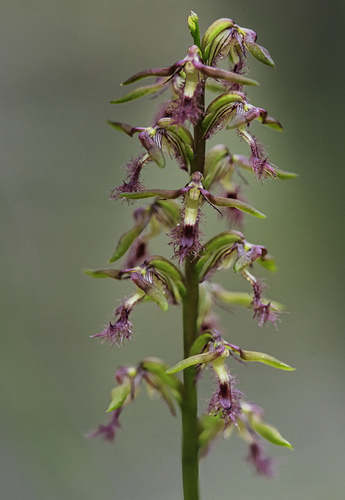
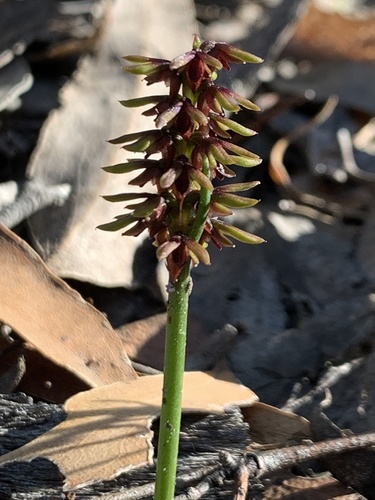
An evergreen shrubby orchid. It grows 60-100 cm high and spreads 30 cm wide. The roots are like tubers and 30-150 cm long. They are yellow-brown. The leaves are like small tear drops. The flowers are greenish-yellow or pale red. The fruit are round. The seeds are small.
Edible Uses
The root can be eaten raw or roasted and is large.
Traditional Uses
The potato like rhizomes are boiled in water for tea or cooked with chicken for soup. They are also used in drinks and bread.
This uses section is brief — help expand it
Medicinal Uses
This species has been used in Chinese herbal medicine for over 1,500 years. The root contains a number of phenolic compounds and is a sweet, acrid herb that is analgesic, anticonvulsive, antispasmodic, carminative, cholagogue, sedative, and tonic. It is used internally for convulsive illnesses such as epilepsy and tetanus, rheumatoid arthritis, vertigo, and numbness associated with liver disharmony. The root is harvested in autumn and dried for later use. The stem is considered aphrodisiac and tonic.
Distribution
A tropical plant. It grows attached to wood. It grows in high latitudes or altitudes in China. In Yunnan. In Sichuan.
Where It Grows
Asia, Bhutan, China, Himalayas, India, Indochina, Japan, Korea, Myanmar, Nepal, Northeastern India, Russia, SE Asia, Siberia, Taiwan, Tibet,
Cultivation
A saprophytic herb, it is without green parts and is entirely dependant upon a fungus for its nutriment. This makes it very difficult to cultivate outside its native range. As well as its fungal host, it also requires a damp humus-rich soil in a sheltered woodland position. The plants are very hardy, tolerating temperatures down to at least -15°c. This plant is becoming increasingly rare in the wild, due to over-collection as a medicinal plant. Methods of cultivating it have now been devised in China. Orchids are, in general, shallow-rooting plants of well-drained low-fertility soils. Their symbiotic relationship with a fungus in the soil allows them to obtain sufficient nutrients and be able to compete successfully with other plants. They are very sensitive to the addition of fertilizers or fungicides since these can harm the symbiotic fungus and thus kill the orchid.
Propagation
Surface sow seed, preferably as soon as it is ripe, either into the plant's natural habitat near existing colonies or onto a bed of Quercus wood inoculated with the fungus Armillaria mellea — introduce this fungus with extreme caution as it kills trees and there is no known preventative. The seed has a minute embryo surrounded by a single layer of protective cells with very little food reserve, and depends on a symbiotic relationship with a soil-dwelling fungus. Fungal hyphae invade the seed and enter the embryo cells; the orchid then digests the fungal tissue, which serves as its food supply. Division can be carried out in autumn, though the plant is very intolerant of root disturbance. When dividing or moving, keep a large ball of soil around the plant.
Other Uses
None known.
Notes
It is also used in medicine. There are about 20 Gastrodia species.
Also Known As
Gastrodia, Taimavq, Tianma, Tien ma, U-nin-te-p
References (12)
- Boa, E. R., 2004, Wild edible fungi and their importance to people. FAO Non Wood Forest Products Booklet 17
- Brown, D., 2002, The Royal Horticultural Society encyclopedia of Herbs and their uses. DK Books. p 220
- Guo, C., et al, 2022, An Ethnobotany Survey of Wild Plants Used by the Tibetan People of the Yadong River Valley, Tibet, China. Journal of Ethnobiology and Ethnomedicine p 24
- Hani Medicine of Xishuangbanna, 1999, p 687
- Hu, Shiu-ying, 2005, Food Plants of China. The Chinese University Press. p 330
Show all 12 references Hide references
- Kang, Y., et al, 2012, Wild food plants and wild edible fungi in two valleys on the Qinling Mountains (Shaanxi, central China) Journal of Ethnobiology and Ethnomedicine; 9:26
- Lim, T. K., 2015, Edible Medicinal and Non Medicinal Plants. Volume 9, Modified Stems, Roots, Bulbs. Springer p 43
- Mus. Bot. 2:174. 1856
- Plants for a Future database, The Field, Penpol, Lostwithiel, Cornwall, PL22 0NG, UK. http://www.scs.leeds.ac.uk/pfaf/
- Wang, J. et al, 2013, A Study on the Utilization of Wild Plants for Food in Liangshan Yi Autonomous Prefecture. Plant Diversity and Resources. 35(4): 416-471
- Wang, J., et al, 2020, An ethnobotanical survey of wild edible plants used by the Yi people of Liangshan Prefecture, Sichuan Province, China. Journal of Ethnobiology and Ethnomedicine 16:10 p 8
- Williams, D., 2017, Ainu Ethnobiology. Contributions in Ethnobiology. Society of Ethnobiology. p 128