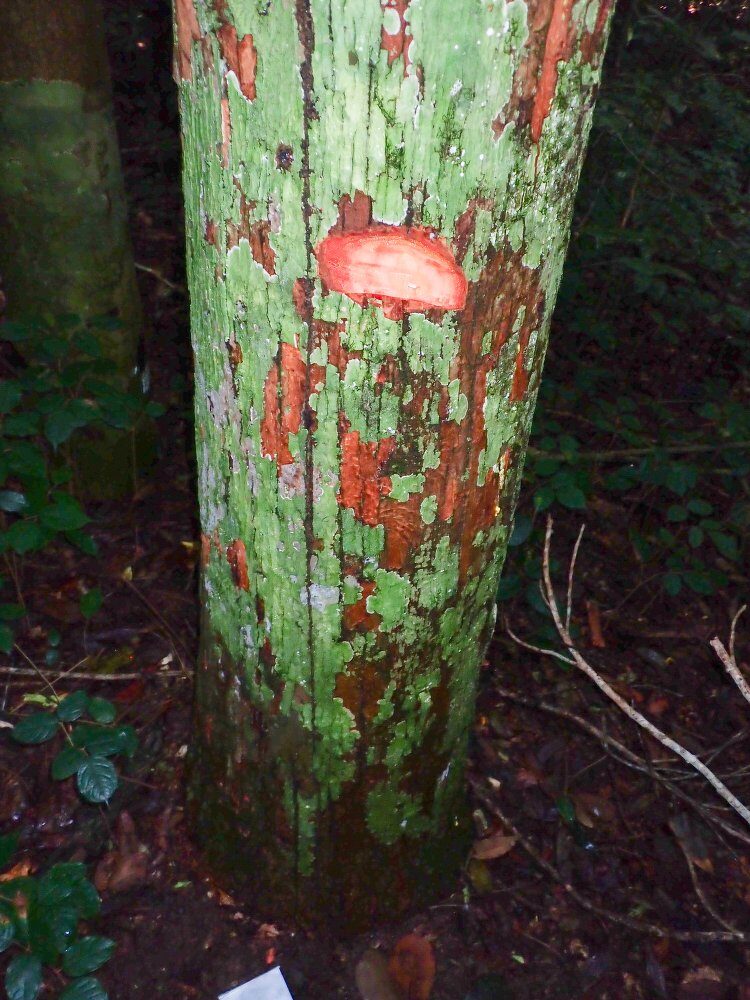
Garcinia smeathmannii
(Planch. et Triana) Oliv.
False chewstick
gbif· cc-by-nc-sa
Eric Akouangou & West & Central Africa program
gbif· cc-by-nc-sa
Eric Akouangou & West & Central Africa program
gbif· cc-by-nc-sa
Eric Akouangou & West & Central Africa program
Description
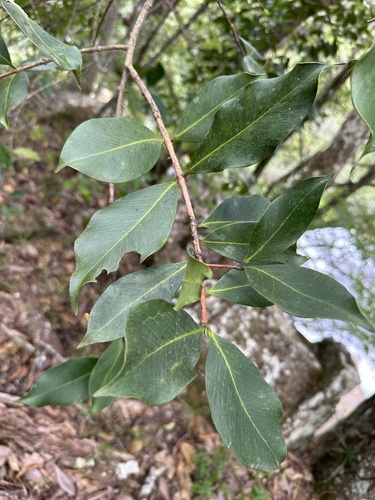
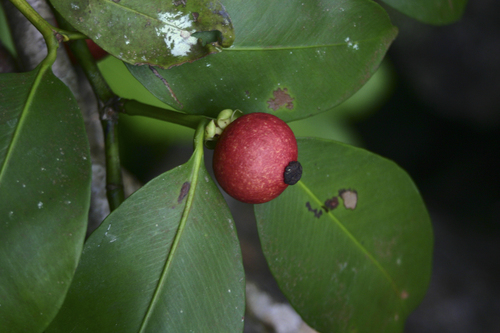
A medium sized tree. It grows to 20 m high. The trunk is straight and the branches are horizontal. The trunk is 50 cm across. The bark is grey and rough. The leaves are 12-30 cm long and 5-10 cm wide. The clusters of flowers occur in pairs. There are 30 flowers in a cluster. The flowers are white or cream. The fruit are round and 2.5 cm across. The pulp and seeds are edible.
Edible Uses
Fruit - raw. The fruit-pulp is edible and is taken in time of scarcity. The yellow, globose berry is 10 - 25mm in diameter. The seeds are used more or less like those of G. Kola, the false kola nut. These uses are as follows:- Seed - raw. The seeds are chewed along with the seeds of the true cola (Cola spp.). They are thought to enhance a person's enjoyment of the cola as well as allowing for consumption of larger quantities without indisposition. They have a bitter, astringent, aromatic flavour; somewhat resembling that of a raw coffee bean. This is followed by a slight sweetness (or lingering pepperiness).
Traditional Uses
The seeds are eaten fresh.
This uses section is brief — help expand it
Medicinal Uses
The bark contains a bright yellow, sticky latex which is used as a wound-dressing. The latex is instilled into the eyes for treating ophthalmia. A decoction of the bark is used as a purgative in the treatment for female sterility and as an antidote for poisoning. Applied externally, it is used as a wash to treat skin-infections - this treatment being followed by an application of the latex. The seeds are used more or less like those of G. Kola, the false kola nut. These uses are as follows:- The seeds are said to be antidote, antitussive, aphrodisiac, astringent and vermifuge. Mastication of the seeds is said to relieve coughs, hoarseness, and bronchial and throat troubles. They are taken dry as a remedy for dysentery. They are said to provide an antidote against Strophanthus poisoning.
Distribution
It is a tropical plant. It grows in forest. It is usually near streams in lowlands and uplands up to 1,300 m altitude in West Africa. In Nigeria it has been recorded up to 1,670 m above sea level.
Where It Grows
Africa, Angola, Benin, Cameroon, Central Africa, Central African Republic, CAR, Congo DR, Congo R, Côte d'Ivoire, East Africa, Gabon, Ghana, Guinea, Guinée, Guinea-Bissau, Ivory Coast, Malawi, Nigeria, Senegal, Sierra Leone, Tanzania, Togo, West Africa, Zambia,
Cultivation
A dioecious species, both male and female forms usually need to be grown if fruit and seed are required. At least some dioecious Garcinia species, however, are able to produce fertile seed even in the absence of fertilization (asexual reproduction). Such seeds would be expected to be genetically identical to the parent
Propagation
Seed - we have no specific information on this species, but the seed of most members of the genus can be slow to germinate, even if sown fresh, often taking 6 months or more.
Other Uses
The Wasa name, and the English, doubtless drawn from it, suggests use for chew-sticks, if only as a substitute. The wood is hard and durable. It has been used for posts in Ghana.
Production
In Central African Republic flowers have been recorded from January to March.
Notes
There are about 300 Garcinia species.
Synonyms
Also Known As
Afon, Aliga, Eru orogbo, Gambe, Leni, Macacundje, Mduma, Mfilafila, Mpekechu, Mtumbu, N'tchocodo, N'tcocodo, Umusalasi
References (16)
- Abbiw, D.K., 1990, Useful Plants of Ghana. West African uses of wild and cultivated plants. Intermediate Technology Publications and the Royal Botanic Gardens, Kew. p 46
- Burkill, H. M., 1985, The useful plants of west tropical Africa, Vol. 2. Kew.
- Busson, 1965,
- Chapman, J. D. & Chapman, H. M., 2001, The Forest Flora of Taraba and Andamawa States, Nigeria. WWF & University of Canterbury. p 176
- Dalziel, J. M., 1937, The Useful plants of west tropical Africa. Crown Agents for the Colonies London.
Show all 16 references Hide references
- FAO Corporate Document Repository. The Major Significance of 'Minor' Forest Products. Appendix 3 (As Garcinia polyantha)
- Fowler, D. G., 2007, Zambian Plants: Their Vernacular Names and Uses. Kew. p 18
- Jardin, C., 1970, List of Foods Used In Africa, FAO Nutrition Information Document Series No 2.p 43, 139
- Keay, R.W.J., 1989, Trees of Nigeria. Clarendon Press, Oxford. p 108
- Lovett, J. C. et al, Field Guide to the Moist Forest Trees of Tanzania. p 66
- Peters, C. R., O'Brien, E. M., and Drummond, R.B., 1992, Edible Wild plants of Sub-saharan Africa. Kew. p 84
- Ruffo, C. K., Birnie, A. & Tengnas, B., 2002, Edible Wild Plants of Tanzania. RELMA p 343
- Terashima, H., et al, 1992, Ethnobotany of the Lega in the Tropical Rainforest of Eastern Zaire (Congo): Part Two, Zone de Walikale, African Study Monographs, Suppl. 19:1-60
- Unwin, A. H., 1920, West African Forests and Forestry. Fisher Unwin Ltd. pdf on Internet p 65 (As Garcinia polyantha)
- White, F., Dowsett-Lemaire, F. and Chapman, J. D., 2001, Evergreen Forest Flora of Malawi. Kew. p 283
- World Checklist of Useful Plant Species 2020. Royal Botanic Gardens, Kew