Aletris spicata
(Thunberg) Franchet
Narrow-leaf Plantain-lily, Chinese stargrass
iNaturalist· cc-by-nc
(c) Lijin Huang (紫楝), some rights reserved (CC BY-NC), uploaded by Lijin Huang (紫楝)
iNaturalist· cc-by-nc
(c) Lijin Huang (紫楝), some rights reserved (CC BY-NC), uploaded by Lijin Huang (紫楝)
Summary
Source: WikipediaCompact perennial reaching 0.3m tall. Flowers March to August with seeds ripening May to August. Prefers light sandy and medium loamy well-drained soils in mildly acidic to neutral pH. Requires full sun and moist soil. Hermaphrodite flowers.
Description
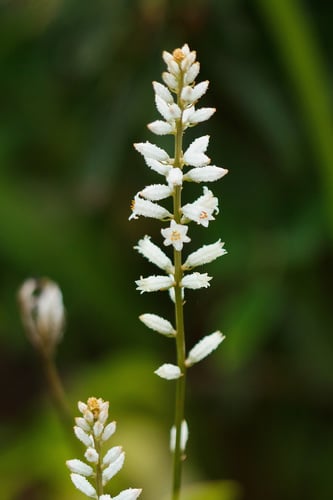
A perennial plant 30 cm high. There are many leaves tufted together. They are very narrow. They are 5-30 cm long by 2-4 mm wide. The flowering stalk is 5-35 cm long and has 10-80 flowers in a loose cluster. This stalk is densely hairy. The flowers can be yellow or white. They can be striped or tinged pink. The fruit is a capsule which is oval and angular. It is 3-5 mm long by 2-3 mm wide.
Edible Uses
Young leaves can be cooked and eaten, but are considered a famine food used only when other options are unavailable.
Traditional Uses
The young leaves are cooked and eaten as an emergency food. They are eaten with oil and salt. The whole plant is boiled with sugar to make a drink given to mothers to improve their milk quality.
Medicinal Uses
The root is antitussive and vermifuge.
Distribution
It is a temperate plant. It grows naturally in low hills in Japan. It prefers a damp sunny position with leaf mould. In China it grows in grassland and scrub between 100-2900 m altitude in many provinces. In Sichuan and Yunnan.
Where It Grows
Asia, China, Japan, Korea, Pacific, Philippines, SE Asia, Taiwan,
Cultivation
Plants can be grown from seed or by division of the clump.
Propagation
No specific germination details are available for this species, but sowing seed thinly in a greenhouse in early spring is recommended. Thin sowing allows seedlings to remain in their original containers for the first year; feed periodically with a liquid fertiliser to prevent nutrient deficiency. The following spring, prick young plants into individual pots and grow them on under glass for another winter before planting out into permanent positions in early summer. Division can also be carried out in spring.
Other Uses
None known Special Uses
Other Information
Low
Notes
There are 21 Aletris species.
Synonyms
Also Known As
Fen tiao er cai
References (4)
- Chen Xinqi, Liang Songyun, Xu Jiemei, Tamura M.N., Liliaceae. Flora of China. p 7
- Hu, Shiu-ying, 2005, Food Plants of China. The Chinese University Press. p 310
- Plants for a Future database, The Field, Penpol, Lostwithiel, Cornwall, PL22 0NG, UK. http://www.scs.leeds.ac.uk/pfaf/
- READ