Fucus vesiculosus
L.
Bladder Wrack, Popweed, Rock weed, Red wrack, Dyer's wrack
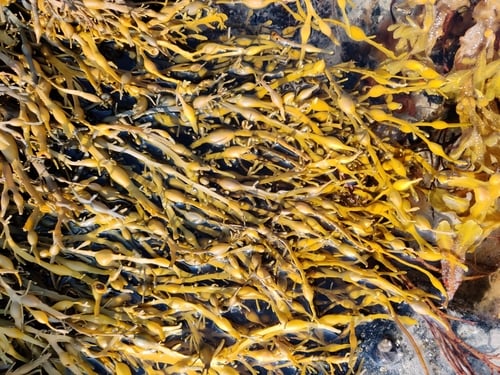
iNaturalist· cc-by-nc
(c) Jamien, some rights reserved (CC BY-NC), uploaded by Jamien
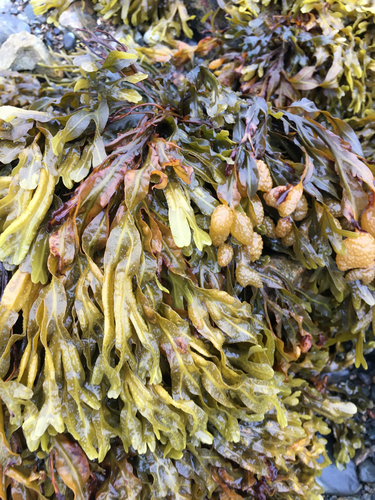
iNaturalist· cc-by-nc-nd
(c) Hans Hillewaert, some rights reserved (CC BY-NC-ND)
Summary
Source: WikipediaFucus vesiculosus, known by the common names bladderwrack, black tang, rockweed, sea grapes, bladder fucus, sea oak, cut weed, dyers fucus, red fucus and rock wrack, is a brown alga a seaweed found on the coasts of the North Sea, the western Baltic Sea and the Atlantic and Pacific Oceans. It was the original source of iodine, discovered in 1811, and was used extensively to treat goitre.
Description
A brown seaweed. It is 15-100 cm long. It has air bladders. These are arranged in groups of 2 or 3 along the fronds. The fronds are leathery and olive-brown. The fronds are branched and strap-like.
Traditional Uses
THE PLANT IS NOT EATEN. The dried plants are used as a herbal tea. The plant is placed in a linen cloth and suspended in the pot to impart flavour to fish, meat or vegetables then the wrack removed. Caution: Using the plant too much could over stimulate the thyroid gland. The plant is a source of iodine.
Medicinal Uses
Fucus vesiculosus can be cooked and eaten. It was the original source of iodine, discovered in 1811, and was used extensively to treat goitre, a swelling of the thyroid gland related to iodine deficiency. It is also sold as a nutritional supplement. Primary chemical constituents include mucilage, algin, mannitol, fucitol, beta-carotene, zeaxanthin, volatile oils, iodine, bromine, potassium and other minerals.
Known Hazards
Consumption of F. vesiculosus can cause platelet inhibition, which may potentiate the anticoagulant activity of warfarin (Coumadin). It should be avoided before surgery. Some people may suffer an allergic reaction to the iodine in F. vesiculosus.
Distribution
It is a temperate and Mediterranean plant. It grows in the Atlantic and English channel as well as the North Sea and Baltic countries.
Where It Grows
Atlantic, Bolivia, Britain, Europe, France, Greenland, Iceland, Ireland, Mediterranean, Morocco, North America, Norway, Portugal, Russia, Spain, USA,
Notes
There are 6 Fucus species. They are seaweeds found in shallow water in the northern hemisphere. It is rich in iodine.
Nutrition
| Part | Moisture | kJ | kcal | Protein | Vit A | Vit C | Iron | Zinc |
|---|---|---|---|---|---|---|---|---|
| seaweed | — | — | 6.1 | — | — | — | — | — |
Also Known As
Pig weed
References (12)
- Bremness, L., 1994, Herbs. Collins Eyewitness Handbooks. Harper Collins. p 288
- Cherry, P., et al, 2019, Risks and benefits of consuming edible seaweeds. Nutrition ReviewsVR Vol. 77(5):307–329
- Facciola, S., 1998, Cornucopia 2: a Source Book of Edible Plants. Kampong Publications, p 258
- http://www.seavegetables.com
- Huxley, A. (Ed.), 1977, The Encyclopedia of the Plant Kingdom. Chartweil Books. p 110
Show all 12 references Hide references
- Irving, M., 2009, The Forager Handbook, A Guide to the Edible Plants of Britain. Ebury Press p 364
- Kiple, K.F. & Ornelas, K.C., (eds), 2000, The Cambridge World History of Food. CUP p 235
- Mabey, R., 1973, Food for Free. A Guide to the edible wild plants of Britain, Collins. p 119
- Pereira, L., 2011, A Review of the Nutrient Composition of Selected Edible Seaweeds. In Seaweed. Pomin V. H., (Ed.) Nova Science Publishers, Inc
- Ruperez, P. et al, 2001, Dietary fibre and physicochemical properties of edible Spanish seaweeds. Eur. Food Res. Technol. 212: 349-354
- Surey-Gent, S. & Morris G., 1987, Seaweed. A User's Guide. Whirret Books. London. p 40, 127
- Zemke-White, W. L. & Ohno, M., 1999, World seaweed utilisation: An end-of-century summary. Journal of Applied Phycology 11: 369-376