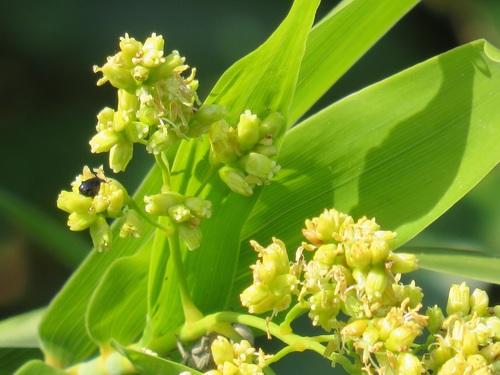
Flagellaria indica
L.
Supplejack, Whip vine, Lawyer vine
iNaturalist· cc-by-nc
(c) Han-Ting Liu, some rights reserved (CC BY-NC), uploaded by Han-Ting Liu
iNaturalist· cc-by-nc
(c) leithallb, some rights reserved (CC BY-NC), uploaded by leithallb
iNaturalist· cc-by-nc
(c) Ian Cowan, some rights reserved (CC BY-NC), uploaded by Ian Cowan
Summary
Source: WikipediaFlagellaria indica is a climbing plant found in many of the tropical and subtropical regions of the Old World, in India, Bangladesh, Southeast Asia, Polynesia, and Australia. A strong climber, it grows often up to 15 metres (49 ft) tall, with thick cane-like stems exceeding 15 mm (0.6 in) in diameter. Its leaves, without hairs, are 10 to 40 centimetres (4 to 16 in) long, and 5 to 20 mm (0.2 to 0.8 in) wide, with a coiled apical tendril which forms the holding part of the climbing plant. Fragrant white flowers form in panicles, 10 to 25 centimetres (4 to 10 in) long. The fruit is inedible. The globose drupes are red when mature, 5 millimetres (25⁄128 in) in diameter, usually with only one seed. Because of its wide distribution, many local common names are used, such as whip vine, hell tail, supplejack, false rattan, and bush cane.
Description
An evergreen vine. It grows to 10 m tall. It climbs high into trees by modified tendrils on the tips of leaves. The stem is vigorous and branching. The stems are woody and 1-3 cm thick. The stem is covered with overlapping leaf sheaths. The leaves are narrow and sword shaped. They taper at both ends and the tips curve backwards forming tendrils. Leaves are 8-30 cm long and 0.7-2 cm wide. They are bright green and have parallel veins. They do not have a leaf stalk but clasp the stem. The flowers are very small and occur in sprays at the ends of branches. They are white. The fruit are berries which are small and fleshy and red when ripe. They are 0.3-0.5 cm across. The fruit are edible.
Edible Uses
The young shoots and leaves are eaten after boiling. The ripe red fruit are eaten fresh. The sweet stems are also chewed.
Traditional Uses
The young shoots and leaves are eaten after boiling. The fruit is eaten. The sweet stems are also chewed.
This uses section is brief — help expand it
Medicinal Uses
The plant has a range of medicinal uses.
Distribution
It is a tropical plant. It does best with a well drained soil rich in compost. It needs a protected sunny position. It is damaged by drought and frost. It grows naturally in rainforests and along the edge of streams. It can be along the edges of mangroves. It grows up to 1,600 m above sea level. It suits humid locations. It can grow on sandstone soils. It suits hardiness zones 9-12.
Where It Grows
Africa, Andamans, Asia, Australia, Cambodia, China, East Africa, East Timor, Fiji, FSM, Guam, India, Indochina, Indonesia, Japan, Kosrae, Lord Howe Island, Madagascar, Malaysia, Mariana Islands, Mauritius, Micronesia, Mozambique, Myanmar, New Caledonia, Pacific Islands, Palau, Pan tropical, Papua New Guinea, PNG, Pohnpei, Reunion, Samoa, SE Asia, Seychelles, Sri Lanka, Taiwan, Tanzania, Thailand, Timor-Leste, Vietnam,
Cultivation
Plants are grown from seed. The seed need to be sown fresh.
Other Uses
The bark and tough stems are used for making mats, baskets, fishtraps, and for constructing huts and roofs. It is considered a good alternative for rattan, all the more so as it will regrow after cutting. The leaves are used for hair washes.
Production
In Australia, flowering occurs periodically mainly December to March.
Notes
There are 4 Flagellaria species. There is only one genus in the Flagellariaceae family. The plant has a range of medicinal uses.
Synonyms
Also Known As
Ban-chanda, Bejuco halum-tano, Bomugra, Dule, False rattan, Hisa-biko, Kokrok, Myauk-kyien, Owar, Panambuvalli, Poyinadiputatige, Rotan dini, Rotan mambang, Rotan-rotanan, Rotan tikus, Vahipiki, Viko, Wai ling, Wai yep chak, Wai-ling, Wala, Wowo
References (42)
- Ambasta, S.P. (Ed.), 2000, The Useful Plants of India. CSIR India. p 225
- Beasley, J., 2011, Plants of Tropical North Queensland - the compact guide. Footloose publications. p 69
- Bhargava, N., 1983, Ethnobotanical Studies of the Tribes of Andaman and Nicobar Islands, India. 1. Onge. Economic Botany 37(1): 110-119
- Bindon, P., 1996, Useful Bush Plants. Western Australian Museum. p 145
- Bodkin, F., 1991, Encyclopedia Botanica. Cornstalk publishing, p 475
Show all 42 references Hide references
- Borrell, O.W., 1989, An Annotated Checklist of the Flora of Kairiru Island, New Guinea. Marcellin College, Victoria Australia. p 21
- Brock, J., 1993, Native Plants of Northern Australia, Reed. p 191
- Burkill, I.H., 1966, A Dictionary of the Economic Products of the Malay Peninsula. Ministry of Agriculture and Cooperatives, Kuala Lumpur, Malaysia. Vol 1 (A-H) p 1042
- Cherikoff V. & Isaacs, J., The Bush Food Handbook. How to gather, grow, process and cook Australian Wild Foods. Ti Tree Press, Australia p 200
- Cooper W & Cooper W T, 1994, Fruits of the Rain Forest. RD Press p 138
- Cooper, W. and Cooper, W., 2004, Fruits of the Australian Tropical Rainforest. Nokomis Editions, Victoria, Australia. p 221
- Cowie, I, 2006, A Survey of Flora and vegetation of the proposed Jaco-Tutuala-Lore National Park. Timor-Lests (East Timor) www.territorystories.nt/gov.au p 48
- Cribb, A.B. & J.W., 1976, Wild Food in Australia, Fontana. p 113
- Cundall, P., (ed.), 2004, Gardening Australia: flora: the gardener's bible. ABC Books. p 606
- Elliot, W.R., & Jones, D.L., 1992, Encyclopedia of Australian Plants suitable for cultivation. Vol 4. Lothian. p 299 (Drawing)
- Facciola, S., 1998, Cornucopia 2: a Source Book of Edible Plants. Kampong Publications, p 117
- Flora of Australia Volume 49, Oceanic Islands 1, Australian Government Publishing Service, Canberra. (1994) p 422
- Ghosh, A, 2014, Survey of Ethno-medicinal Climbing plants in Andaman and Nicobar Islands, India. Int. J. of Pharm. Life Sci. 5(7): July, 2014:3671-3677
- Hedrick, U.P., 1919, (Ed.), Sturtevant's edible plants of the world. p 310
- Heywood, V.H., Brummitt, R.K., Culham, A., and Seberg, O., 2007, Flowering Plant Families of the World. Royal Botanical Gardens, Kew. p 368
- Hiddins, L., 1999, Explore Wild Australia with the Bush Tucker Man. Penguin Books/ABC Books. p 164
- Jackes, B.R., 2001, Plants of the Tropics. Rainforest to Heath. An Identification Guide. James Cook University. p 56
- Jones, D.L. & Gray, B., 1977, Australian Climbing Plants. Reed. p 57, 61, 103
- Kenneally, K.E., Edinger, D. C., and Willing T., 1996, Broome and Beyond, Plants and People of the Dampier Peninsula, Kimberley, Western Australia. Department of Conservation and Land Management. p 210
- Kuo, W. H. J., (Ed.) Taiwan's Ethnobotanical Database (1900-2000), http://tk.agron.ntu.edu.tw/ethnobot/DB1.htm
- Lazarides, M. & Hince, B., 1993, Handbook of Economic Plants of Australia, CSIRO. p 115
- McMakin, P.D., 2000, Flowering Plants of Thailand. A Field Guide. White Lotus. p 50
- Melzer, R. & Plumb, J., 2011, Plants of Capricornia. Belgamba, Rockhampton. p 374
- Morley, B.D., & Toelken, H.R., (Eds), 1983, Flowering Plants in Australia. Rigby. p 375
- Nicholson, N & H., 1996, Australian Rainforest Plants, Terania Rainforest Publishing. NSW. p 34
- Paczkowska, G. & Chapman, A.R., 2000, The Western Australian Flora. A Descriptive Catalogue. Western Australian Herbarium. p 61
- Peekel, P.G., 1984, (Translation E.E.Henty), Flora of the Bismarck Archipelago for Naturalists, Division of Botany, Lae, PNG. p 76, 74
- Scarth-Johnson, V., 2000, National Treasures. Flowering Plants of Cooktown and Northern Australia. Vera Scarth-Johnson Gallery Association. Cooktown, Australia. p 131
- Smith, A.C., 1979, Flora Vitiensis Nova, Lawaii, Kuai, Hawaii, Volume 1 p 287
- Sukarya, D. G., (Ed.) 2013, 3,500 Plant Species of the Botanic Gardens of Indonesia. LIPI p 929
- Styger, E., et al, 1999, Indigenous fruit trees of Madagascar: potential components of agroforestry systems to improve human nutrition and restore biological diversity. Agroforestry Systems 46: 289-310
- Townsend, K., 1994, Across the Top. Gardening with Australian Plants in the tropics. Society for Growing Australian Plants, Townsville Branch Inc. p 216
- Wheeler, J.R.(ed.), 1992, Flora of the Kimberley Region. CALM, Western Australian Herbarium, p 1110
- Wightman, G. & Andrews, M., 1991, Bush Tucker Identikit. Common Native Food Plants of Australia’s top end. Conservation Commission Northern Territory. p 50
- Wightman, G. M. & Andrews, M.R., 1989, Plants of Northern Territory Monsoon Vine Forests (Vol 1). Conservation Commission of Northern Territory. p 124
- Wightman, G. & Brown, J., 1994, Jawoyn Plant Identikit, Common Useful Plants in the Katherine Area of Northern Australia. Conservation Commission Northern Territory. p 55
- World Checklist of Useful Plant Species 2020. Royal Botanic Gardens, Kew