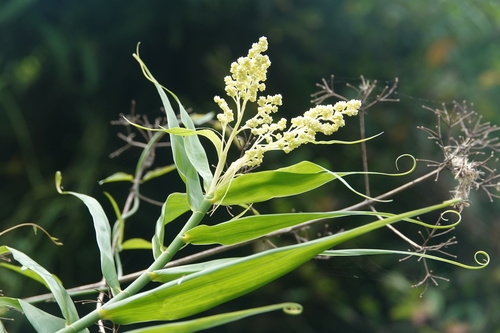
Flagellaria guineensis
Schumach.
iNaturalist· cc-by-nc
(c) magdastlucia, some rights reserved (CC BY-NC), uploaded by magdastlucia
iNaturalist· cc-by-nc
(c) Sharon Louw, some rights reserved (CC BY-NC), uploaded by Sharon Louw
iNaturalist· cc-by-nc
(c) Bart Wursten, some rights reserved (CC BY-NC), uploaded by Bart Wursten
Description
A tropical vine in the family Flagellariaceae with edible fruit.
This description is brief — help expand it
Edible Uses
The fruits are sometimes eaten. The seed is made into a porridge that is eaten during periods of severe food shortage, even though it causes stomach problems.
Medicinal Uses
The whole plant is prepared into medicine for skin-diseases and veldt sores and for refractory leg ulcers. Ash from the roasted plant, mixed with castor-oil, is rubbed into areas affected by rheumatic pain, and into scarifications on the temples as an analgesic for headache. The ash of burnt plants is also placed over a rupture to cure it. The leaf is thought to be aphrodisiac. A decoction of the leaves and twigs is claimed to be a good cure for chronic gonorrhoea. A decoction of the leafy twigs is used as a mouth wash against dental caries, whilst the leaf pulp is applied to the affected tooth. A decoction of the leafy twigs is used as a wash or vapour bath to cure kidney pain. The boiled leaves are applied hot for the treatment of hernia. The fleshy berry, applied externally, is widely used as a cure for venereal disease. An infusion is also drunk for this purpose. The fruit-pulp is highly irritant to the skin, and is made up as a poultice which is applied topically as a treatment for skin infections and venereal disease.
Distribution
It is a tropical plant.
Where It Grows
Africa, East Africa, Madagascar, Mozambique,
Cultivation
Occurs as a weed on tree crop plantations in E Africa and is said to be resistant to herbicides. It is a weed invader of rice-fields in the Bendel state of Nigeria. The plant regrows from the base after cutting back.
Other Uses
Pieces of the stem are used as writing pens. The strong supple stems are commonly used to make fish-traps. The stems are used in hut-construction, basketry and weaving, whilst forest people prepare necklace cords from them. The wood is used as fuel.
Also Known As
Midela, Mudali, Namitale
References (3)
- East African Herbarium records, 1981, (As Flagellaria indica)
- Peters, C. R., O'Brien, E. M., and Drummond, R.B., 1992, Edible Wild plants of Sub-saharan Africa. Kew. p 115
- World Checklist of Useful Plant Species 2020. Royal Botanic Gardens, Kew