Ficus stuhlmannii
Warb.
Stuhlmann's wild fig, Lowveld fig
iNaturalist· cc-by-nc
(c) Mark Hyde, Bart Wursten and Petra Ballings, some rights reserved (CC BY-NC)
iNaturalist· cc-by-nc
(c) Mark Hyde, Bart Wursten and Petra Ballings, some rights reserved (CC BY-NC)
iNaturalist· cc-by-nc
(c) Mark Hyde, Bart Wursten and Petra Ballings, some rights reserved (CC BY-NC)
Summary
Source: WikipediaFicus stuhlmannii is a tree in the family Moraceae. It is commonly known as the lowveld fig. These trees are distributed from KwaZulu-Natal in South Africa to east Africa.
Description
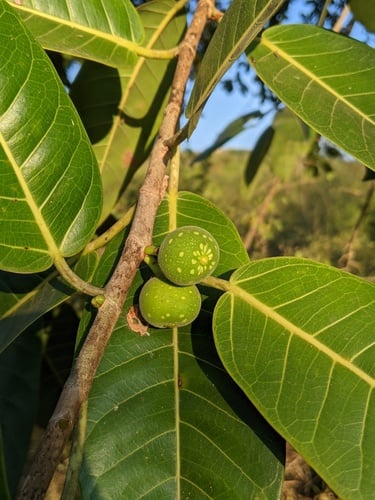
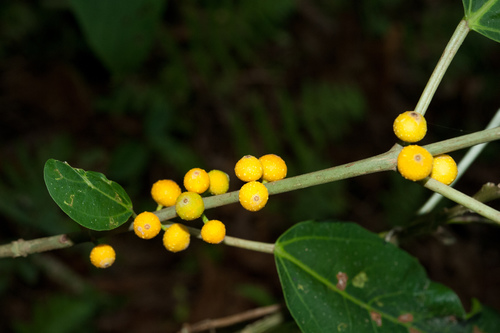
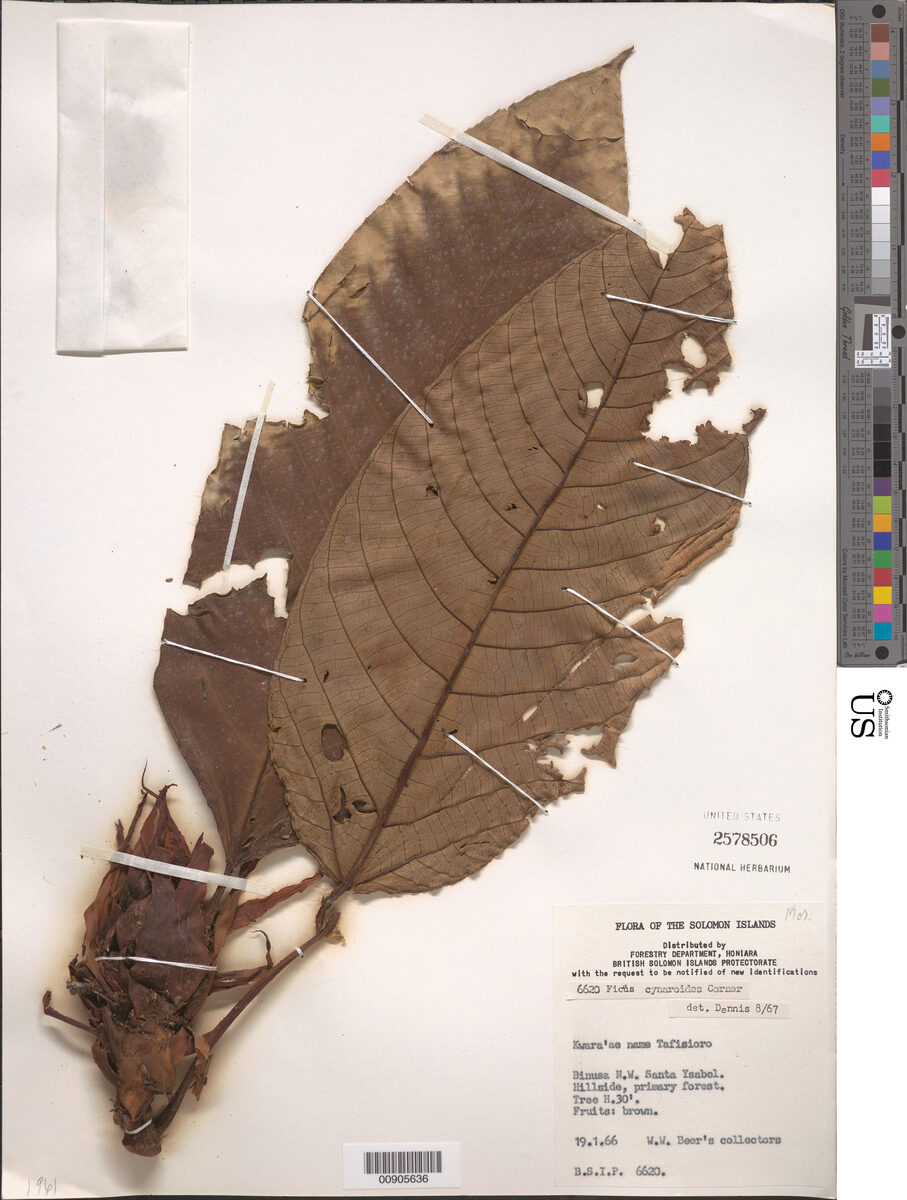
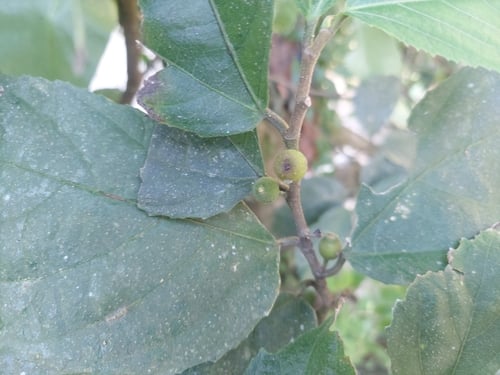
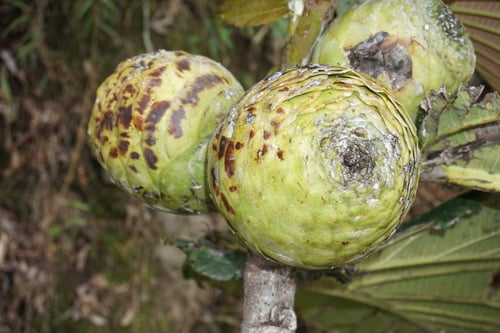
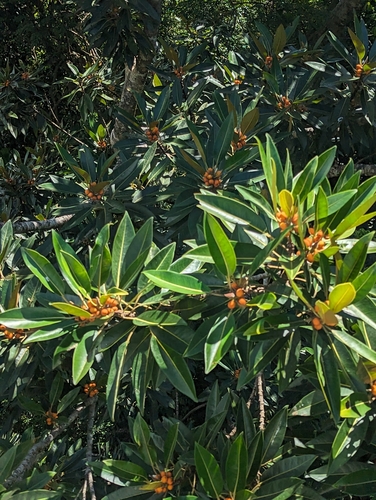
A fig. It is a medium sized strangler. It grows up to 10 m tall. It has a dense well formed crown. The bark is pale white to grey. The stem is ribbed and fluted. The leaves are oblong and 9-18 cm long by 4-8 cm wide. They are leathery and dark green. Underneath the veins form a net. Underneath is also velvety. The base of the leaf is square and slightly lobed. The leaf stalk is 2 cm long and thick. The figs are small and often less than 10 mm long but can be 2 cm long. They are oval and often in pairs. They are velvety green with a reddish tinge.
Edible Uses
Fruit - raw. The pulp is sweet when ripe but watery when unripe. Both ripe and unripe fruits are collected, especially by children, and eaten with the seeds as a snack. The pink-purple-red, rounded fruits are 15 - 22mm in diameter.
Traditional Uses
The pulp of the ripe fruit is eaten as a snack.
This uses section is brief — help expand it
Medicinal Uses
No medicinal uses mentioned in the data.
Distribution
A tropical plant. It grows in the lowlands and highlands. It grows at low altitudes and in mixed forests. It can grow in arid places. In Zimbabwe it grows up to 1,500 m above sea level. In Tanzania it grows in areas with a rainfall between 1,000-1,400 mm.
Where It Grows
Africa, Botswana, Central Africa, Congo DR, East Africa, Eswatini, Ethiopia, Kenya, Malawi, Mozambique, Namibia, Senegal, South Africa, Southern Africa, Swaziland, Tanzania, West Africa, Zambia, Zimbabwe,
Cultivation
Plants can be grown from seeds or by cuttings. The pollinator wasp is Alfonsiella binghami Wiebes.
Propagation
Seed - Cuttings.
Other Uses
A fibre is obtained from the bark.
Production
In Tanzania the fruit are collected in June-July.
Other Information
The fruit are only occasionally eaten by adults. They are especially eaten by children.
Notes
There are about 800-1000 Ficus species. They are mostly in the tropics. There are 120 Ficus species in tropical America.
Synonyms
Also Known As
Kigeni, Mgumo, Mkuyu, Mtamba, Mukunyu, Mulumba, Okilili, Posombino, Tiita
References (19)
- Bot. Jahrb. Syst. 20:161. 1894
- Fowler, D. G., 2007, Zambian Plants: Their Vernacular Names and Uses. Kew. p 49
- Fox, F. W. & Young, M. E. N., 1982, Food from the Veld. Delta Books. p 274
- http://www.fao.org/forestry/25323-096344a3de335832e8f363c3ac5184a66.pdf
- Jardin, C., 1970, List of Foods Used In Africa, FAO Nutrition Information Document Series No 2.p 138 and p 137 (As Ficus homblei)
Show all 19 references Hide references
- Long, C., 2005, Swaziland's Flora - siSwati names and Uses http://www.sntc.org.sz/flora/
- Malaisse, F., 1997, Se nourrir en floret claire africaine. Approche ecologique et nutritionnelle. CTA., p 63
- Ogle & Grivetti, 1985,
- Palgrave, K.C., 1996, Trees of Southern Africa. Struik Publishers. p 115
- Peters, C. R., O'Brien, E. M., and Drummond, R.B., 1992, Edible Wild plants of Sub-saharan Africa. Kew. p 151
- Royal Botanic Gardens, Kew (1999). Survey of Economic Plants for Arid and Semi-Arid Lands (SEPASAL) database. Published on the Internet; http://www.rbgkew.org.uk/ceb/sepasal/internet [Accessed 4th May 2011]
- Ruffo, C. K., Birnie, A. & Tengnas, B., 2002, Edible Wild Plants of Tanzania. RELMA p 324
- Ruiters-Welcome, A. K., 2019, Food plants of southern Africa. Ph.D. thesis. Univ. of Johannesburg p 79
- Schmidt, E., Lotter, M., & McCleland, W., 2007, Trees and shrubs of Mpumalanga and Kruger National Park. Jacana Media p 82
- Swaziland's Flora Database http://www.sntc.org.sz/flora
- Tredgold, M.H., 1986, Food Plants of Zimbabwe. Mambo Press. p 101
- Welcome, A. K. & Van Wyk, B.-E., 2019, An inventory and analysis of the food plants of southern Africa. South African Journal of Botany 122 (2019) 136–179
- World Checklist of Useful Plant Species 2020. Royal Botanic Gardens, Kew
- www.figweb.org