Ficus pleurocarpa
F. Muell.
Banana Fig, Ribbed fig
iNaturalist· cc-by
(c) Wairambar Rainforest, some rights reserved (CC BY), uploaded by Wairambar Rainforest
iNaturalist· cc-by-sa
(c) Steve Fitzgerald, some rights reserved (CC BY-SA)
Summary
Source: WikipediaFicus pleurocarpa, commonly known as the banana fig, karpe fig or gabi fig, is a fig that is endemic to the wet tropical rainforests of northeastern Queensland, Australia. It has characteristic ribbed orange and red cylindrical syconia. It begins life as a hemiepiphyte, later becoming a tree up to 25 m (82 ft) tall. F. pleurocarpa is one of the few figs known to be pollinated by more than one species of fig wasp.
Description
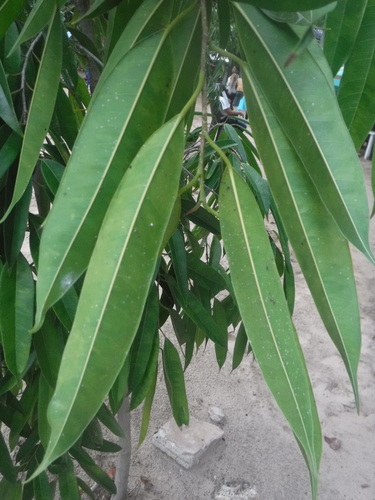
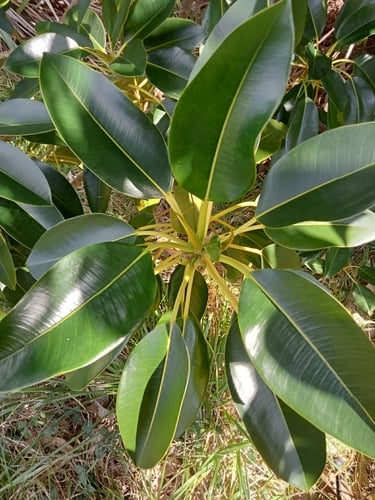
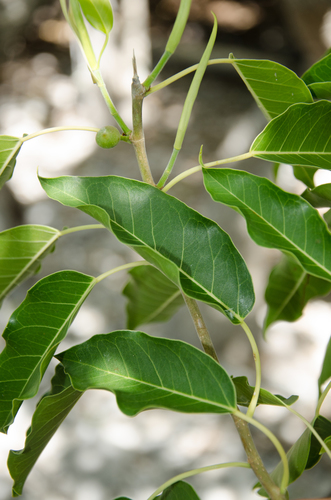
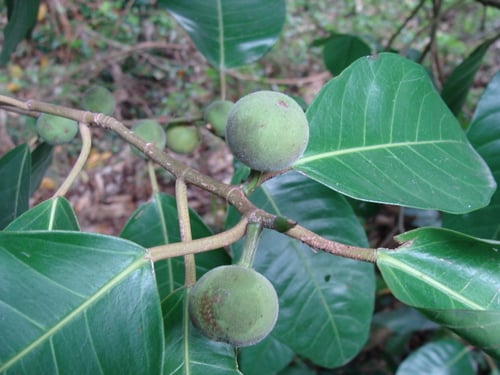
A fig. It is a tree which grows up to 15-35 m high but it can also be a strangler. It spreads 15-30 m across. The leaves are simple and 15-28 cm long by 8-10 cm wide. The younger leaves are softly hairy along the midrib on the underside. The mature leaves are smooth. The fruit are 35-65 mm long by 13-25 mm wide. They occur in clusters in the axils of leaves. They are orange-yellow and ribbed. The fruit are edible.
Edible Uses
The figs are edible fresh or dried and are described as "tasty at the fully ripe red stage".
Distribution
A tropical plant. They grow in tropical and subtropical places. The grow in rainforest in NE Queensland, Australia. It grows from sea level to 1000 m altitude. It grows on humid volcanic soils. It suits hardiness zones 11-12.
Where It Grows
Australia*,
Cultivation
Plants can be grown from seed or aerial layers.
Notes
There are about 800-1000 Ficus species. They are mostly in the tropics. There are 120 Ficus species in tropical America.
Synonyms
Also Known As
Gabi fig, Karpe fig
References (12)
- Barwick, M., 2004, Tropical and Subtropical Trees. A Worldwide Encyclopedic Guide. Thames and Hudson p 186
- Beasley, J., 2011, Plants of Tropical North Queensland - the compact guide. Footloose publications. p 97
- Cooper, W. & Cooper, W. T., 1994, Fruits of the Rain Forest. RD Press p 134
- Cooper, W. and Cooper, W., 2004, Fruits of the Australian Tropical Rainforest. Nokomis Editions, Victoria, Australia. p 326
- Cundall, P., (ed.), 2004, Gardening Australia: flora: the gardener's bible. ABC Books. p 603
Show all 12 references Hide references
- Elliot, W.R., & Jones, D.L., 1992, Encyclopedia of Australian Plants suitable for cultivation. Vol 4. Lothian. p 289
- Etherington, K., & Imwold, D., (Eds), 2001, Botanica's Trees & Shrubs. The illustrated A-Z of over 8500 trees and shrubs. Random House, Australia. p 328
- Flora of Australia, Volume 3, Hamamelidales to Casuarinales, Australian Government Publishing Service, Canberra (1989) p 47, 48
- Jackes, B.R., 2001, Plants of the Tropics. Rainforest to Heath. An Identification Guide. James Cook University. p 66
- Jones, D. L., 1986, Ornamental Rainforest Plants in Australia, Reed Books, p 219
- Nicholson, N & H., 1994, Australian Rainforest Plants 4, Terania Rainforest Publishing. NSW. p 34
- Townsend, K., 1994, Across the Top. Gardening with Australian Plants in the tropics. Society for Growing Australian Plants, Townsville Branch Inc. p 214