Alaria esculenta
(L.) Greville
Dabberlocks, Wing kelp, Atlantic wakame
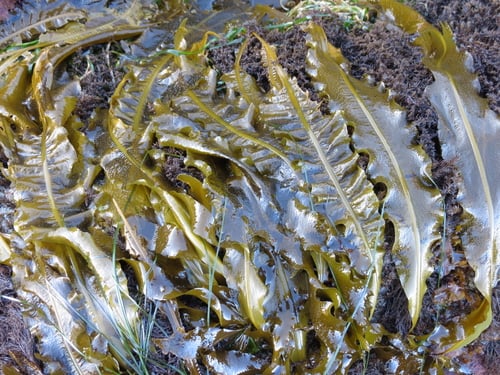
iNaturalist· cc-by-sa
(c) Thor-Rune Hansen, some rights reserved (CC BY-SA), uploaded by Thor-Rune Hansen
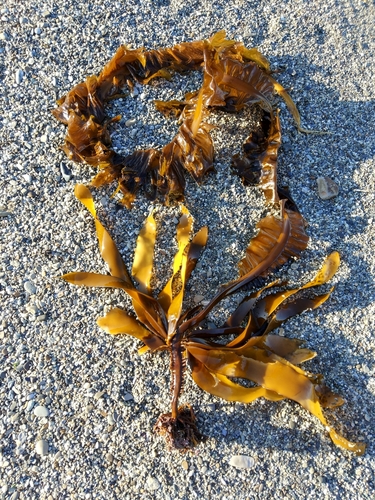
iNaturalist· cc-by-nc
(c) krkzv, some rights reserved (CC BY-NC), uploaded by krkzv
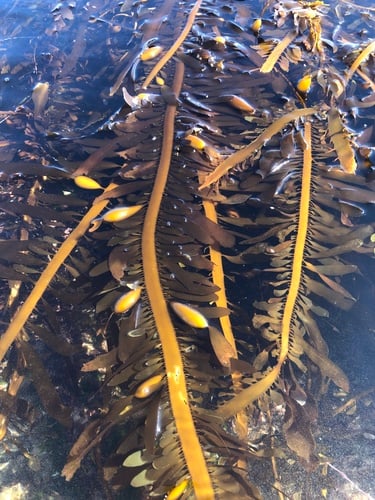
iNaturalist· cc-by-nc
(c) libby_orcutt, some rights reserved (CC BY-NC), uploaded by libby_orcutt
Summary
Source: WikipediaAlaria esculenta is an edible seaweed, also known as dabberlocks or badderlocks, or winged kelp, and occasionally as Atlantic Wakame. It is a traditional food along the coasts of the far north Atlantic Ocean. It may be eaten fresh or cooked in Greenland, Iceland, Scotland and Ireland. It is the only one of twelve species of Alaria to occur in both Ireland and in Great Britain.
Description
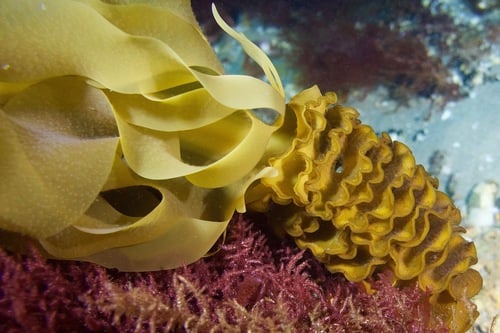
A seaweed. It is olive of yellow-brown. The fronds are long and ribbed. They can be 4 m long and 25 cm wide. They are attached to the rocks by a holdfast at the base. This has a flexible stipe and one or more fronds attached to it. The reproductive structures are on leaflets (sporophylls) near the base.
Edible Uses
The sweet and crunchy midrib is added to soups, stews, sandwiches and salads. The nutty sporophylls are eaten raw. The fronds require soaking in water for one or two days to remove the acrid taste, then can be cooked, dried or smoked. The plant can also yield a gel for gelatin making.
Traditional Uses
The midrib is sweet and crunchy. It is added to soups, stews, sandwiches and salads. The sporophylls are nutty. They are eaten raw. The fronds need processing before eaten to remove the acrid taste. They are soaked in water for one or two days before cooking. They are dried and smoked. It can yield a gel for gelatin making.
Distribution
It grows in temperate waters. It grows on rocks in low tide places in the north Atlantic and can occur in rock pools.
Where It Grows
Alaska, Arctic, Britain, Canada, Denmark, Europe, Faroe Islands, France, Greenland, Iceland, Ireland, Japan, Korea, Netherlands, North America, Norway, Russia, Scandinavia, Scotland, Siberia, USA,
Nutrition
| Part | Moisture | kJ | kcal | Protein | Vit A | Vit C | Iron | Zinc |
|---|---|---|---|---|---|---|---|---|
| Seaweed | — | — | 9.1 | — | — | — | — | — |
Synonyms
Also Known As
American wakame, Atlantic wakame, Badderlock, Butare, Bu-tarre, Edible fucus, Henware, Honeyware, Keys murlins, Lady's tresses, Murlins, Ribini
References (20)
- Beckstrom-Sternberg, Stephen M., and James A. Duke. "The Foodplant Database." http://probe.nalusda.gov:8300/cgi-bin/browse/foodplantdb.(ACEDB version 4.0 - data version July 1994)
- Cherry, P., et al, 2019, Risks and benefits of consuming edible seaweeds. Nutrition ReviewsVR Vol. 77(5):307–329
- Eidlitz, M., 1969, Food and Emergency food in the circumpolar area. Uppsala, Sweden.
- Facciola, S., 1998, Cornucopia 2: a Source Book of Edible Plants. Kampong Publications, p 257
- Girard, N. J., 2020, Sustainable Foraging of Wild Edible Plants in Norway. A Bioculutral Approach. M. Sc. thesis Norwegian University. p 127
Show all 20 references Hide references
- Hedrick, U.P., 1919, (Ed.), Sturtevant's edible plants of the world. p 369 (As Laminaria esculenta)
- http://www.seavegetables.com
- Irving, M., 2009, The Forager Handbook, A Guide to the Edible Plants of Britain. Ebury Press p 366
- Johnston, H.W., 1970, The biological and economic importance of algae. Part 3 Edible algae of fresh and brackish water. Tuatara 18:17-35
- Kiple, K.F. & Ornelas, K.C., (eds), 2000, The Cambridge World History of Food. CUP p 235
- Kuhnlein, H. V. and Turner, N. J., 1991, Traditional Plant Foods of Canadian Indigenous Peoples. Food and Nutrition in History and Anthropology Volume 8. Gordon and Breach. p 18
- Mabey, R., 1973, Food for Free. A Guide to the edible wild plants of Britain, Collins. p 119
- Pereira, L., 2011, A Review of the Nutrient Composition of Selected Edible Seaweeds. In Seaweed. Pomin V. H., (Ed.) Nova Science Publishers, Inc
- Porsild, A.E., 1953, Edible plants of the Arctic. Arctic 6:15-34.
- Surey-Gent, S. & Morris G., 1987, Seaweed. A User's Guide. Whirret Books. London. p 30, 124.
- Svanberg, I., et al, 2012, Edible wild plant use in the Faroe Islands and Iceland. Acta Societatis Botanicorum Poloniae 81(4): 233-238
- Tozer, F., 2007, The Uses of Wild Plants. Green Man Publishing. p 22
- Wikipedia
- Yanovsky, E., 1936, Food Plants of the North American Indians. United States Department of Agriculture Miscellaneous Publication No 237. Washington, D.C. p 2
- Zemke-White, W. L. & Ohno, M., 1999, World seaweed utilisation: An end-of-century summary. Journal of Applied Phycology 11: 369-376