Undaria pinnatifida
(Harvey) Suringar
Wakame, Japanese kelp, Apron-ribbon vegetable
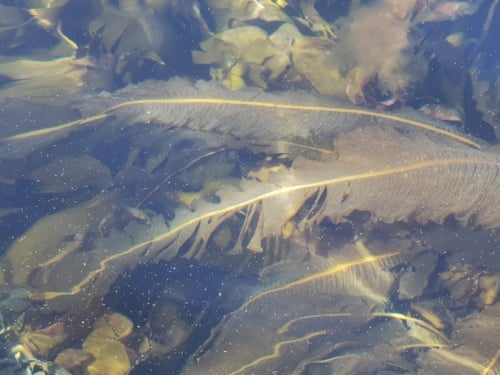
iNaturalist· cc-by-nc
(c) janebowman, some rights reserved (CC BY-NC)
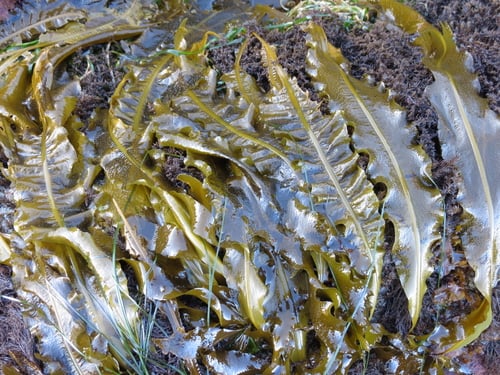
iNaturalist· cc-by-nc-nd
(c) Brenna Green, some rights reserved (CC BY-NC-ND), uploaded by Brenna Green
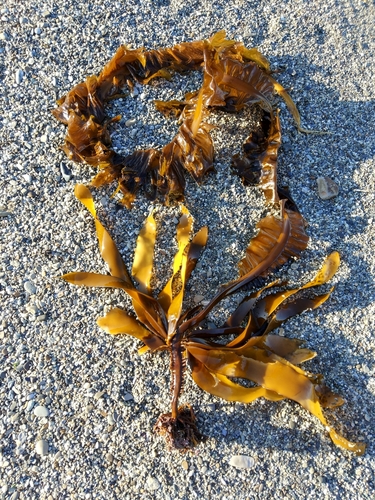
iNaturalist· cc-by-nc
(c) Angelina Young, some rights reserved (CC BY-NC), uploaded by Angelina Young
Description
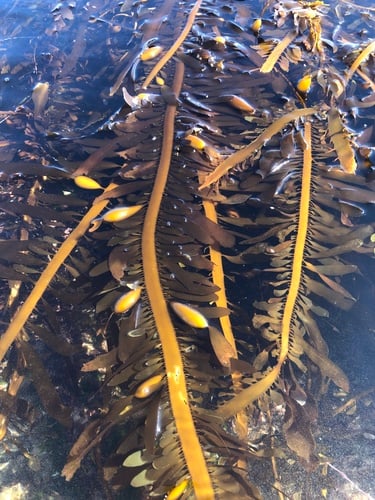
A brown seaweed. It is 1-1.5 m long and 50-100 cm wide. It is sword shaped with lobes along the side.
This description is brief — help expand it
Edible Uses
Wakame fronds are green and have a subtly sweet flavour and satiny texture. The leaves should be cut into small pieces as they will expand during cooking. In Japan and Europe, wakame is distributed either dried or salted, and used in soups (particularly miso soup), and salads (tofu salad), or often simply as a side dish to tofu and a salad vegetable like cucumber. These dishes are typically dressed with soya sauce and vinegar, possibly rice vinegar. Goma wakame, also known as seaweed salad, is a popular side dish at American and European sushi restaurants. Literally, it means "sesame seaweed", as sesame seeds are usually included in the recipe. In Korea, wakame is used to make a seaweed soup called miyeok-guk, in which wakame is stir-fried in sesame oil and boiled with meat broth.
Traditional Uses
The blades can be eaten fresh or dried. They are often used in miso soups. They are also eaten in salads, tofu preparations or cooked with rice vinegar. It is cooked with bamboo shoots to soften their tough fibres. It is also dried and ground to a powder and added to soups and cereal dishes. The midribs are salted or preserved in vinegar. The sporophylls are added to root vegetable stews.
Distribution
It is a temperate plant. It grows rapidly and can crowd out native seaweeds.
Where It Grows
Adriatic, Argentina, Asia, Australia, Britain, China, Europe, France, Italy, Japan, Korea, Mediterranean, Mexico, Netherlands, New Zealand, North America, Portugal, Russia, South America, Spain, Tasmania, USA,
Production
It grows very rapidly.
Other Information
It is very popular. It is cultivated in warm waters. It is sold fresh or dried. It is an important food in Japan, Korea and China.
Nutrition
| Part | Moisture | kJ | kcal | Protein | Vit A | Vit C | Iron | Zinc |
|---|---|---|---|---|---|---|---|---|
| Seaweed - raw | 80 | 188 | 45 | 3 | 36 | 3 | 2.2 | 0.4 |
| Seaweed dried | 16 | — | 227 | 10.2 | — | — | 13 | — |
Also Known As
Mekabu, Miyeouk, Miyok, Precious sea grass, Qun dai cai, Sea mustard
References (22)
- Breidahl H., 1997, Australian Southern Shores. Lothian. p 126
- Cherry, P., et al, 2019, Risks and benefits of consuming edible seaweeds. Nutrition ReviewsVR Vol. 77(5):307–329
- Dawczynski, C et al, 2007, Amino acids, fatty acids, and dietary fibre in edible seaweed products. Food Chemistry 103: 891-899
- Facciola, S., 1998, Cornucopia 2: a Source Book of Edible Plants. Kampong Publications, p 257
- Food Composition Tables for use in East Asia FAO http://www.fao.org/infoods/directory No. 725
Show all 22 references Hide references
- Fujiwara-Arasaki, T. et al, 1984, The protein value in human nutrition of edible marine algae in Japan. Hydrobiologia 116/117, 513-516
- http://www.seavegetables.com
- Hu, Shiu-ying, 2005, Food Plants of China. The Chinese University Press. p 260
- Kiple, K.F. & Ornelas, K.C., (eds), 2000, The Cambridge World History of Food. CUP p 236
- Lee, B., 2008, Seaweed Potential as a marine vegetable. RIRDC Publication No. 08/009
- Pereira, L., 2011, A Review of the Nutrient Composition of Selected Edible Seaweeds. In Seaweed. Pomin V. H., (Ed.) Nova Science Publishers, Inc
- Pillay, T. V. R. & Kutty, M. N., 2005, Aquaculture Principles and Practices. 2nd edition. Blackwell. p.
- Ruperez, P. et al, 2001, Dietary fibre and physicochemical properties of edible Spanish seaweeds. Eur. Food Res. Technol. 212: 349-354
- Sanchez-Machado, et al, 2003, High-Performance Liquid Chromatographic Analysis of Amino Acids in Edible Seaweeds after Derivatization with Phenyl Isothiocyanate. Chromatographia 58: 159-163
- Simoons, F.J., 1991, Food in China. Boca Raton, Fla
- Solomon, C., 2001, Encyclopedia of Asian Food. New Holland. p 335
- Song, M., et al, 2013, Traditional knowledge of wild edible plants in Jeju Island, Korea. Indian Journal of Traditional Knowledge. 12(2) pp 177-194
- Teas, J. et al, 2004, Variability of Iodine Content in Common Commercially Available Edible Seaweeds. Thyroid. Vol. 14, No. 10 Subba Rao, G.N., 1965, Uses of seaweed directly as human food. Indo-Pacific Fisheries Council Regional Studies 2:1-32
- Surey-Gent, S. & Morris G., 1987, Seaweed. A User's Guide. Whirret Books. London. p 140
- Van Ginneken, V. JT., et al, 2011, Polyunsaturated fatty acids in various macroalgal species from north Atlantic and tropical seas. Lipids in Health and Disease 10:104
- Xia, B., and Abbott, I.A., 1987, Edible seaweeds of China and their place in the Chinese diet. Economic Botany 41:341-53
- Zemke-White, W. L. & Ohno, M., 1999, World seaweed utilisation: An end-of-century summary. Journal of Applied Phycology 11: 369-376