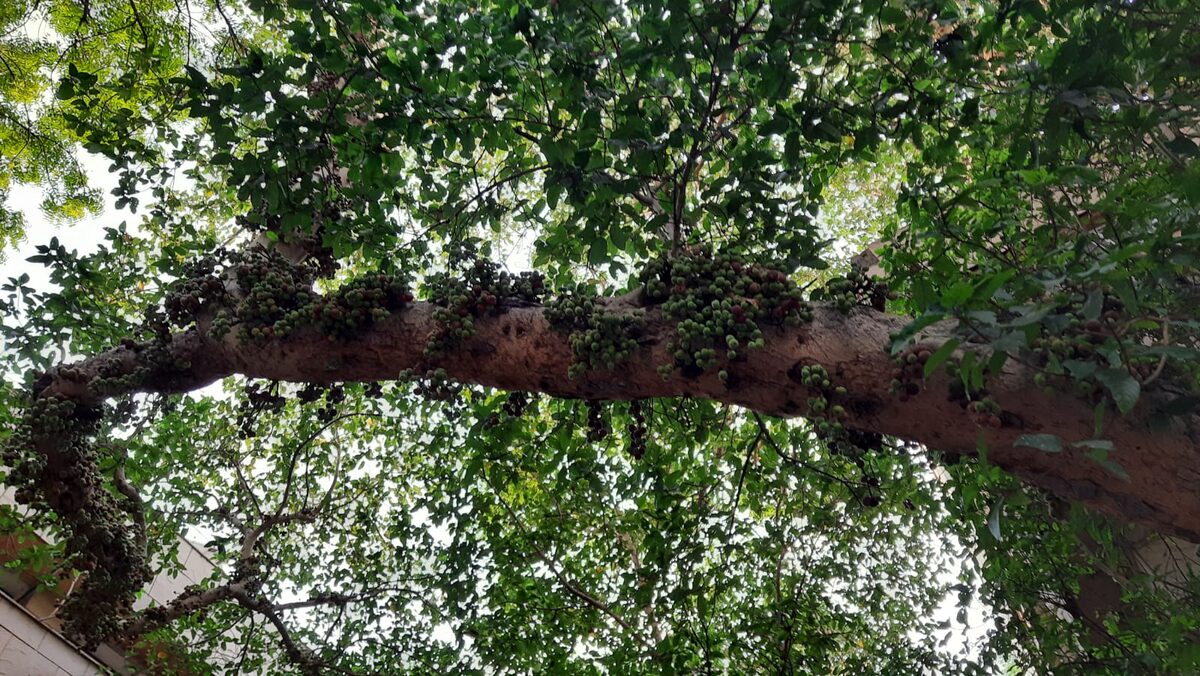
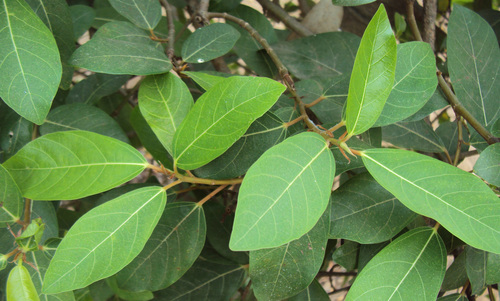
Ficus palmata
Forssk.
Punjab fig
iNaturalist· cc-by
(c) Siddarth Machado, some rights reserved (CC BY), uploaded by Siddarth Machado
iNaturalist· cc-by-nc
(c) arham_farooq, some rights reserved (CC BY-NC)
Summary
Source: WikipediaFicus palmata, the Punjab fig, or "Bedu" is a plant in the family Moraceae. It is native to southern Egypt across to north-eastern tropical Africa and also the Arabian Peninsula. It is a shrub/tree with edible fruit.
Description
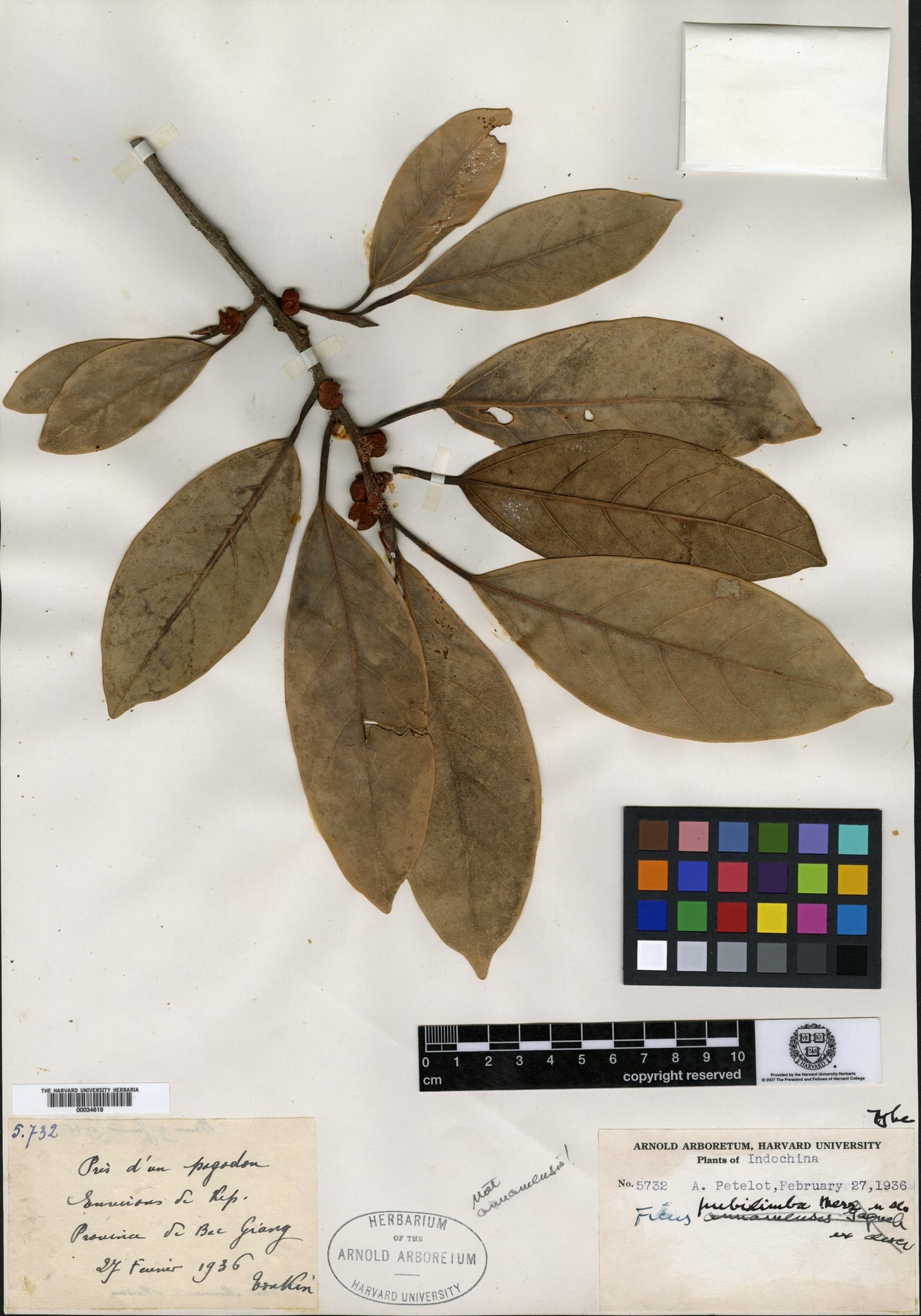
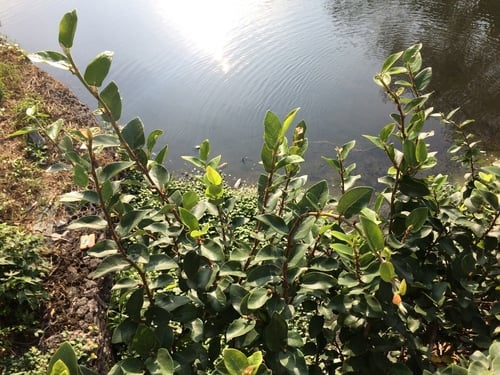
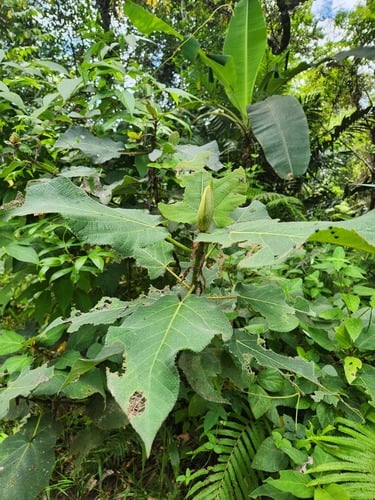
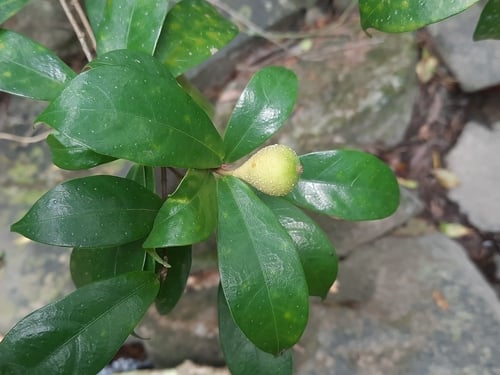
This is the eastern form of the cultivated fig, Ficus carica. It is a shrub. It loses its leaves during the year. It grows to about 4-8 m high. The twigs are furry. The bark is smooth and ashy or brown. The leaves are round and sometimes deeply lobed. There are teeth along the edge. The leaves have stalks. The leaves are 2.5-15 cm long by 3-13.5 cm wide. The figs occur singly and have stalks. They are downy. The figs are yellow-purple when ripe. They are 1-2.5 cm across.
Edible Uses
The fruit is eaten raw — sweet, succulent, and very tasty. It is about 2.5cm in diameter, and wild trees yield around 25kg annually. The fruit contains approximately 6% sugars, 1.7% protein, 0.9% ash, and 0.2% pectin, and is low in vitamin C at about 3.3mg per 100g. It is often dried for later use. Unripe fruits and young growth are cooked as a vegetable: boiled, squeezed to remove water, then fried. Some caution is advised regarding toxicity.
Traditional Uses
The ripe fig fruit are eaten raw. They are used in drinks, jam and jelly and are also dried. The young shoots are cooked and eaten. They are boiled, fried and used as a green vegetable. The leaves are boiled for 2 hours to soften completely then eaten. The latex is used to curdle milk.
Medicinal Uses
The fruit is demulcent, emollient, laxative, and used as a poultice. It is eaten as part of the diet to treat constipation and diseases of the lungs and bladder. The sap is applied to warts, and the plant's latex is used to extract spines lodged deeply in the flesh.
Known Hazards
The sap and the half-ripe fruits are said to be poisonous.
Distribution
A subtropical plant. It grows in open places near watercourses. In Nepal it grows from 600-2700 m altitude. It is often on rocky slopes and in drier areas. It can grow in arid places.
Where It Grows
Africa, Afghanistan, Arabia, Asia, East Africa, Egypt, Ethiopia, Himalayas, India, Iran, Israel, Mediterranean, Middle East, Myanmar, Nepal, North Africa, Northeastern India, NW India, Pakistan, Saudi Arabia, SE Asia, Sikkim, Sinai, Somalia, Sri Lanka, Sudan, Yemen,
Cultivation
Requires a well-drained medium to light loam and some lime rubble incorporated into the soil. A heavy wet soil tends to encourage excessive plant growth at the expense of fruit. Not very hardy in Britain it is best on a south or south-west facing wall in order to provide winter protection and more heat in the summer for ripening the fruit. It would probably succeed in a sheltered position in the open in the milder areas of Britain. The young growth in spring, even on mature plants, is frost-tender and so it is best to grow the plants in a position sheltered from the early morning sun. This species is closely related to the common fig, Ficus carica, and is not perhaps specifically distinct. It has been recommended for growing in areas where the climate is too wet for common figs since it fruits during the monsoon season in the Himalayas. However, it probably requires the fig-wasp in order to pollinate the flowers and so is unlikely to fruit in areas such as Britain that are too cold for the fig-wasp to survive. The fruits are often sold in local markets in the Himalayas. There is a potential for commercial cultivation.
Propagation
Sow seed in spring in a warm greenhouse. Prick out seedlings once large enough to handle and overwinter young plants under glass for at least their first year. Plant out in late spring after the last expected frosts and provide some protection during their first winter outdoors. Cuttings of mature wood, 10–12cm with a heel, can be taken in winter and rooted in a frame; they must be kept frost-free and are best placed in individual pots. Layering is also suitable.
Other Uses
The pliable wood is of little commercial value but has been used for making hoops, garlands, and ornaments.
Production
In India fruit are available from February to July.
Other Information
The leaves are sold in markets. The fruit are eaten raw, especially by children. They are a tasty fruit,
Notes
There are about 800-1000 Ficus species. They are mostly in the tropics. There are 120 Ficus species in tropical America.
Nutrition
| Part | Moisture | kJ | kcal | Protein | Vit A | Vit C | Iron | Zinc |
|---|---|---|---|---|---|---|---|---|
| Fruit | 83.5 | 286 | 68 | 2.9 | — | — | — | — |
Synonyms
Also Known As
Abjiri, Anjeeri, Anjiri, Areen, Balas, Bedu, Bedulo, Beles, Belese, Beru, Camera, Dagla, Fagu, Fagwara, Feru, Guma, Hamat, Hamat wahashi, Heiban, Ingar, Inzat, Inzar, Inzeer, Inzer, Kaimbar, Kala-thapan, Kamari, Kappa, Khasri, Khemri, Kock, Kok, Manmjedi, Nibhro, Pagoye, Pepri Kak, Phag, Phagoru, Phagwara, Phah, Phedu, Phegra, Pheru, Raggad, Sarmangol, Thapur, Togha, Warookay, Yekola-beles
References (66)
- Abbasi, A. M., et al, 2013, Ethnobotanical appraisal and cultural values of medicinally important wild edible vegetables of Lesser Himalayas-Pakistan. Journal of Ethnobiology and Ethnomedicine 9:66
- Abbasi, A. M., Khan, M & Zafar, M., 2013, Ethno-medicinal assessment of some selected wild edible fruits and vegetables of Lesser-Himalayas, Pakistan. Pak. J. Bot. 45 (SI):215-222
- Acharya K. P. and Acharya, R., 2010, Eating from the Wild: Indigenous knowledge on wild edible plants in Parroha VDC of Rupandehi District, Central Nepal. International Journal of Social Forestry. 3(1):28-48
- Addis, G., et al, 2005, Ethnobotanical Study of Edible Wild Plants in Some Selected Districts of Ethiopia. Human Ecology, Vol. 33, No. 1, pp. 83-118
- Agarwal, R. & Chandra, V., 2019, Diversity of wild edible plants in the Mandal-Chopta forest, Uttarakhand. Journal of Medicinal Plants Studies 2019; 7(1): 89-92
Show all 66 references Hide references
- Ahmad, K. & Pieroni, A., 2016, Folk knowledge of wild food plants among the tribal communities of Thakht-e-Sulaiman Hills, North-West Pakistan. Journal of Ethnobiology and Ethnomedicine, 12:17
- Al-Fatimi, M. A., Wild Edible Plants Traditionally Collected and Used in Southern Yemen. Research Square. University of Aden. p 19
- Ali, H., et al, 2011, Ethnobotanical profile of some plant resources in Malam Jabba valley of Swat, Pakistan. Journal of Medicinal Plants Research Vol. 5(18), pp 4676-4687
- Al-Sodany, Y. M., et al, 2013, Medicinal Plants in Saudi Arabia: I. Sarrwat Mountains at Taif, KSA. Academic Journal of Plant Sciences 6 (4): 134-145
- Altschul, S.V.R., 1973, Drugs and Foods from Little-known Plants. Notes in Harvard University Herbaria. Harvard Univ. Press. Massachusetts. no. 710
- Ambasta, S.P. (Ed.), 2000, The Useful Plants of India. CSIR India. p 223
- Amin, M., et al, 2023, Edible wild plant species used by different linguistic groups of Kohistan Upper Khyber Pakhtunkhwa (KP), Pakistan. Journal of Ethnobiology and Ethnomedicine 19:6 p 9
- Amjad, M. S., et al, 2015, Ethnobotanical inventory and folk uses of indigenous plants from Pir Nasoora National Park, Azad Jammu and Kashmir. Asian Pac J Trop Biomed 2015; 5(3): 234-241
- Asfaw, Z. and Tadesse, M., 2001, Prospects for Sustainable Use and Development of Wild Food Plants in Ethiopia. Economic Botany, Vol. 55, No. 1, pp. 47-62
- Ashagre, M., et al, 2016, Ethnobotanical study of wild edible plants in Burji District, Segan Area Zone of Southern Nations, Nationalities and Peoples Region (SNNPR), Ethiopia. Journal of Ethnobiology and Ethnomedicine (2016) 12:32
- Bailey, C. and Danin, A., 1981, Bedouin Plant Utilization in Sinai and the Negev. Economic Botany 35(2): 145-162 (As Ficus pseudosycomorus)
- Barkatullah, et al, 2009, Ethnobotanical studies of plants of Charkotli Hills, Batkhela District, Malakand, Pakistan. Front. Biol. China 2009, 4(4): 539–548
- Bhatia, H., et al, 2018, Traditionally used wild edible plants of district Udhampur, J&K, India. Journal of Ethnobiology and Ethnomedicine (2018) 14:73
- Devi, O.S., P. Komor & D. Das, 2010, A checklist of traditional edible bio-resources from Ima markets of Imphal Valley, Manipur, India. Journal of Threatened Taxa 2(11): 1291-1296
- Dobriyal, M. J. R. & Dobriyal, R., 2014, Non Wood Forest Produce an Option for Ethnic Food and Nutritional Security in India. Int. J. of Usuf. Mngt. 15(1):17-37
- Ethnobotanical Study of Tehsil Kabal, Swat District, KPK, Pakistan, Table 1
- Facciola, S., 1998, Cornucopia 2: a Source Book of Edible Plants. Kampong Publications, p 155
- FAO, 1988, Traditional Food Plants, FAO Food and Nutrition Paper 42. FAO Rome p 283
- Fl. aegypt.-arab. 179. 1775
- Flora of Pakistan. www.eFloras.org
- Food Composition Tables for the Near East. http://www/fao.org/docrep No. 471
- Gautam, R. S., et al, 2020, Wild Edible Fruits of Nepal. Int. J. Appl. Sci. Biotechnol. Vol 8(3): 289-304
- GUPTA,
- Haj, F., et al, 2012, Species Diversity and Ethno Botanical Classes of the Flora of Allai Valley District Battagram Pakistan. International Journal of Plant Research 2012, 2(4): 111-123
- Hedrick, U.P., 1919, (Ed.), Sturtevant's edible plants of the world. p 308 and p 307 (As Ficus forskalaei)
- Jardin, C., 1970, List of Foods Used In Africa, FAO Nutrition Information Document Series No 2.p 137 (As Ficus petitiana and Ficus pseudocarica)
- Kala, C. P., 2007, Prioritization of cultivated and wild edibles by local people in the Uttaranchal hills of Indian Himalaya. Indian Journal of Traditional Knowledge. 6(1) pp 239-244
- Khalid, N., et al, 2023, Wild food plants gathered by four cultural groups in North Waziristan, Pakistan. Genet Resour Crop Evol. 70:1243–1276
- Khan, M. & Hussain, S., 2014, Diversity of wild edible plants and flowering phenology of district Poonch (J & K) in the northwest Himalaya. Indian Journal of Sci, Res. 9(1): 032-038
- Krishen P., 2006, Trees of Delhi, A Field Guide. DK Books. p 95
- Kumar, P. D., et al, 2015, Ethnobotanical Knowledge and Usage of Wild Plants in Theog Forest Division, Himachal Pradesh, North Western Himalaya. The Journal of Ethnobiology and Traditional Medicine. Photon 124(2015) 922-935
- Kunwar, R.M. & Bussmann, R. W., 2006, Ficus (Fig) species in Nepal: a review of diversity and indigenous uses. Lyonia 11(1)
- London J. Bot. 7:225. 1848 (As Ficus pseudocarica)
- Lulekal, E., et al, 2011, Wild edible plants in Ethiopia: a review on their potential to combat food insecurity. Afrika Focus - Vol. 24, No 2. pp 71-121
- Lyle, S., 2006, Discovering fruit and nuts. Land Links. p 207
- Manandhar, N.P., 2002, Plants and People of Nepal. Timber Press. Portland, Oregon. p 234
- Manju, S., and Sundriyal, R. C., 2001, Wild Edible Plants of the Sikkim Himalaya: Nutritive Values of Selected Species. Economic Botany 55(3): 377-390
- Mehta, P. S. et al, 2010, Native plant genetic resources and traditional foods of Uttarakhand Himalaya for sustainable food security and livelihood. Indian Journal or Natural products and Resources. Vol 1(1), March 2010 pp 89-96
- Masoodi, H. U. R. & Sundriyal, R. C., 2020, Richness of non-timber forest products in Himalayan communities—diversity, distribution, use pattern and conservation status. Journal of Ethnobiology and Ethnomedicine 16:56
- Namrata, et al, 2011, Wild Edible Plants of Uttarakhand Himalaya: A Potential Nutraceutical Source. Research Journal of Medicinal Plant. (5) 6: 670-684
- Negi, P. S. & Subramani, S. P., 2015, Wild Edible Plant Genetic Resources for Sustainable Food Security and Livelihood of Kinnaur District, Himachal Pradesh, India, International Journal of Conservation Science. 6 (4): 657-668
- Pandey, K. C. & Pande, N., 2016, Ethnobotanical Documentation of Wild Edible Plants used by Gujjar Community of Tarai West Forest Division Ramnagar, Nainital, India, Current World Environment. Vol. 11(3), 808-818
- Parmar, C., & Kaushel, M. K., 1982, In Wild Fruits. Kalyani Publishers, New Delhi, India. p 31-34
- Plants for a Future database, The Field, Penpol, Lostwithiel, Cornwall, PL22 0NG, UK. http://www.scs.leeds.ac.uk/pfaf/
- Polunin, O., & Stainton, A., 2006, Flowers of the Himalaya, Oxford India Paperbacks. p 370
- Radha, B., et al, 2013, Wild Edible Plant Resources of the Lohba Range of Kedarnath Forest Division (KFD), Garhwal Himalaya, India. Int. Res J. Biological Sci. Vol. 2 (11), 65-73
- Rashid, A., Anand, V.K. & Serwar, J., 2008, Less Known Wild Plants Used by the Gujjar Tribe of District Rajouri, Jammu and Kashmir State. International Journal of Botany 4(2):219-244
- Royal Botanic Gardens, Kew (1999). Survey of Economic Plants for Arid and Semi-Arid Lands (SEPASAL) database. Published on the Internet; http://www.rbgkew.org.uk/ceb/sepasal/internet [Accessed 4th May 2011]
- Sadia, H., et al, 2014, Nutrient and mineral assessment of edible wild fig and mulberry fruits. Fruits, Vol. 69, p 159-166
- Sharma, P., et al, 2013, Wild edibles of Murari Devi and surrounding areas in Mandi district of Himachal Pradesh, India. International Journal of Biodiversity and Conservation. Vol. 5(9), pp. 580-592, September 2013
- Sher, H. et al, 2011, Ethnobotanical and Economic Observations of Some Plant Resources from the Northern Parts of Pakistan. Ethnobotany research & Applications 9:027-041
- Sher, Z., Hussain, F., & Ibrar, M., 2014, Traditional knowledge on plant resources of Ashezai and Salarzai Valleys, District Buner, Pakistan. African Journal of Plant Science. Vol. 8(1), pp. 42-53, January 2014
- Sina, B. & Degu, H. D., 2015, Knowledge and use of Wild Edible Plants in the Hula District of the Sidama Zone. International Journal of Bio-resource and Stress Management 6(3):352-365
- Singh, H.B., Arora R.K.,1978, Wild edible Plants of India. Indian Council of Agricultural Research, New Delhi. p 60
- Singh, V. and Singh, P., 1981, Edible Wild Plants of Eastern Rajasthan. J. Econ. Tax. Bot. Vol 2 pp 197-207
- Singh, V. B., et al, (Ed.) Horticulture for Sustainable Income and Environmental Protection. Vol. 1 p 216
- Tomar, A., Kumar, A., & Dubey, K., 2002, Underutilized Wild Edible fruits of Nutritional and Medicinal Value. J. Res. Educ. Indian Med., Vol XX1
- Upreti, K., et al, 2010, Diversity and Distribution of Wild Edible Fruit Plants of Uttarakhand. Bioversity Potentials of the Himalaya. p 171
- Wiersema, J. H. & Leon, B., 2013, World Economic Plants. A Standard Reference CRC Press. 2nd Ed. p 305
- World Checklist of Useful Plant Species 2020. Royal Botanic Gardens, Kew
- www.figweb.org