Ficus insipida
Willd.
Caxinguba, Amate
iNaturalist· cc-by-nc-sa
(c) Reinaldo Aguilar, some rights reserved (CC BY-NC-SA)
iNaturalist· cc-by-nc-sa
(c) Reinaldo Aguilar, some rights reserved (CC BY-NC-SA)
iNaturalist· cc-by-nc-sa
(c) Reinaldo Aguilar, some rights reserved (CC BY-NC-SA)
Summary
Source: WikipediaFicus insipida is a common tropical tree in the fig genus of the family Moraceae growing in forest habitats along rivers. It ranges from Mexico to northern South America.
Description
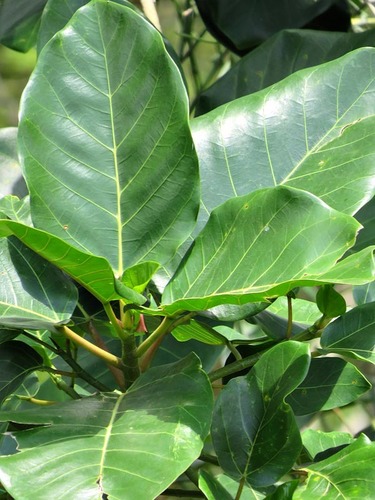
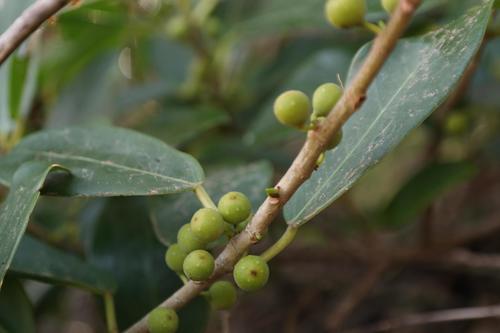
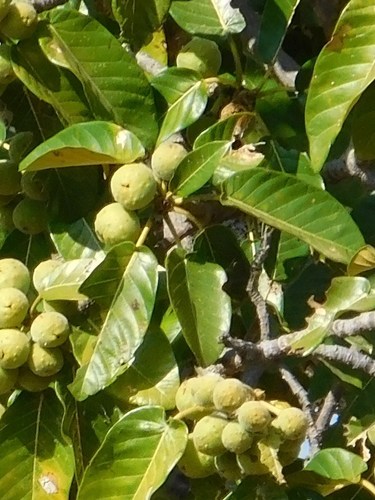
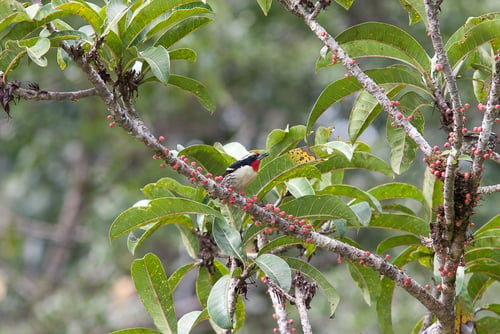
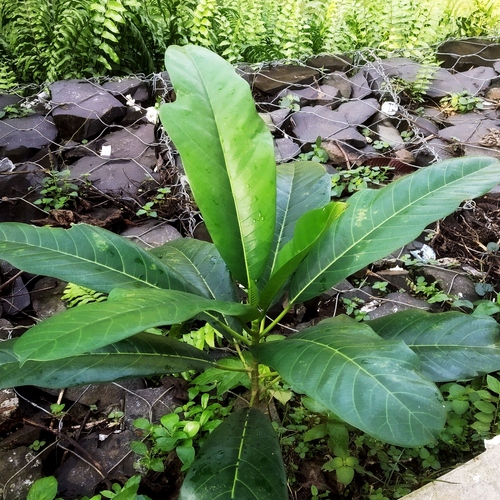
A fig. It is a large tree. It has buttresses. the bark is smooth and grey brown. The leaves are bright shiny green with yellow veins. The fallen leaves turn bright yellow. There is a circular scar at the base of each leaf. Broken leaves drip white latex. The flowers and fruit are inside the fig balls. The flowers are pollinated by wasps.
Edible Uses
The fruit are eaten, though they are not particularly popular. The latex is used commercially as a meat tenderiser, in edible collagen films, sausage casings, beer chillproofing, and for curdling milk in cheese production.
Traditional Uses
The latex is used commercially as a meat tenderiser, and in edible collagen films, sausage casings and in chillproofing beer. It is also used in curdling milk for cheese. The fruit are eaten.
Medicinal Uses
The latex that flows from the trunk and branches is considered to be antiinflammatory, porgative, tonic and vermifuge It has a range of medicinal applications, being mixed with water and taken internally.. It is an effective anthelmintic, though it can be drastic, even corrosive, and is recommended in the treatment of ancylostomiasis (hookworm infection of the small intestine, which often leads to anaemia) and jaundice. It is also said to be aphrodisiac, a remedy for anaemia and to aid the memory. The leaves contain psoralen and several triterpenes.
Known Hazards
The latex is sold in South America as an anthelmintic, marketed as 'doctor oje' (ojé in Brazil). An analysis of overdoses in one area of Peru found only 3 cases that were apparently fatal and 39 cases requiring hospitalization over a 12 year period, which, based on an analysis of probable sales in the region, amounted to very low 0.01–0.015% fatality and 0.13–0.2% hospitalization rates. The authors concluded the product was safe when dosed properly. No serious adverse effects were observed in any of several clinical trials on the product conducted in Peru, except for possibly one miscarriage in one 18-year-old woman (who did not disclose her pregnancy to those running the clinical trial) receiving a very low dose of ojé. The latex can be purified, leaving a complex of enzymes known as ficin, a white powder that was first produced in 1930. This product is likely safe. It was initially observed that intestinal nematodes dissolved in a ficin solution, which increased interest in the product at the time as an anthelmintic, although it was not widely adopted. Ficin is a mix of different enzymes and can be produced from many different species of Ficus. The main proteolytic enzyme found in ficin produced from F. insipida has officially been named ficain. Purified ficin has numerous medical and industrial uses. It is used for cleaning in the production of stitching material for sutures, to prepare animal arteries before transplantation into humans, and for unmasking antigens in serology. It is similarly used for cleaning the animal intestines used as sausage or cheese-casings. It is used as an additive to make freeze-resistant beer, and has been added to certain formulations of meat tenderizers along with related protease-type enzymes. According to Schultes and Raffauf in their 1990 book The Healing Forest, the fruit of Ficus anthelmintica (an antiquated synonym of F. insipida) has been used by an unknown people somewhere in the northern Amazon of Brazil as an aphrodisiac and for what they categorise as a 'memory enhancer'.
Distribution
It is a tropical plant. It grows in open areas.
Where It Grows
Belize, Bolivia, Brazil, Central America, Colombia, Costa Rica, Dominican Republic, Ecuador, French Guiana, Guatemala, Guianas, Guyana, Mexico*, Nicaragua, North America, Panama, Peru, South America, Suriname, Venezuela, West Indies,
Cultivation
Prefers a sunny position. A fairly fast-growing plant. Fig trees have a unique form of fertilization, each species relying on a single, highly specialized species of wasp that is itself totaly dependant upon that fig species in order to breed. The trees produce three types of flower; male, a long-styled female and a short-styled female flower, often called the gall flower. All three types of flower are contained within the structure we usually think of as the fruit. The female fig wasp enters a fig and lays its eggs on the short styled female flowers while pollinating the long styled female flowers. Wingless male fig wasps emerge first, inseminate the emerging females and then bore exit tunnels out of the fig for the winged females. Females emerge, collect pollen from the male flowers and fly off in search of figs whose female flowers are receptive. In order to support a population of its pollinator, individuals of a Ficus spp. must flower asynchronously. A population must exceed a critical minimum size to ensure that at any time of the year at least some plants have overlap of emmission and reception of fig wasps. Without this temporal overlap the short-lived pollinator wasps will go locally extinct.
Propagation
Seed - best sown as soon as it is ripe in a shaded position in a nursery seedbed. A low germination rate can be expected, with the seed sprouting within 20 - 60 days. When the seedlings are 3 - 4cm tall, transplant them to individual containers. They are ready to plant out 8 - 9 months later.
Other Uses
A copious white, bitter-tasting latex flows from the trunk and branches when they are cut. It has medicinal uses. The young, hard fruits are used for making designs on hats and probably other articles. If a cross section of the fruit is pressed against the surface, a blackish circular figure of more or less permanence is left upon it. The heartwood is light brown, with dark gum striping and extensive pale or dark gray areas caused probably by stain; the sapwood is a creamy yellow or almost white. The texture is medium tos coarse; the grain straight to interlocked; lustre is medium; there is no distinctive odour or taste. The wood is light in weight to moderately heavy; soft; of low natural durability. It seasons quickly, with risks of twisting. It is easy to work, though it saws woolly; planing, moulding and turning are good to excellent; it takes a moderately smooth finish. It is used for doors and panels, light boxes, mouldings, furniture etc.
Other Information
The fruit are eaten but are not popular.
Notes
There are about 800-1000 Ficus species. They are mostly in the tropics. There are 120 Ficus species in tropical America.
Nutrition
| Part | Moisture | kJ | kcal | Protein | Vit A | Vit C | Iron | Zinc |
|---|---|---|---|---|---|---|---|---|
| Fruit | 0 | — | — | 7 | — | — | — | — |
Synonyms
References (10)
- Condit, R., et al, 2011, Trees of Panama and Costa Rica. Princeton Field Guides. p 324
- Facciola, S., 1998, Cornucopia 2: a Source Book of Edible Plants. Kampong Publications, p 155
- Kermath, B. M., et al, 2014, Food Plants in the Americas: A survey of the domesticated, cultivated and wild plants used for Human food in North, Central and South America and the Caribbean. On line draft. p 370
- Kew Plants of the World Online
- Lopez-Diago, D. & Garcia, N., 2021, Wild edible fruits of Colombia. Biota ColomBiana 22 (2) p 43
Show all 10 references Hide references
- Piedra-Malagon, E. M., et al, 2006, El Genero Ficus (Moraceae) en al estado de Morelos, Mexico. Acta Botanica Mexicana 75:45-75
- Sp. pl. 4(2):1143. 1806
- Wiersema, J. H. & Leon, B., 2013, World Economic Plants. A Standard Reference CRC Press. 2nd Ed. p 305
- World Checklist of Useful Plant Species 2020. Royal Botanic Gardens, Kew
- Yetman, D., 2002, The Guarijios of the Sierra Madre: Hidden People of Northwestern Mexico. University of New Mexico Press. p 212