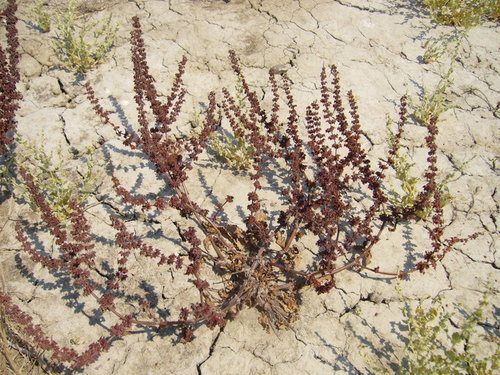
Fagopyrum tataricum
(L.) Gaertner
Tartary buckwheat, Indian buckwheat
iNaturalist· cc-by-nc
(c) Сергей, some rights reserved (CC BY-NC), uploaded by Сергей
iNaturalist· cc-by-nc
(c) Leonid, some rights reserved (CC BY-NC), uploaded by Leonid
iNaturalist· cc-by-nc
(c) Aleksandr Ebel, some rights reserved (CC BY-NC), uploaded by Aleksandr Ebel
Summary
Source: WikipediaFagopyrum tataricum, also known as Tartary buckwheat, green buckwheat, ku qiao, Tatar buckwheat, or bitter buckwheat, is a domesticated food plant in the genus Fagopyrum in the family Polygonaceae. With another species in the same genus, common buckwheat, it is often counted as a cereal, but the buckwheats are not closely related to true cereals. Tartary buckwheat is more bitter and contains more rutin than common buckwheat. It also contains other bioactive components such as flavonoids, phenolic acids, 2-hydroxybenzylamine and quercitrin.
Description
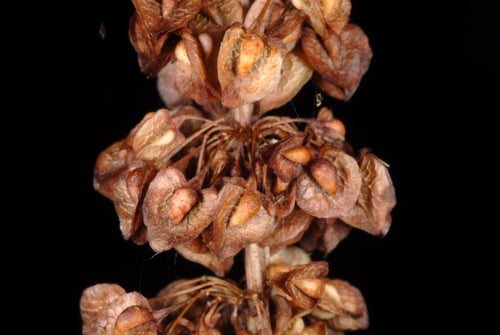
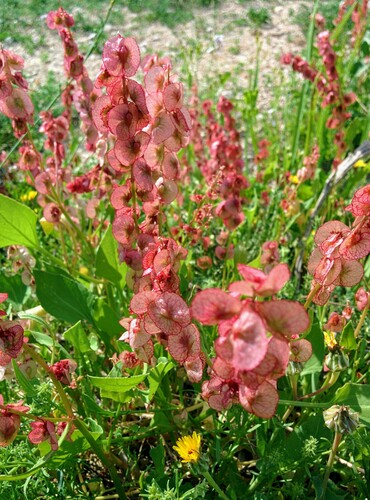
An annual herb. It grows to 100 cm high. The upper leaves have long stalks. The leaves are 2.5-12 cm long by 2.5-11.5 cm wide. They are broadly triangular shape. The flowers are pink or white. The fruit is dry and with one seed. It is grooved. There are several named cultivated varieties.
Edible Uses
Leaves can be eaten raw or cooked. When raw, they are acceptable in small quantities mixed into chopped salads, but are much better cooked. They are rich in rutin. The seed is cooked and used as a cereal, and can also be sprouted for salads or dried and ground into a flour. An edible oil is obtained from the seed.
Traditional Uses
Seeds are ground into flour. The flour can be eaten raw. It is also used for bread. The seeds also yield an edible oil. The leaves are also edible. They are cooked. Often they are cut small and fried. The seeds are also roasted.
Medicinal Uses
The bark is astringent.
Distribution
It is a subtropical plant. It is more drought and cold tolerant than normal buckwheat. In Nepal it grows between 1400-3000 m altitude. It grows in open places. In Uttar Pradesh it grows between 1800-3500 m altitude. In Sichuan. In Yunnan.
Where It Grows
Afghanistan, Asia, Bhutan, Canada, Caucasus, Central Asia, China, Europe, France, Georgia, Himalayas, India, Indochina, Japan, Kyrgyzstan, Mongolia, Myanmar, Nepal, North America, Northeastern India, Pakistan, Russia, SE Asia, Siberia, Sikkim, Slovenia, Spain, Tajikistan, Tibet, USA, Vietnam,
Cultivation
Plants are grown from seed.
Propagation
Sow seed in situ from mid-spring to early summer. Germination typically occurs within 5 days. Earlier sowings are intended for a seed or leaf crop; later sowings are used mainly for leaf crops or green manure.
Other Uses
An oil is obtained from the seed.
Other Information
It is a cultivated food plant. It is sold in local markets.
Nutrition
| Part | Moisture | kJ | kcal | Protein | Vit A | Vit C | Iron | Zinc |
|---|---|---|---|---|---|---|---|---|
| Leaves - dry wt | 24 | 6 | — | — | — | — | — | — |
Synonyms
Also Known As
Braphu, Brapu, Chin, Dattan-soba, Duckwheat, Dyat, E luo, Eastern Tatarya buckwheat, Fafrol, Kaspat, Kathu, Nora ajda, Phapar, Phaphraya, Shari-mam, Tiath, Tite phaphar, Ts'its'bura, Ugal
References (40)
- Ambasta, S.P. (Ed.), 2000, The Useful Plants of India. CSIR India. p 218
- Aryal, K. P., et al, 2018, Diversity and use of wild and non-cultivated edible plants in the Western Himalaya. Journal of Ethnobiology and Ethnomedicine (2018) 14:10
- BHARGAVA,
- Brouk, B., 1975, Plants Consumed by Man. Academic Press, London. p 35
- Brown, D., 2002, The Royal Horticultural Society encyclopedia of Herbs and their uses. DK Books. p 211
Show all 40 references Hide references
- Bussman, R. W., et al, 2021, Unity in diversity—food plants and fungi of Sakartvelo (Republic of Georgia), Caucasus. Journal of Ethnobiology and Ethnomedicine (2021) 17:72 p 13
- Campbell, C.G., 1979, Buckwheat, in Simmonds, N.W., (ed), Crop Plant Evolution. Longmans. London. p 235
- Dangol, D. R. et al, 2017, Wild Edible Plants in Nepal. Proceedings of 2nd National Workshop on CUAOGR, 2017.
- Facciola, S., 1998, Cornucopia 2: a Source Book of Edible Plants. Kampong Publications, p 185
- Flora of China @ efloras.org Volume 5
- Flora of Pakistan. www.eFloras.org
- Fruct. sem. pl. 2:182. 1790
- Fu, Yongneng, et al, 2003, Relocating Plants from Swidden Fallows to Gardens in Southwestern China. Economic Botany, 57(3): 389-402
- Hedrick, U.P., 1919, (Ed.), Sturtevant's edible plants of the world. p 305
- Hu, Shiu-ying, 2005, Food Plants of China. The Chinese University Press. p 371
- Joshi, N., et al, 2007, Traditional neglected vegetables of Nepal: Their sustainable utilization for meeting human needs. Tropentag 2007. Conference on International Agricultural Research for Development.
- Kaul, M.K. et al, 1985, Ethno-botanic studies in North-West and Trans-Himalaya - contribution to the wild food plants of Ladakh. J.Econo. Tax. Bot. Vol. 6 No. 3 pp 523-527
- Kunkel,
- Li, S., et al, 2020, Monpa, memory, and change: an ethnobotanical study of plant use in Mêdog County, South-east Tibet, China. Journal of Ethnobiology and Ethnomedicine. (2020) 16:5 p 22
- Liu, Yi-tao, & Long, Chun-Lin, 2002, Studies on Edible Flowers Consumed by Ethnic Groups in Yunnan. Acta Botanica Yunnanica. 24(1):41-56
- Manandhar, N.P., 2002, Plants and People of Nepal. Timber Press. Portland, Oregon. p 232
- Martin, F.W. & Ruberte, R.M., 1979, Edible Leaves of the Tropics. Antillian College Press, Mayaguez, Puerto Rico. p 213
- Murugan, Pal M., et al, 2010, Phytofoods of Nubra valley, Ladakh - The cold desert. Indian Journal of Traditional Knowledge. Vol. 9(2): 303-308
- Negi, K.S., 1988, Some little known wild edible plants of U.P. Hills. J. Econ. Tax. Bot. Vol. 12 No. 2 pp 345-360
- Pham-Hoang Ho, 1999, An Illustrated Flora of Vietnam. Nha Xuat Ban Tre. p 754
- Plants for a Future database, The Field, Penpol, Lostwithiel, Cornwall, PL22 0NG, UK. http://www.scs.leeds.ac.uk/pfaf/
- Polunin, O., & Stainton, A., 2006, Flowers of the Himalaya, Oxford India Paperbacks. p 347
- Rana, J.C. et al, 2011, Genetic resources of wild edible plants and their uses among tribal communities of cold arid regions of India. Genetic Resources and Crop Evolution. 59:135-149
- Rawat, G.S., & Pangtey, Y.P.S., 1987, A Contribution to the Ethnobotany of Alpine Regions of Kumaon. J. Econ. Tax. Bot. Vol. 11 No. 1 pp 139-147
- Rigat, M et al, 2009, Ethnobotany of Food Plants in the High River Ter Valley (Pyrenees, catalonia, Iberian Peninsula): Non-Crop Food Vascular Plants and Crop Food Plants with medicinal Properties. Ecology of Food and Nutrition, 48:303-327
- Sharma, B.B., 2005, Growing fruits and vegetables. Publications Division. Ministry of Information and broadcasting. India. p 196
- Tanaka,
- Terra, G.J.A., 1973, Tropical Vegetables. Communication 54e Royal Tropical Institute, Amsterdam, p 46
- USDA, ARS, National Genetic Resources Program. Germplasm Resources Information Network - (GRIN). [Online Database] National Germplasm Resources Laboratory, Beltsville, Maryland. Available: www.ars-grin.gov/cgi-bin/npgs/html/econ.pl (10 April 2000)
- Wang, J. et al, 2013, A Study on the Utilization of Wild Plants for Food in Liangshan Yi Autonomous Prefecture. Plant Diversity and Resources. 35(4): 416-471
- Wiersema, J. H. & Leon, B., 2013, World Economic Plants. A Standard Reference CRC Press. 2nd Ed. p 298
- Wild edible plants of Himachal Pradesh
- World Checklist of Useful Plant Species 2020. Royal Botanic Gardens, Kew
- Zhang, L. et al, 2013, An Ethnobotanical Study of Traditional Edible Plants Used by Naxi People in Northwestern Yunnan, China. - A Case Study in Wenhai Village. Plant Diversity and Resources. p 5
- Zhang, L., et al, 2016, Ethnobotanical study of traditional edible plants used by the Naxi people during droughts. Journal of Ethnobiology and Ethnomedicine. 12:39