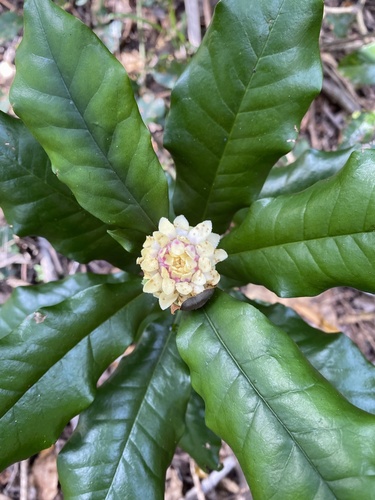
Eupomatia laurina
R. Br.
Bolwarra, Copper Laurel, Native Guava
iNaturalist· cc-by-nc
(c) bennybotany85, some rights reserved (CC BY-NC), uploaded by bennybotany85
iNaturalist· cc-by-nc
(c) Queensland Nature Refuge, some rights reserved (CC BY-NC)
iNaturalist· cc-by-nc
(c) Queensland Nature Refuge, some rights reserved (CC BY-NC)
Summary
Source: WikipediaEupomatia laurina, commonly named bolwarra, native guava or copper laurel, is a species of plant in the primitive flowering-plant family Eupomatiaceae endemic to Australia and New Guinea.
Description
An evergreen shrub or tree. It grows to 6-10 m high and spreads to 1-3 m across. The bush can be upright or bend over. The stem is erect and sturdy. It is 10 cm across. It has a shrubby crown. The twigs have lines along them and have a large soft pith. The leaves are entire and a rich copper colour when young and become shiny green when mature. They are 5-22 cm long. The leaves have 7-17 pairs of side veins which curve and form a network near the leaf edge. The leaves have a smell when crushed. The flowers are yellow or pale green. The are round in bud and 1-1.5 cm across. The flower stalk can be 2 cm long. The flowers have a sweet scent. The fruit are 2 cm long and urn shaped. They can be 4 cm across and are berries looking like rose hips. They are succulent and pale green. They turn darker green when ripe. They hang singly on stalks produced in the axils of leaves. They contain many very small seeds. The fruit are edible.
Edible Uses
Fruit - raw. A soft, clear pulp with a sweet, aromatic, pleasant taste. The flavour is somewhat reminiscent of a kiwi fruit (Actinidia spp.) or guava (Psidium quajava) with overtones of nutmeg. The globose to urn-shaped berries are green, turning brownish when fully ripe. They are 15 - 20mm in diameter and contain many small seeds. The juice of the fruit can be added to ice cream or yoghourt.
Traditional Uses
The ripe fruit are eaten raw. The fruit become almost black when fully ripe and then fall. The juice from the fruit can be used for ice cream or yogurt. The seeds are bitter and should be avoided.
Medicinal Uses
No medicinal uses are known.
Distribution
A tropical and subtropical plant. It does best in rich moist soils. It suits a protected sunny position. It is damaged by drought and frost. It grows in the lowland rainforest. It can grow in full sun or shade. In Papua New Guinea is grows from sea level to 1250 m altitude. It needs well drained soil. It is often along creek banks. In the Cairns Botanical Gardens. It can grow in cooler places and tolerate light frosts. Melbourne Botanical gardens. Mt Cootha Botanical Gardens.
Where It Grows
Australia*, Pacific, Papua New Guinea, PNG,
Cultivation
It can be grown from seed or cuttings. The flesh is removed and the seed sown fresh. Seed can be slow to germinate. It can take 1-6 months to germinate. A temperature above 25°C is probably necessary. Flowers are pollinated by beetles.
Propagation
Propagate from seed.
Other Uses
The wood is soft and coarse-grained.
Production
Plants flower from November to March and fruit from January to June. The fruit fall to the ground when ripe.
Notes
There are 2 Eupomatia species.
Nutrition
| Part | Moisture | kJ | kcal | Protein | Vit A | Vit C | Iron | Zinc |
|---|---|---|---|---|---|---|---|---|
| Fruit | 82.1 | 345 | 83 | 1 | — | 1 | 1.1 | 1.1 |
Also Known As
Soli
References (33)
- Beasley, J., 2011, Plants of Tropical North Queensland - the compact guide. Footloose publications. p 132
- Bodkin, F., 1991, Encyclopedia Botanica. Cornstalk publishing, p 465
- Caton, J.M. & Hardwick, R. J., 2016, Field Guide to Useful Native Plants from Temperate Australia. Harbour Publishing House. p 196
- Cherikoff V. & Isaacs, J., The Bush Food Handbook. How to gather, grow, process and cook Australian Wild Foods. Ti Tree Press, Australia p 154, 195, 200
- Cooper W & Cooper W T, 1994, Fruits of the Rain Forest. RD Press p 124 (Picture)
Show all 33 references Hide references
- Cooper, W. and Cooper, W., 2004, Fruits of the Australian Tropical Rainforest. Nokomis Editions, Victoria, Australia. p 199
- Cribb, A.B. & J.W., 1976, Wild Food in Australia, Fontana. p 33
- Croft, J.R., in Womersley, J.S., (ed), 1978, Handbooks of the Flora of Papua New Guinea. Melbourne University Press,Victoria. Vol 1, p 123 (Drawing)
- Cronin, L., 1989, The Concise Australian Flora. Reed. p 139
- Elliot, W.R., & Jones, D.L., 1992, Encyclopedia of Australian Plants suitable for cultivation. Vol 4. Lothian. p 260
- Facciola, S., 1998, Cornucopia 2: a Source Book of Edible Plants. Kampong Publications, p 101
- M. Flinders, Voy. Terra austr. 2:597, t. 2. 1814
- Hardwick, G., 2001, Economically Useful Plants for Northern Australia: Master Species List. Crusader eBooks.
- Hardwick, R.J., 2000, Nature's Larder. A Field Guide to the Native Food Plants of the NSW South Coast. Homosapien Books. p 108
- Haslam, S., 2004, Noosa's Native Plants. Noosa Integrated Catchment Assn. Inc. p 292
- Heywood, V.H., Brummitt, R.K., Culham, A., and Seberg, O. 2007, Flowering Plant Families of the World. Royal Botanical Gardens, Kew. p 147
- Hiddins, L., 1999, Explore Wild Australia with the Bush Tucker Man. Penguin Books/ABC Books. p131
- Hibbert, M., 2002, The Aussie Plant Finder 2002, Florilegium. p 100
- Hide, R. L., (Ed.) 1984, Research Report of the Simbu Land Use Project. Vol.V1 South Simbu: Studies in Demography, Nutrition, and Subsistence. p 434
- Jackes, B.R., 2001, Plants of the Tropics. Rainforest to Heath. An Identification Guide. James Cook University. p 54
- Jones D, L, 1986, Ornamental Rainforest Plants in Australia, Reed Books, p 217, 340
- Johns, R.J., 1976, Common Forest Trees of Papua New Guinea. Part 2 Angiospermae, Forestry College Bulolo, PNG p 38
- Lord, E.E., & Willis, J.H., 1999, Shrubs and Trees for Australian gardens. Lothian. p 15
- Low, T., 1991, Wild Food Plants of Australia. Australian Nature FieldGuide, Angus & Robertson. p 71
- Molyneux, B. and Forrester, S., 1997, The Austraflora A-Z of Australian Plants. Reed. p 95
- Morley, B.D., & Toelken, H.R., (Eds), 1983, Flowering Plants in Australia. Rigby. p 34
- Nicholson, N & H., 1996, Australian Rainforest Plants 2, Terania Rainforest Publishing. NSW. p 28
- Ratcliffe D & P., 1987, Australian Native Plants for Indoors. Little Hills press. p 88
- Recher, P, 2001, Fruit Spirit Botanical Gardens Plant Index. www.nrg.com.au/~recher/ seedlist.html p 6
- Yallakool Reserve Plant List July 1, 2009 Off internet
- Young, P.A.R., 1991, Rainforest Guide. Brisbane Forest Park. p 30
- World Checklist of Useful Plant Species 2020. Royal Botanic Gardens, Kew
- www.ceres.org.au/bushfoodcatalogue