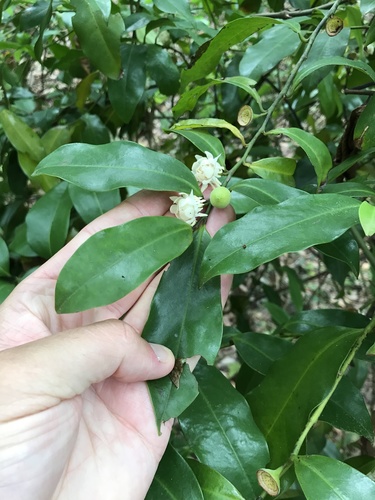
Eupomatia bennettii
F. Muell.
Small Bolwarra
iNaturalist· cc-by-nc
(c) michellesnativeplants, some rights reserved (CC BY-NC)
wikimedia· cc-by-sa
Wikimedia Commons - Krzysztof Ziarnek, Kenraiz
Summary
Source: WikipediaEupomatia bennettii, commonly named small bolwarra, is a species of shrubs of the Australian continent ancient plant family Eupomatiaceae, found in sub-tropical rainforest in eastern Australia. They grow naturally north from the Nambucca River and are sometimes found in moist gullies dominated by Eucalyptus trees. Usually seen from 70 cm to 140 cm high. Leaves are hairless, reverse lanceolate in shape, 8 to 20 cm long, 2.5 to 5 cm wide. Attractive cream and red flowers form in spring, 25 mm in diameter. The fruit is an obconical berry; starting green then turning a yellowish colour. 2 to 3 cm in diameter.
Description
A shrub up to 2 m high. The roots are fleshy. The leaves are simple and 8-24 cm long and 2.5-4.5 cm wide. The leaf stalk is swollen at the base. The leaves taper to the tip. The stems zigzag from leaf to leaf. The flowers are yellow and 2.5 cm long. They occur singly in the axils of the upper leaves. The stamens are leaf like and yellow and orange. The fruit are up to 30 mm across. They hang singly at the tips of the twigs. There are several seeds inside. They are 4 mm long. The fruit is edible in small quantities.
Edible Uses
The fruit are eaten in small quantities and have a strong flavour.
Traditional Uses
The fruit are eaten. They have a strong flavour.
This uses section is brief — help expand it
Distribution
It grows naturally in tropical and warm temperate rainforests in Queensland and New South Wales in Australia. Plants can grow in shady places. Coffs Harbour Botanical Gardens.
Where It Grows
Australia*,
Cultivation
Plants can be grown from seed. They can also probably be grown from cuttings.
Notes
There are 2 Eupomatia species. There is only one genus in the Eupomatiaceae. Both species occur in Australia and one in Papua New Guinea.
References (10)
- Bodkin, F., 1991, Encyclopedia Botanica. Cornstalk publishing, p 465
- Cherikoff V. & Isaacs, J., The Bush Food Handbook. How to gather, grow, process and cook Australian Wild Foods. Ti Tree Press, Australia p 154, 200
- Cooper W & Cooper W T, 1994, Fruits of the Rain Forest. RD Press p 124
- Elliot, W.R., & Jones, D.L., 1992, Encyclopedia of Australian Plants suitable for cultivation. Vol 4. Lothian. p 260
- Fragm. 1:45. 1858
Show all 10 references Hide references
- Heywood, V.H., Brummitt, R.K., Culham, A., and Seberg, O. 2007, Flowering Plant Families of the World. Royal Botanical Gardens, Kew. p 147
- Jackes, B.R., 2001, Plants of the Tropics. Rainforest to Heath. An Identification Guide. James Cook University. p 54
- Jones D, L, 1986, Ornamental Rainforest Plants in Australia, Reed Books, p 217, 340
- Nicholson, N & H., 1996, Australian Rainforest Plants, Terania Rainforest Publishing. NSW. p 31
- Williams, J.B., Harden, G.J., and McDonald, W.J.F., 1984, Trees and shrubs in rainforests of New South Wales and Southern Queensland. Univ. of New England, Armidale. p 79