Erythronium japonicum
Decne.
Katakuri, Dog's tooth violet
iNaturalist· cc-by-nc
(c) 空猫 T. N, some rights reserved (CC BY-NC), uploaded by 空猫 T. N
iNaturalist· cc-by-nc
(c) 空猫 T. N, some rights reserved (CC BY-NC), uploaded by 空猫 T. N
iNaturalist· cc-by-nc
(c) 空猫 T. N, some rights reserved (CC BY-NC), uploaded by 空猫 T. N
Summary
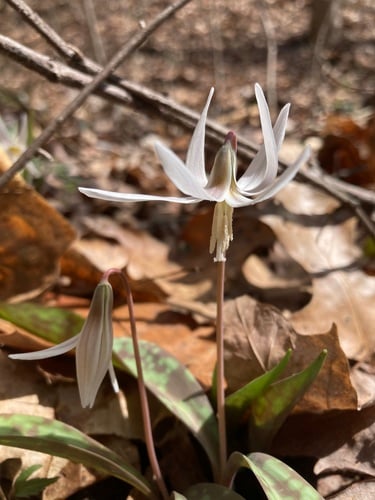
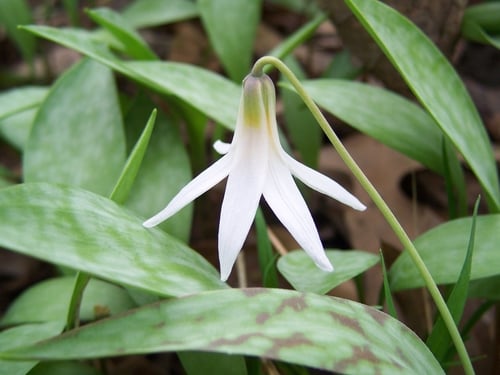
Source: WikipediaErythronium japonicum, known as Asian fawn lily, Oriental fawn lily, Japanese fawn lily is a pink-flowered species trout lily, belonging to the Lily family and native to Japan, Korea, the Russian Far East (Sakhalin Island, Kuril Islands) and northeastern China (Jilin and Liaoning). It is a spring ephemeral, blooming April–June in woodlands. It is known as zhūyáhuā (猪牙花) in Chinese, eolleji (얼레지) in Korean, and katakuri (片栗) in Japanese. Erythronium japonicum has a stem up to 20 centimetres (7.9 in) long, although as much as 30% of the stem may be underground. Bulb is elongated, up to 6 cm (2.4 in) long but rarely more than 1 cm wide (0.39 in). Leaves are broadly elliptical to lanceolate, the blade up to 12 cm (4.7 in) long and 7 cm (2.8 in) wide. Flowers are solitary, rose-colored. Applying the generic common name trout lily may be somewhat of a misnomer, because in the Japanese species, the individual plant may or may not exhibit the flecked dark markings on the leaves, which is emblematic of that common name (see gallery below).
Description
A bulb plant. It grows 16-20 cm tall. It has about 1.3 of its length underground. The bulb is 5-6 cm long by 1 cm wide. There can often be several small bulbs near the base. The leaf stalk is 3-4 cm long. The leaf blade is oval and 10-11 cm long by 2.5-6.5 cm wide. The flowers occur singly. The have long stalks. They are rose purple.
Edible Uses
The bulb can be eaten raw or cooked and is the source of a starch known in Japan as 'katakuri-ko'. This starch is used in dumplings, confectionery, and as a thickener in soups and sauces. It is particularly valued in sauces that need to thicken without gelling upon cooling. The bulb is approximately 1cm wide and up to 6cm long.
Traditional Uses
The bulbs are used for starch. This is used in dumplings, confectionary, fritters, to thicken soups and in other foods. The leaves are used fresh or dried.
Medicinal Uses
None known
Known Hazards
Although no records of toxicity have been seen for this species, the following notes have been seen for another member of this genus and so some caution is advised. Skin contact with the bulbs has been known to cause dermatitis in sensitive people.
Distribution
It is a temperate plant. It grows in moist places in forests in N China.
Where It Grows
Asia, China, Japan, Korea,
Cultivation
Prefers slightly acid soil conditions but succeeds in chalky soils if these contain plenty of humus. Requires semi-shade, preferably provided by trees or shrubs, and a well-drained soil. Succeeds in almost any light soil, preferring one that is rich in humus. Slugs love this plant and often eat out the leaves. Flowers are produced in 3 - 4 years from seed. Bulbs should be planted about 7cm deep. According to some botanists, this species is no more than a variety of E. dens-canis.
Propagation
Seed is best sown as soon as it is ripe in a shady position in a cold frame. Water lightly in summer; germination should occur in autumn or winter. Stored seed requires a period of cold stratification and should be sown as early in spring as possible in a cold frame. Sow thinly to avoid the need to prick out seedlings in their first year, and give occasional liquid feeds to prevent nutrient deficiency. When plants go dormant, pot up the small bulbs 2–3 per pot and grow them on in a shady greenhouse for another 2–3 years before planting out into permanent positions while dormant in late summer. Bulbs can also be divided in summer as the leaves die down. Larger bulbs can go straight into permanent positions, while smaller ones are better potted and grown on in a shady greenhouse for a year before planting out when dormant in late summer.
Other Uses
None known
Notes
There are about 22 Erythronium species.
Synonyms
Also Known As
Olleji, Zhu ya hua
References (8)
- Chen Xinqi, Liang Songyun, Xu Jiemei, Tamura M.N., Liliaceae. Flora of China. p 55
- Facciola, S., 1998, Cornucopia 2: a Source Book of Edible Plants. Kampong Publications, p 143
- Hwang, HS, et al, 2014, Distribution characteristics of plant in the Ungseokbong Mountain, Gyeongsangnam-do, Korea. Journal of Asia-Pacific Biodiversity. 7(2014) e164-e178
- Lim, T. K., 2015, Edible Medicinal and Non Medicinal Plants. Volume 9, Modified Stems, Roots, Bulbs. Springer p 41
- Pemberton, R. W. & Lee, N. S., 1996, Wild Food Plants in South Korea: Market Presence, New Crops, and Exports to the United States. Economic Botany, Vol. 50, No. 1, pp. 57-70
Show all 8 references Hide references
- Plants for a Future database, The Field, Penpol, Lostwithiel, Cornwall, PL22 0NG, UK. http://www.scs.leeds.ac.uk/pfaf/
- Rev. Hort. ser. 4, 3:284. 1854
- Tanaka,