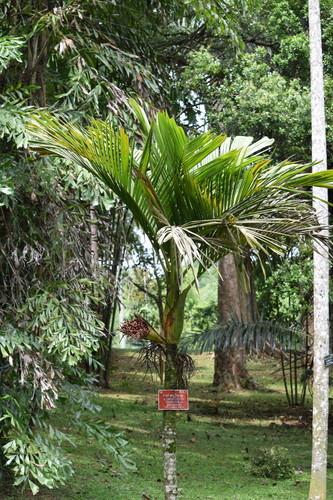
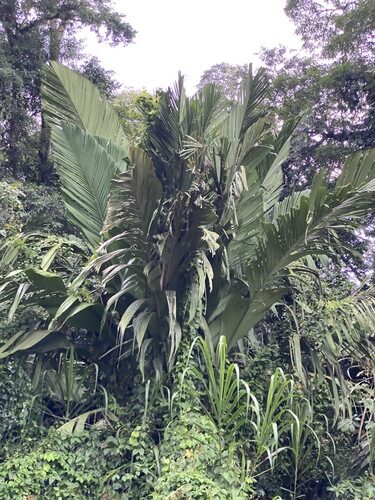
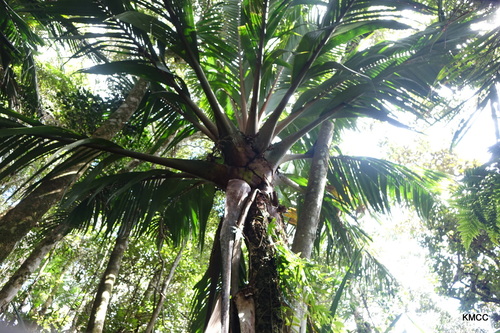
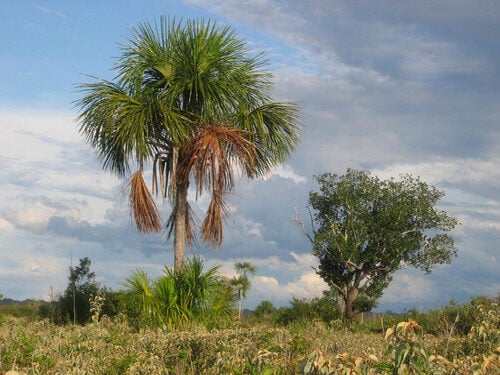
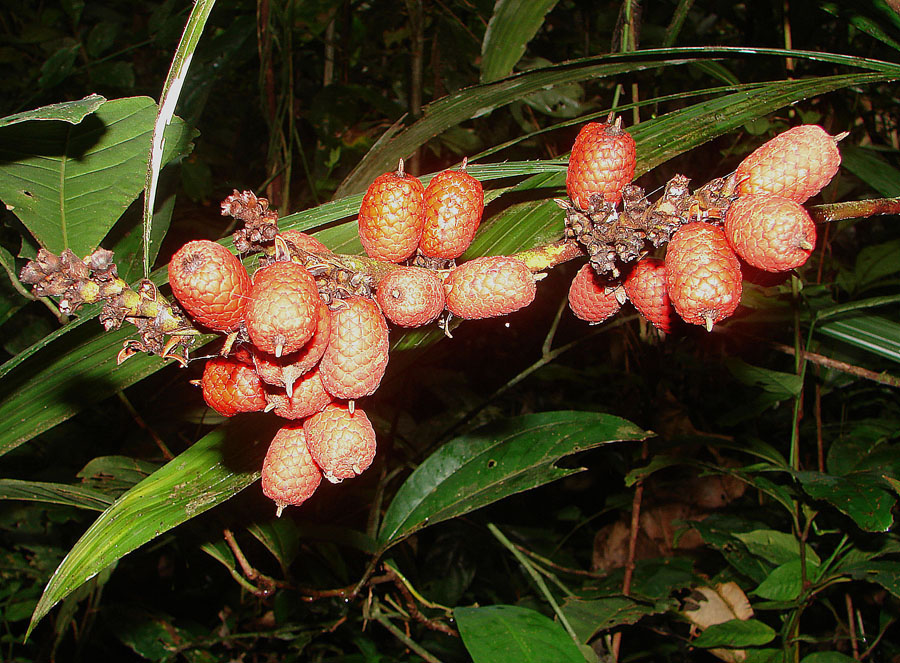
Metroxylon amicarum - (H.Wendl.) Hook.f.
(H.Wendl.) Hook.f.
Caroline Ivory Nut Palm
gbif· cc-by-nc
Arizona State University Vascular Plant Herbarium (ASU-Plants)
gbif· cc-by
The New York Botanical Garden
gbif· cc-by
The New York Botanical Garden
Description
Metroxylon amicarum is an evergreen Tree growing to 25 m (82ft) by 15 m (49ft) at a fast rate. See above for USDA hardiness. It is hardy to UK zone 10. Suitable for: light (sandy), medium (loamy) and heavy (clay) soils and can grow in heavy clay and nutritionally poor soils. Suitable pH: mildly acid, neutral and basic (mildly alkaline) soils and can grow in very acid and saline soils. It cannot grow in the shade. It prefers moist or wet soil. The plant can tolerate maritime exposure.
Edible Uses
Sago is sometimes prepared from the pith of this tree. It is said to keep well and not to be injured by salt water. It is considered a valuable food to take on canoe journeys. Not as productive as the sago palm (Metroxylon sagu), it is more likely to be viewed as an emergency food. The apical meristems or palm hearts are large and soft. The trees may be harvested prior to maturation exclusively for this purpose, with the meristem and several feet of the immature leaves being used. These palm hearts are used locally or are sold in local markets. They are eaten raw as a vegetable or cooked with other foods, often in curries. Harvesting the palm heart leads to the death of the tree since it is unable to produce side branches. Immature seeds are sometimes eaten by children.
Medicinal Uses
The roots, young leaves, and stem cork are used for traditional medicine.
Known Hazards
Plant has spines or sharp edges; use extreme caution when handling
Distribution
West Pacific - Caroline Islands.
Where It Grows
PACIFIC: Micronesia, Pohnpei, Chuuk, Marshall Islands
Cultivation
It prefers a mean annual rainfall in the range 2,000 - 5,000mm, and does not tolerate more than a short dry period. It prefers a mean annual temperature of around 25°c with a minimum of 17°c. It is not tolerant of frost, though it can succeed in cooler areas of the tropics such as Hawaii, but then grows more slowly. Prefers a relatively sunny position. Succeeds in a wide range of soils, preferring medium to heavy soils with somewhat impeded drainage. It can persist on well drained, poor quality materials including sand, clay, or 'aï' lava. It will grow in soil that is periodically inundated by salt water as long as fresh water flow is more prevalent. Plants are not very tolerant of water shortage, but nor do they like inundation for more than short periods. Succeeds in a wide range of pH, from 4 - 7.4. Plants are tolerant of strong, salt-laden winds. Plants usually take 12 - 15 years to come to flowering maturity from seed, though in ideal conditions this can be reduced to about 10 years. Unlike other members of this genus, which flower once and then die, this species is able to flower for a number of years before dying. The seeds can be transported by water from one island to another. Judging by the plants natural range, the seed viability is likely to be fairly short in salt water. Spacing: 20-30 ft. (6-9 m) 30-40 ft. (9-12 m).
Propagation
The seed loses its viability rapidly when stored and does not tolerate dry conditions. It is best sown as soon as it falls from the tree, usually germinating within 1 - 2 months. They germinate best at a temperature of 30°c, though temperatures above 38°c can harm the seeds. Seeds sometimes germinate whilst still attached to the infructescence and can grow to a height of 90 - 120cm before falling to the ground. Germination can be speeded up if the seed husk is removed and the covering over the embryo is loosened. Care should be taken not to damage the embryo. The large seed size and rapid early growth mean this species is well suited for direct-seeding in the field, assuming conditions are consistently moist. Seedlings can also be germinated in a nursery and transplanted bareroot. They transplant well as long as the roots are not bound. Plants should be planted out as soon as possible. Although best planted out whilst fairly small, specimens with several sub-mature leaves 1 - 2 metres long and a well developed root system have been successfully planted out.
Other Uses
Basketry Broom Buttons Containers Fencing Fuel Nails Needles Pins Roofing Soil stabilization Thatching Wood. Agroforestry Uses: Especially when in wetter soils, the roots help to stabilize the soil by trapping silt. Young palms, with their numerous spines, act as effective barriers for livestock and potential trespassers. As the palms mature and develop above-ground stems, new palms may be planted adjacent to the juveniles to maintain the spininess of the fence. Other Uses The large, very hard, ivory-like seeds are used to make a range of carved items and also to make buttons. The leaves and their petioles have a wide range of applications. In particular, they are one of the major sources of thatch, roofs made from these leaves are said to last for 5 years. In addition, the leaflets can be woven into temporary baskets or used to line cooking pits. Gourd bottle-corks/stoppers are made from lightly rolled discs of sago leaves. Whole leaves are used to cover and protect dry-stored canoes. The leaf sheaths are commonly covered externally with rough spines and/or rib-like protuberances. These rough sheaths have served as rasps in the preparation of sago and other food products that must be grated. The stiff, hard midribs may be used to make brooms, may serve as temporary sewing needles or pins, or may be used as thatch sheet skewers. The smooth inner surface of the sheaths can be used as temporary containers, and as kneading boards for bread made from sago. Children sometimes make surfboards from the petiole base (leaf sheath) that can be up to one metre wide. Bats, balls, and rafts are made by children from the leaf base. The wood (outer cortex) of the stems is used as flooring and as planking for crossing short streams or swampy areas. The wood is not reported as being long lasting or durable, but is employed as a by-product by those who extract starch. Wood has also been used as house rafters and as wall material, although this is an infrequent usage. The bark can be used as a fuel.
Synonyms
Also Known As
Caroline Ivory Nut Palm, Rupung, Oahs, Oj, Rupwung