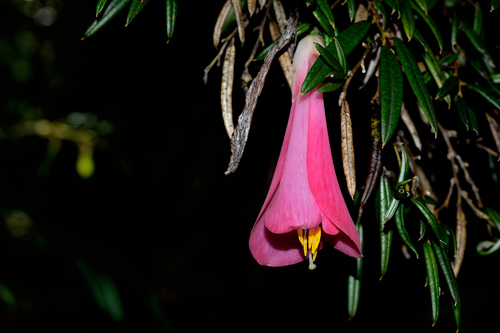
Lapageria rosea
Ruiz.&Pav.
Chilean Bellflower
iNaturalist· cc-by-nc
(c) Constanza, some rights reserved (CC BY-NC), uploaded by Constanza
iNaturalist· cc-by-nc
(c) Eitel Carlos Thielemann Pinto, some rights reserved (CC BY-NC), uploaded by Eitel Carlos Thielemann Pinto
iNaturalist· cc-by-nc-sa
(c) Ariel Cabrera Foix, some rights reserved (CC BY-NC-SA), uploaded by Ariel Cabrera Foix
Description
Lapageria rosea is an evergreen Climber growing to 5 m (16ft) by 5 m (16ft) at a medium rate. See above for USDA hardiness. It is hardy to UK zone 9. It is in leaf all year, in flower from July to December, and the seeds ripen from September to October. The species is hermaphrodite (has both male and female organs) and is pollinated by Insects. Suitable for: light (sandy), medium (loamy) and heavy (clay) soils and prefers well-drained soil. Suitable pH: mildly acid and neutral soils. It can grow in full shade (deep woodland) or semi-shade (light woodland). It prefers dry or moist soil.
Edible Uses
Fruit - raw or cooked[2, 139, 163, 177, 200]. A sweet white juicy pulp, the yellow fruits are the size of a hen's egg.
Distribution
S. America - Argentina, Chile.
Where It Grows
SOUTHERN AMERICA: Chile
Cultivation
Thrives in a lime-free humus-rich soil. Requires a cool shady position in a warm moist atmosphere. Succeeds in dry shade according to another report. Requires a deep open-textured soil in a warm position with shade. Requires a well-drained soil. Dislikes cold winds. The Chilean bellflower is best grown on a partially shady and sheltered wall where it will withstand temperatures down to about -5°c. Plants on sunny walls tend to succumb in cold winters whilst those on shady walls are much more likely to survive. Plants can be cut back to the ground in cold winters but will often regrow in the spring. A climbing plant that supports itself by twining around other plants and other supports. It does not really require pruning. A very ornamental plant, it is the national flower of Chile. It is not very cold-tolerant, but is commonly cultivated in greenhouses in Britain. It is, however, hardy outdoors in the milder areas of the country. The fruits are only occasionally formed in Britain. When growing this plant from seed, it pays to be very selective and only grow on the strongest seedlings since a weak plant tends to remain weak. Slugs are very fond of the young plants and will soon destroy them if given an opportunity. Plants are also subject to attacks by aphis in the spring. Seedlings require a very free-draining soil and it is best to cover them in a plastic bag for a few days after transplanting. Plants are slow to establish, but are very long-lived.
Propagation
Seed - it is best to sow 2 - 3 seeds per pot as soon as the seed is ripe, in a humus-rich sandy soil in a warm greenhouse. It usually germinates within 6 weeks at 20°c. The flesh of the fruit might contain germination inhibitors and should be completely removed before the seed is sown. The stored seed will require stratification. Pre-soak for 3 days in warm water, changing the water 3 - 5 times a day, then stratify for 1 - 3 months at 4°c. Stored seed germinates within 1 - 3 months at 22°c. Thin the seedlings to the strongest plant in each pot and grow on for at least the first winter in a greenhouse before planting out in early summer. Give the plants some protection for their first winter outdoors. Layering in spring before new growth begins or in autumn. It is best done in individual pots because the roots are very brittle. It takes about 12 months. Leaf bud cuttings.