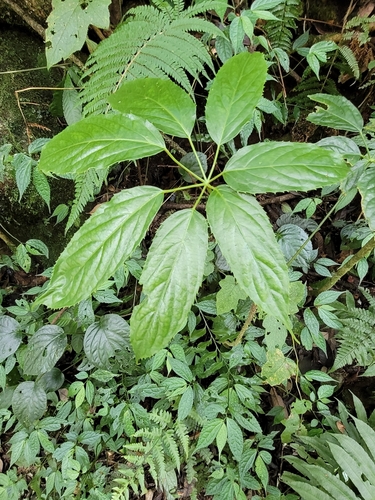
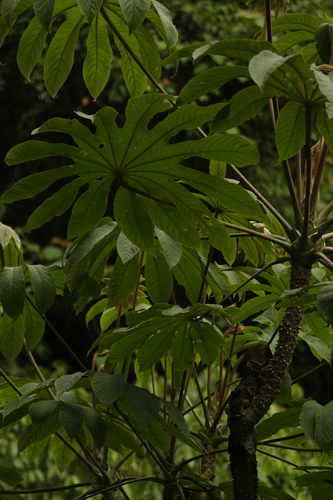
Eleutherococcus sieboldianus
(Makino) Koidz.
Hedging Eleutherococcus, Fiveleaf aralia
iNaturalist· cc-by
(c) Manuel, some rights reserved (CC BY)
iNaturalist· cc-by-nc
(c) plnthunter22, some rights reserved (CC BY-NC), uploaded by plnthunter22
iNaturalist· cc-by-nc
(c) Janet Novak, some rights reserved (CC BY-NC), uploaded by Janet Novak
Summary
Source: WikipediaEleutherococcus sieboldianus, the five-fingered aralia or fiveleaf aralia, is a species of flowering plant in the family Araliaceae. It is native to Anhui province in China, and has been introduced to Korea, Japan and the United States. A variegated form is available which only reaches 8 ft (2.4 m).
Description
A shrub. It grows 3 m high. It spreads 2.5 m wide. The branches are slender and arching. The flowers are greenish-white and occur in single heads. The fruit are black and 8 mm across.
Edible Uses
Young leaves are edible when cooked, offering a delicious and somewhat fragrant flavour. The dried leaves can also be used as a tea substitute.
Traditional Uses
The young leaves are boiled and eaten. The leaves are also used as a tea substitute. A liqueur is brewed from the plant.
This uses section is brief — help expand it
Medicinal Uses
None known
Distribution
It is a temperate plant. It grows on well drained poor soil in the sun. It suits hardiness zones 4-9.
Where It Grows
Asia, Australia, Britain, China, Europe, Japan, Korea,
Propagation
Seed is best sown as soon as it is ripe in autumn in a cold frame, though germination can be slow. Stored seed requires 6 months of warm stratification followed by 3 months of cold stratification, and may also be very slow to germinate. Prick seedlings out into individual pots when large enough to handle, then grow on in light shade in a cold frame or greenhouse for at least the first winter before planting out in late spring or early summer. Other options include half-ripe wood cuttings in July/August in a frame, ripe wood cuttings of the current season's growth at 15–30cm long in a cold frame, root cuttings in late winter, or division of suckers during the dormant season.
Other Uses
The plant can be used as a hedge.
Synonyms
Also Known As
Ukogi, Wu-chia
References (9)
- Acta Phytotax. Geobot. 8:52. 1939
- Cundall, P., (ed.), 2004, Gardening Australia: flora: the gardener's bible. ABC Books. p 534
- Etherington, K., & Imwold, D., (Eds), 2001, Botanica's Trees & Shrubs. The illustrated A-Z of over 8500 trees and shrubs. Random House, Australia. p 278
- Facciola, S., 1998, Cornucopia 2: a Source Book of Edible Plants. Kampong Publications, p 25 (As Acanthopanax sieboldianus)
- Plants for a Future database, The Field, Penpol, Lostwithiel, Cornwall, PL22 0NG, UK. http://www.scs.leeds.ac.uk/pfaf/
Show all 9 references Hide references
- Tanaka,
- USDA, ARS, National Genetic Resources Program. Germplasm Resources Information Network - (GRIN). [Online Database] National Germplasm Resources Laboratory, Beltsville, Maryland. Available: www.ars-grin.gov/cgi-bin/npgs/html/econ.pl (10 April 2000)
- Wiersema, J. H. & Leon, B., 2013, World Economic Plants. A Standard Reference CRC Press. 2nd Ed. p 268
- World Checklist of Useful Plant Species 2020. Royal Botanic Gardens, Kew