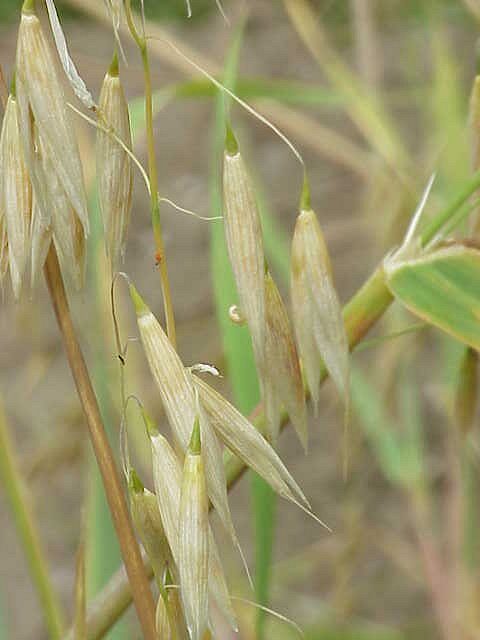
Eleusine coracana
(L.) Gaertn.
Finger millet
iNaturalist· cc-by-nc-sa
(c) Dinesh Valke, some rights reserved (CC BY-NC-SA)
iNaturalist· cc-by-nc
(c) Nanna Joubert, some rights reserved (CC BY-NC)
iNaturalist· cc-by-nc
(c) Nanna Joubert, some rights reserved (CC BY-NC)
Summary
Source: WikipediaAn annual grass reaching 12 inches tall. Flowers July to August with seeds ripening August to October. Wind-pollinated and self-fertile. Grows in light, medium, or heavy soils with good drainage; tolerant of poor soil, saline conditions, and various pH levels from acidic to alkaline. Requires full sun and prefers moist soil.
Description
A millet grass. It is an annual grass. It is robust and forms many tillers or young shoots from the base. It grows 40-120 cm tall. The stems are somewhat flattened. The leaves are narrow. The flower heads are made up of 2-7 finger like spikes. These spikes are 1.5 cm across and 10-15 cm long. These in turn have about 70 smaller spikes. Each one of these smaller spikes has 4-7 seeds. The seeds can be 1-2 mm across. The seeds are roughly rounded. The colour varies. There are coracana and africana subsp.
Edible Uses
The seed is cooked and used as a millet — either whole or ground into a flour for cakes, puddings, and porridge. The flour makes a fair unleavened bread if soaked overnight in water first. It is also commonly used in fermented foods. Finger millet is the principal food grain for many people in dry regions of India, Nepal, and Sri Lanka, and provides a sustaining diet particularly for those doing hard physical work. The grain is higher in protein, fat, and minerals than rice, corn, or sorghum. It can be malted, and flour made from malted grain serves as a nourishing food for infants and invalids. It is also considered especially wholesome for diabetics. The seed is about 2mm in diameter, and yields around 5 tonnes per hectare. Ragi grain stores exceptionally well and is said to improve in quality with storage — seeds can be kept without damage for up to 50 years, making them highly valued as a famine reserve. Yield varies by variety and is directly related to plant duration, height, and tillering capacity; straight-spiked types generally outyield those with curved spikes. Nutritional content per 100g dry weight (370 calories, 0% water): Protein 7.6g, Fat 1.5g, Carbohydrate 88g, Fibre 3g, Ash 2.7g; Calcium 410mg, Phosphorus 290mg, Iron 12.6mg; Vitamin A 0.48mg, Thiamine (B1) 0.33mg, Riboflavin (B2) 0.11mg, Niacin 1.2mg. (Figures are the median of a reported range.)
Traditional Uses
The seed are eaten either roasted or ground into flour. This is used for porridge and flat bread. Alcohol is brewed from the grain. Caution: Alcohol is a cause of cancer. The leaves are also edible.
Medicinal Uses
The seed is astringent, tonic, and cooling, and is used in treating fevers, biliousness, and hepatitis. Leaf juice has been given to women in childbirth, and the plant is reported to be diaphoretic, diuretic, and vermifuge. It is a folk remedy for leprosy, liver disease, measles, pleurisy, pneumonia, and smallpox.
Distribution
It is a tropical plant. It is a very drought resistant crop. For good yields it needs good soil drainage and adequate moisture. It cannot stand water-logging. It becomes important where rainfall is 900-1250 mm. It especially suits areas with long hot summers. It needs a minimum temperature above 18°C and does best where temperatures are above 27°C. It grows from sea level to 2400 m altitude in Africa. It is a short day length plant and does best where daylength is 12 hours. In Nepal it is grown to about 2500 m altitude. In Kenya it grows from sea level to 2,400 m altitude. It can grow in arid places. In Sichuan and Yunnan.
Where It Grows
Afghanistan, Africa, Angola, Asia, Australia, Bangladesh, Bhutan, Botswana, Britain, Burkina Faso, Burundi, Cameroon, Central Africa, Central African Republic, CAR, Chad, China, Comoros, Congo DR, East Africa, Egypt, Eritrea, Eswatini, Ethiopia, Europe, Fiji, Ghana, Guam, Himalayas, India, Indochina, Indonesia, Japan, Kenya, Laos, Lesotho, Libya, Madagascar, Malawi, Malaysia, Mali, Middle East, Mozambique, Myanmar, Namibia, Nepal, Niger, Nigeria, North Africa, Northeastern India, Oman, Pacific, Pakistan, Rwanda, Sahel, Saudi Arabia, SE Asia, Senegal, Sikkim, Socotra, Somalia, South Africa, Southern Africa, Sri Lanka, Sudan, Swaziland, Taiwan, Tanzania, Thailand, Tibet, Uganda, United Arab Emirates, UAE, West Africa, Yemen, Zambia, Zimbabwe,
Cultivation
It is grown from seed. Often plants are grown mixed with sorghum or maize. Good soil preparation is needed to reduce weed competition. Seed can be broadcast or drilled. Young plants need to be weeded and thinned. Seed viability drops to about 50 % after 2 years. Spacing of 5 cm apart in rows 30-33 cm apart or 10-12 cm apart in rows 25 cm apart are recommended. About 25-35 kg of seed per hectare are needed if seed are broadcast. 5-10 kg per hectare are required if seed are drilled. Using fertiliser can dramatically increase yield. 125 kg per hectare of sulphate of ammonia when plants are 15 cm high is used in Uganda.
Propagation
Sow seed in early spring in a greenhouse, only just covering it. Germination should occur within 2 weeks. Prick seedlings out into individual pots as soon as they are large enough to handle and plant out in late spring after the last expected frosts. Seed can also be sown in mid to late spring in situ, though it may not ripen if the summer is cool.
Other Uses
None known.
Production
It is self pollinating and pollination occurs over 8-10 days. Millet seed stores very well and can be stored without damage for 10 years. Often it is stored on the head. Yields of about 450-900 kg of dried grain per hectare are usual. This can easily be increased to 1650 kg per hectare. Crops take 3-6 months until harvest. Seeds are heated before grinding.
Other Information
It is grown on about 1 million hectares in Southern Africa. It is cultivated on about 3 million hectares in India.
Notes
There are 9 Eleusine species. They are mostly in tropical Africa. Demo
Nutrition
| Part | Moisture | kJ | kcal | Protein | Vit A | Vit C | Iron | Zinc |
|---|---|---|---|---|---|---|---|---|
| Seeds | 11.7 | 1594 | 381 | 6.2 | — | — | 5.3 | — |
| Seeds | 1403 | — | 7.3 | — | — | 9.9 | 1.5 | — |
Synonyms
Also Known As
African millet, Amale, Bavto, Bule, Can, Coracan, Dagussa, Degussa, Gyo-ni, Indian Millet, Kattu kepai, Kayur, Kelvagaru, Kelvaregu, Khakwe, Kodha, Kodo, Kodro, Kremalu, Kurahan, Kurakkan, Kurkan, Lipoko, Long zhao ji, Lupoko, Majolothi, Malesi, Malu, Mandal, Mandua, Marua, Matai, Mawe, Mawere, Mijo corocano, Mofoho, Mpogo, Mufhoho, Mulimbi, Murwa, Muttari, Nachani, Nachoni, Nagli, Namarrupe, Natchnee, Mjera, Popoko, Ragi, Ragulu, Rajika, Rapoko, Remaru, Rukweza, Rupoko, Samgorai, Sat-ni, Shina, Tailabon, Tellaboon, Tocusso, Tokuso, Ulezi, Uphoko, Usanje, Wimbi, Ya jiao su, Zviyo, Zvuyo
References (74)
- Ambasta, S.P. (Ed.), 2000, The Useful Plants of India. CSIR India. p 193
- Anderson, E. F., 1993, Plants and people of the Golden Triangle. Dioscorides Press. p 210
- Arinathan, V., et al, 2007, Wild edibles used by Palliyars of the western Ghats, Tamil Nadu. Indian Journal of Traditional Knowledge. 6(1) pp 163-168
- Brouk, B., 1975, Plants Consumed by Man. Academic Press, London. p 24
- Burkill, H. M., 1985, The useful plants of west tropical Africa, Vol. 2. Kew.
Show all 74 references Hide references
- Burkill, I.H., 1966, A Dictionary of the Economic Products of the Malay Peninsula. Ministry of Agriculture and Cooperatives, Kuala Lumpur, Malaysia. Vol 1 (A-H) p 930
- Chen Shouliang, Lu Shenglian, Wu Zhenlan, et al Poaceae Tribe 19 Eragrostidae Flora of China
- de Wet, J.M.J., 2006. Eleusine coracana (L.) Gaertn. [Internet] Record from Protabase. Brink, M. & Belay, G. (Editors). PROTA (Plant Resources of Tropical Africa), Wageningen, Netherlands. < http://database.prota.org/search.htm>. Accessed 15 October 2009.
- Facciola, S., 1998, Cornucopia 2: a Source Book of Edible Plants. Kampong Publications, p 175
- FAO, 1988, Traditional Food Plants, FAO Food and Nutrition Paper 42. FAO Rome p 264
- Flora of Pakistan. www.eFloras.org
- Fowler, D. G., 2007, Zambian Plants: Their Vernacular Names and Uses. Kew. p 69
- Fox, F. W. & Young, M. E. N., 1982, Food from the Veld. Delta Books. p 294
- Fruct. sem. pl. 1:8. 1788
- Grubben, G. J. H. and Denton, O. A. (eds), 2004, Plant Resources of Tropical Africa 2. Vegetables. PROTA, Wageningen, Netherlands. p 561
- Hedrick, U.P., 1919, (Ed.), Sturtevant's edible plants of the world. p 288 (Also as Eleusine tocussa)
- Heywood, V.H., Brummitt, R.K., Culham, A., and Seberg, O., 2007, Flowering Plant Families of the World. Royal Botanical Gardens, Kew. p 394
- Hu, Shiu-ying, 2005, Food Plants of China. The Chinese University Press. p 289
- Jardin, C., 1970, List of Foods Used In Africa, FAO Nutrition Information Document Series No 2.p 2
- Khanal, R., et al, 2014, Documenting abundance and use of underutilized plant species in the mid hill region of Nepal. ECOPRINT 21: 63-71, 2014
- Kiple, K.F. & Ornelas, K.C., (eds), 2000, The Cambridge World History of Food. CUP p 115, 1774
- Kuo, W. H. J., (Ed.) Taiwan's Ethnobotanical Database (1900-2000), http://tk.agron.ntu.edu.tw/ethnobot/DB1.htm
- Lazarides, M. & Hince, B., 1993, Handbook of Economic Plants of Australia, CSIRO. p 89
- Li, S., et al, 2020, Monpa, memory, and change: an ethnobotanical study of plant use in Mêdog County, South-east Tibet, China. Journal of Ethnobiology and Ethnomedicine. (2020) 16:5 p 21
- Long, C., 2005, Swaziland's Flora - siSwati names and Uses http://www.sntc.org.sz/flora/ (As subsp. africana)
- Macmillan, H.F. (Revised Barlow, H.S., et al), 1991, Tropical Planting and Gardening. Sixth edition. Malayan Nature Society. Kuala Lumpur. p 352
- Magwede, K., van Wyk, B.-E., & van Wyk, A. E., 2019, An inventory of Vhavenḓa useful plants. South African Journal of Botany 122 (2019) 57–89
- Mal, B., S., et al, (Eds), 2010, Minor Millets in South Asia. Bioversity.
- Malaisse, F., 1997, Se nourrir en floret claire africaine. Approche ecologique et nutritionnelle. CTA., p 61
- Manandhar, N.P., 2002, Plants and People of Nepal. Timber Press. Portland, Oregon. p 215
- Martin, F.W. & Ruberte, R.M., 1979, Edible Leaves of the Tropics. Antillian College Press, Mayaguez, Puerto Rico. p 194
- Maundu, P. et al, 1999, Traditional Food Plants of Kenya. National Museum of Kenya. 288p
- Medhi, P. & Borthakur, S. K., 2012, Phytoresources from North Cachur Hills of Assam -3: Edible plants sold at Hflong market. Indian Journal of Natural Products and Resources. 3(1) pp 84-109
- Menninger, E.A., 1977, Edible Nuts of the World. Horticultural Books. Florida p 147
- Molla, A., Ethiopian Plant Names. http://www.ethiopic.com/aplants.htm
- Mutie, F. M., et al, 2023, Important Medicinal and Food Taxa (Orders and Families) in Kenya, Based on Three Quantitative Approaches. Plants 2023, 12, 1145
- National Research Council, 1996, Lost Crops of Africa. Volume 1: Grains. National Academy Press, Washington, D.C. p 39
- Negi, P. S. & Subramani, S. P., 2015, Wild Edible Plant Genetic Resources for Sustainable Food Security and Livelihood of Kinnaur District, Himachal Pradesh, India, International Journal of Conservation Science. 6 (4): 657-668
- Nyadanu, D., et al, 2015, Agro-biodiversity and challenges of on-farm conservation: the case of plant genetic resources of neglected and underutilized crop species in Ghana. Genet. Resourc. Crop Evol. 62(7):
- Ochse, J.J. et al, 1931, Vegetables of the Dutch East Indies. Asher reprint. p 311
- Paczkowska, G. & Chapman, A.R., 2000, The Western Australian Flora. A Descriptive Catalogue. Western Australian Herbarium. p 103
- Peduruhewa, P. S., et al, 2021, Potential of Underutilized Wild Edible Plants as the Food for the Future – A Review. Journal of Food Security, Vol. 9, No. 4, 136-147
- Peters, C. R., O'Brien, E. M., and Drummond, R.B., 1992, Edible Wild plants of Sub-saharan Africa. Kew. p 22
- Plants for a Future database, The Field, Penpol, Lostwithiel, Cornwall, PL22 0NG, UK. http://www.scs.leeds.ac.uk/pfaf/
- PROSEA (Plant Resources of South East Asia) handbook Volume 10 Cereals. p 91
- Purseglove, J.W., 1972, Tropical Crops. Monocotyledons. Longmans p 146 (Eleusine africana), 147
- Purseglove, J.W., 1979, Millets, in Simmonds N.W.,(ed), Crop Plant Evolution. Longmans. London. p 91
- Rajapaksha, U., 1998, Traditional Food Plants in Sri Lanka. HARTI, Sri Lanka. p 384
- Rashid, H. E., 1977, Geography of Bangladesh. Westview. p 251
- Royal Botanic Gardens, Kew (1999). Survey of Economic Plants for Arid and Semi-Arid Lands (SEPASAL) database. Published on the Internet; http://www.rbgkew.org.uk/ceb/sepasal/internet [Accessed 3rd June 2011]
- Ruiters-Welcome, A. K., 2019, Food plants of southern Africa. Ph.D. thesis. Univ. of Johannesburg p 87
- Shava, S., et al, 2009, Traditional food crops as a source of community resilience in Zimbabwe. International Journal of the African Renaissance 4(1)
- Small, E., 2009, Top 100 Food Plants. The world's most important culinary crops. NRC Research Press. p 352
- Smith, A.C., 1979, Flora Vitiensis Nova, Lawaii, Kuai, Hawaii, Volume 1 p 305
- Solomon, C., 2001, Encyclopedia of Asian Food. New Holland. p 234
- Swaziland's Flora Database http://www.sntc.org.sz/flora
- Termote, C., et al, 2014, Assessing the potential of wild foods to reduce the cost of a nutritionally adequate diet: An example from eastern Baringo District, Kenya. Food and Nutrition Bulletin, vol. 35, no. 4
- Teron, R. & Borthakur, S. K., 2016, Edible Medicines: An Exploration of Medicinal Plants in Dietary Practices of Karbi Tribal Population of Assam, Northeast India. In Mondal, N. & Sen, J.(Ed.) Nutrition and Health among tribal populations of India. p 154
- Terra, G.J.A., 1973, Tropical Vegetables. Communication 54e Royal Tropical Institute, Amsterdam, p 45
- Tredgold, M.H., 1986, Food Plants of Zimbabwe. Mambo Press. p 24
- Ulian, T., et al, 2020, Unlocking plant resources to support food security and promote sustainable agriculture. Plants, People, Planet. 2020;2:421–445.
- USDA, ARS, National Genetic Resources Program. Germplasm Resources Information Network - (GRIN). [Online Database] National Germplasm Resources Laboratory, Beltsville, Maryland. Available: www.ars-grin.gov/cgi-bin/npgs/html/econ.pl (10 April 2000)
- van Wyk, B., 2005, Food Plants of the World. An illustrated guide. Timber press. p 187
- van Wyk, Be, & Gericke, N., 2007, People's plants. A Guide to Useful Plants of Southern Africa. Briza. p 10
- van Wyk, B-E., 2011, The potential of South African plants in the development of new food and beverage products. South African Journal of Botany 77 (2011) 857–868
- Vickery, M.L. and Vickery, B., 1979, Plant Products of Tropical Africa, Macmillan. p 10
- Wehmeyer, A. S, 1986, Edible Wild Plants of Southern Africa. Data on the Nutrient Contents of over 300 species
- Welcome, A. K. & Van Wyk, B.-E., 2019, An inventory and analysis of the food plants of southern Africa. South African Journal of Botany 122 (2019) 136–179
- Wiersema, J. H. & Leon, B., 2013, World Economic Plants. A Standard Reference CRC Press. 2nd Ed. p 268
- Williamson, J., 2005, Useful Plants of Malawi. 3rd. Edition. Mdadzi Book Trust. p 105
- Wilson, J.M. & Witcombe, J.R., Crops for Arid lands, in Wickens, G.E., Goodin, J.R., and Field, D.V.,(Eds.) 1985, Plants for Arid Lands. Unwin Hyman, London, p 39
- World Checklist of Useful Plant Species 2020. Royal Botanic Gardens, Kew
- www.zimbabweflora.co.zw 2011
- Zeven, A. C. & de West, J. M. J., 1982, Dictionary of cultivated plants and their regions of diversity. Wageningen. p 74