Elaeocarpus dentatus
(J. R. Forst. & G. Forst.) Vahl.
Hinau
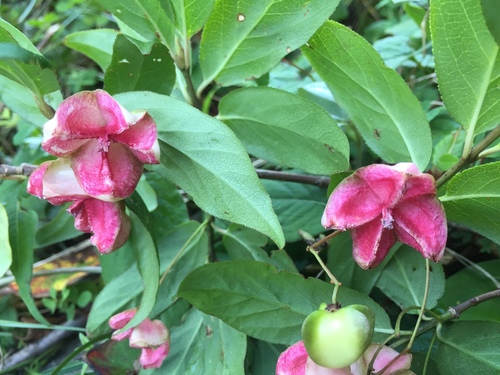
iNaturalist· cc-by
(c) Jon Sullivan, some rights reserved (CC BY)
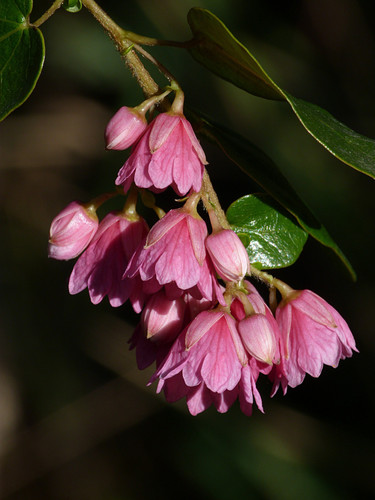
iNaturalist· cc-by
(c) Jon Sullivan, some rights reserved (CC BY)
iNaturalist· cc-by-nc-sa
(c) bernard smith, some rights reserved (CC BY-NC-SA), uploaded by bernard smith
Summary
Source: WikipediaElaeocarpus dentatus, commonly known as hinau (Māori: hīnau), is a native lowland forest tree of New Zealand. Other names in Māori for the tree are hangehange, pōkākā, and whīnau. A member of the family Elaeocarpaceae, it is found on both the North and South Islands of New Zealand, but not on Stewart Island. The leaves are dark green, with a toothed edge. On the underside of the leaf, small domatia are present. Clusters of small white flowers are produced in spring, and in late summer the flowers form into a fleshy fruit. It was officially first recorded for science by botanists Joseph Banks and Daniel Solander on 5 November 1769.
Description
A tree. It can grow 15-20 m high. The trunk can be 1 m across. The leaves are oblong and are white and hairy underneath. The leaves are tough and the edges are rolled. There are teeth along the edge. The flowers are white. These hang in clusters of 8-12 flowers. The fruit are fleshy with a hard stone inside. The fruit are 18 mm long. The fruit ripen to grey-purple. The flesh is edible.
Edible Uses
The fruit, which is about 15mm in diameter, is edible when cooked. To prepare it, the fruit is soaked, rubbed, and sieved to remove the stalks and skins, then baked into a cake with an oily flavour. It can also be pickled and used in the same way as olives.
Traditional Uses
The flesh of the fruit is used cooked. It is also pickled and used in curries. The kernel of the fruit is used to make a floury meal and eaten as a bread after baking.
Medicinal Uses
None known.
Distribution
It is a warm temperate to subtropical plant. In New Zealand it grows from sea level to 600 m altitude. It is best in rich, well drained soils and a protected sunny position. It is resistant to frost but damaged by drought. It suits hardiness zones 9-10.
Where It Grows
Australia, New Zealand*,
Cultivation
Plants can be grown from seed. They can also be grown from cuttings.
Propagation
Sow seed in spring in a greenhouse. Germination can be very slow, sometimes taking 2 years or more. Prick seedlings out into individual pots once large enough to handle and grow on in the greenhouse for at least the first winter. Plant out into permanent positions in late spring or early summer, after the last expected frosts. Cuttings of almost ripe shoots can be taken in August/September and rooted in sandy soil in a frame, with leaves left on the stem.
Other Uses
A blue/black dye is obtained from the bark. The bark is also a good source of tannin.
Production
It is slow growing.
Notes
There are about 360 Elaeocarpus species mostly in the tropics.
References (16)
- Bodkin, F., 1991, Encyclopedia Botanica. Cornstalk publishing, p 376
- Cambie, R. C. & Ferguson, L. R., 2003, Potential functional foods in the traditional Maori diet. Mutation Research/Fundamental and Molecular Mechanisms of Mutagenesis. Volumes 523–524, February–March 2003, Pages 109-117
- Crowe, A., 1997, A Field Guide to the Native Edible Plants of New Zealand. Penguin. p 21
- Etherington, K., & Imwold, D., (Eds), 2001, Botanica's Trees & Shrubs. The illustrated A-Z of over 8500 trees and shrubs. Random House, Australia. p 276
- Hedrick, U.P., 1919, (Ed.), Sturtevant's edible plants of the world. p 287
Show all 16 references Hide references
- Heywood, V.H., Brummitt, R.K., Culham, A., and Seberg, O. 2007, Flowering Plant Families of the World. Royal Botanical Gardens, Kew. p 137
- Kiple, K.F. & Ornelas, K.C., (eds), 2000, The Cambridge World History of Food. CUP p 1785
- Lavelle, M., 2008, Wild Flowers of Australia and Oceania. Southwater. p 95
- Lord, E.E., & Willis, J.H., 1999, Shrubs and Trees for Australian gardens. Lothian. p 53
- Matthews, J., 1987, New Zealand Native Plants for your Garden. Pacific Publishers, p 47
- Plants for a Future database, The Field, Penpol, Lostwithiel, Cornwall, PL22 0NG, UK. http://www.scs.leeds.ac.uk/pfaf/
- Salmon, J.T., 1989, The Native Trees of New Zealand. Heinmann Reid p 176
- Skinner, G. & Brown, C., 1981, Simply Living. A gatherer's guide to New Zealand's fields, forests and shores. Reed. p 41
- Stewart, K., 1984, Collins handguide to the Native Trees of New Zealand. Collins. p 40
- Symb. Bot. 3: 66 - 67. 1794
- World Checklist of Useful Plant Species 2020. Royal Botanic Gardens, Kew