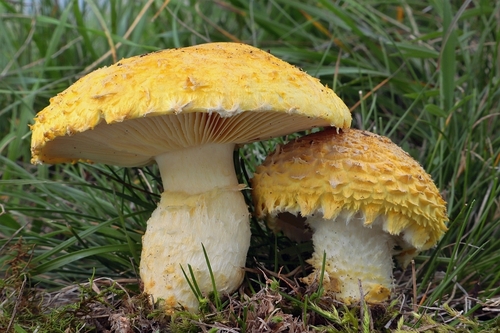
Agaricus bernardii
(Quel.) Sacc.
Salt-loving agaricus
iNaturalist· cc-by-nc
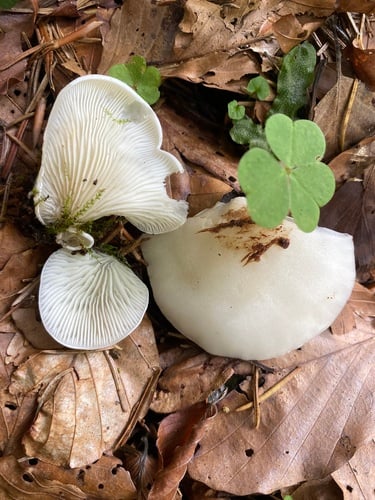
(c) Christian Schwarz, some rights reserved (CC BY-NC), uploaded by Christian Schwarz
iNaturalist· cc-by
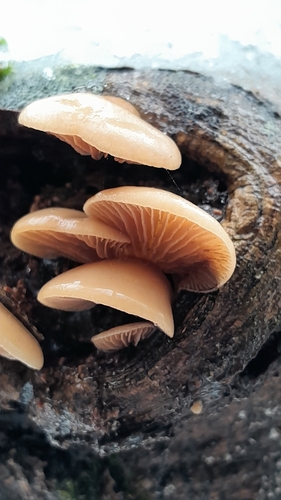
(c) Davide Puddu, some rights reserved (CC BY), uploaded by Davide Puddu
iNaturalist· cc-by-nc-sa
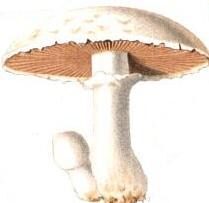
(c) cyberfungus, some rights reserved (CC BY-NC-SA)
Summary
Source: WikipediaAgaricus bernardii, commonly called the salt-loving agaricus, or salty mushroom, is an agaric fungus in the family Agaricaceae. The mushroom's thick stem is usually shorter than the diameter of the cap, which ranges from 5–15 centimetres (2–6 inches) and is convex to flattened. The cap surface is whitish to buff, and can develop scales or warts in age. The gills are initially pink before turning brown when the spores mature. The flesh turns reddish when it is cut or bruised. It resembles species such as A. bitorquis. Found in Eurasia, North America, New Zealand, and Australia, A. bernardii is a salt-tolerant species that grows in salt marshes, dunes, and coastal grassland. An edible mushroom, it is stronger in flavor but similar to the store-bought button mushrooms, A. bisporus.
Description
A mushroom.
This description is brief — help expand it
Edible Uses
Although the mushrooms sometimes have an odor that is briny or pungent, they are edible and good. David Arora compares it to the closely related A. bitorquis, "but a little chewier".
Distribution
It is a Mediterranean plant.
Where It Grows
Africa, Asia, China, Europe, France, Iraq, Mediterranean, Middle East, North Africa, North America, Tunisia, USA,
Notes
There are about 300 Agaricus species.
Also Known As
Baixiangu
References (2)
- Aziz, F. H. & Toma, F. M., 2012, First Observations on the Mushroom in Mountain Area of Iraqi Kurdistan Region. Journal of Advanced Laboratory Research in Biology 3(4)
- Jardin, C., 1970, List of Foods Used In Africa, FAO Nutrition Information Document Series No 2.p 113