Dovyalis macrocalyx
(Oliv.) Warb.
Shaggy-fruited dovyalis
iNaturalist· cc-by-nc
(c) Botanica, some rights reserved (CC BY-NC)
iNaturalist· cc-by-nc
(c) Botanica, some rights reserved (CC BY-NC)
iNaturalist· cc-by-nc
(c) Botanica, some rights reserved (CC BY-NC)
Description
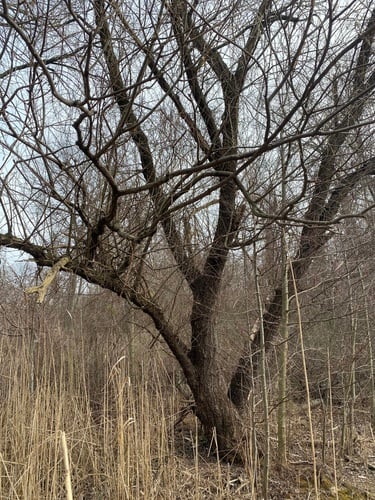
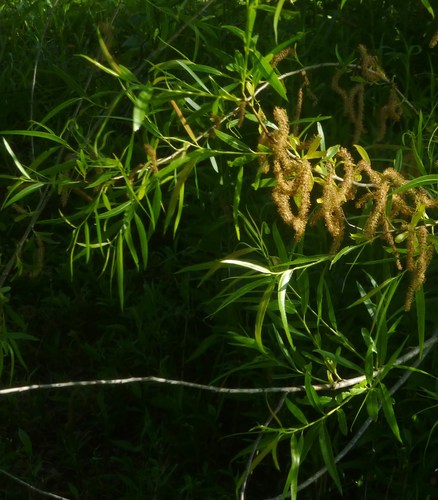
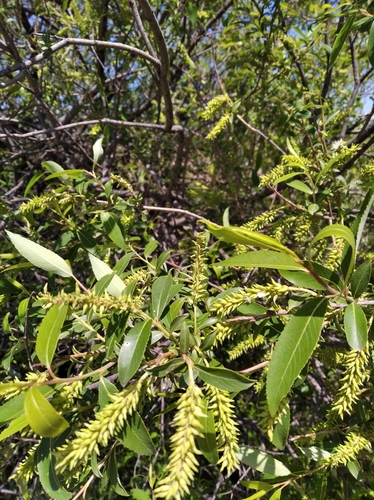
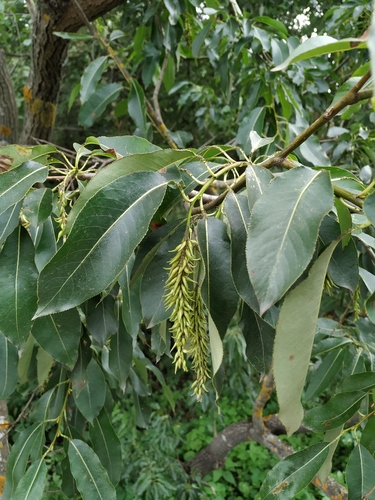
An under shrub in the forest. It grows 3-8 m high. The plant has many branches and often these droop over. The bark is smooth and grey. It is often dotted with breathing pores. It has spines. These are single, straight and needle like. They are 1-6 cm long. They occur beside the leaves. The leaves are thin, long and oval. The leaves occur in clusters. They can be 4-9 cm long and with 3-5 veins. These are slightly raised on both surfaces. The edges of the leaves have teeth but these can be rounded. The leaf stalk is short. The flowers occur as either one or a few together near the leaves or spines. The flowers are hairy and yellow-green. They have about 20 easy to see stamens. The female flowers have hairs on the calyx lobes. The female flowers occur singly while the male flowers grow several together. The fruit are oval and about 2 cm long. They are orange red and fleshy. They are edible. The fruit hang down and have an enlarged layer of red leaves (calyx) bent back and with a fringe of sticky hairs. The fruit have a strong distinctive smell. There are 2 woolly covered seeds inside.
Edible Uses
Ripe fruit is eaten fresh and particularly enjoyed by children. The fruit can be used for jams and jellies after removing the skin and boiling, and young green fruit can be pickled.
Traditional Uses
The ripe fruit is eaten. Fruit can be used for jams and jellies. The skin is removed and the fruit boiled. The young green fruit can also be used in pickles.
Distribution
A tropical plant. It grows in moist tropical rainforest but also in drier forests and grassland. It suits humid locations. In East Africa it grows from sea level to 1,500 m altitude or higher. It grows in well-drained deep, sandy loams. It grows in areas with an annual rainfall of 1,100-1,900 mm. It can grow in arid places.
Where It Grows
Africa, Angola, Botswana, Burundi, Central Africa, Central African Republic, CAR, Congo, East Africa, Kenya, Malawi, Mozambique, Rwanda, South Africa, Southern Africa, Sudan, Tanzania, Uganda, Zambia, Zimbabwe,
Cultivation
Plants are often self sown. They can be grown from seed. Fruit are collected form the tree when ripe and the seed removed. It is best to use fresh seed.
Other Uses
The wood is hard. It is used for building poles and tool handles. The wood is used for fuel.
Production
The fruit are ripe September to November in Zimbabwe and March to June in Tanzania.
Other Information
A useful fruit tree. The fruit are especially enjoyed by children.
Notes
There are about 22 Dovyalis species. Also put in the Flacourtiaceae family.
Synonyms
Also Known As
Amatagyengyere, Cheptabirbiriet, Imitegengeri, Munyhee, Mutunku, Mzuyuyu, N'tudza, Olmorogo, Umutegeengeri, Vumahodzi
References (21)
- Bigirimana, C., et al, 2016, Utilisation of Indigenous Fruit Tree Species within the Lake Victoria Basin, Rwanda. Agricultural Science: An International Journal. (AGRIJ) Vol. 1, No. 1
- Dale, I. R. and Greenway, P. J., 1961, Kenya Trees and Shrubs. Nairobi. p 225
- Dharani, N., 2002, Field Guide to common Trees & Shrubs of East Africa. Struik. p 225
- H. G. A. Engler & K. A. E. Prantl, Nat. Pflanzenfam. 3(6a):44. 1893
- Fox, F. W. & Young, M. E. N., 1982, Food from the Veld. Delta Books. p 230
Show all 21 references Hide references
- Glover, et al, 1966b,
- Grivetti, L. E., 1980, Agricultural development: present and potential role of edible wild plants. Part 2: Sub-Saharan Africa, Report to the Department of State Agency for International Development. p 44
- Jardin, C., 1970, List of Foods Used In Africa, FAO Nutrition Information Document Series No 2.p 134
- Katende, A.B., Birnie, A & Tengnas B., 1995, Useful Trees and Shrubs for Uganda. Identification, Propagation and Management for Agricultural and Pastoral Communities. Technical handbook No 10. Regional Soil Conservation Unit, Nairobi, Kenya. p 250
- Maundu, P. et al, 1999, Traditional Food Plants of Kenya. National Museum of Kenya. 288p
- Mbuvi, M. T. E., et al, 2019, Annonated checklist of plant species of Loita Forest Narok County, Kenya. Int. J. Adv. Res. Biol. Sci. (2019). 6(3): 54-110
- Musinguzi, E., et al, 2006, Utilization of Indigenous Food Plants in Uganda: A Case Study of South-Western Uganda. AJFAND Vol. 6(2):
- Mutie, F. M., et al, 2023, Important Medicinal and Food Taxa (Orders and Families) in Kenya, Based on Three Quantitative Approaches. Plants 2023, 12, 1145
- Palgrave, K.C., 1996, Trees of Southern Africa. Struik Publishers. p 639
- Peters, C. R., O'Brien, E. M., and Drummond, R.B., 1992, Edible Wild plants of Sub-saharan Africa. Kew. p 114
- Plowes, N. J. & Taylor, F. W., 1997, The Processing of Indigenous Fruits and other Wildfoods of Southern Africa. in Smartt, L. & Haq. (Eds) Domestication, Production and Utilization of New Crops. ICUC p 190
- Royal Botanic Gardens, Kew (1999). Survey of Economic Plants for Arid and Semi-Arid Lands (SEPASAL) database. Published on the Internet; http://www.rbgkew.org.uk/ceb/sepasal/internet [Accessed 16th April 2011]
- Ruffo, C. K., Birnie, A. & Tengnas, B., 2002, Edible Wild Plants of Tanzania. RELMA p 288
- Tredgold, M.H., 1986, Food Plants of Zimbabwe. Mambo Press. p 99
- von Katja Rembold, 2011, Conservation status of the vascular plants in East African rain forests. Dissertation Universitat Koblenz-Landau p 166
- World Checklist of Useful Plant Species 2020. Royal Botanic Gardens, Kew