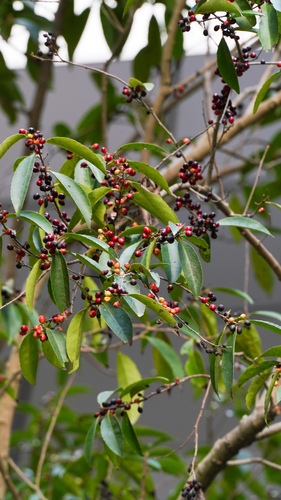
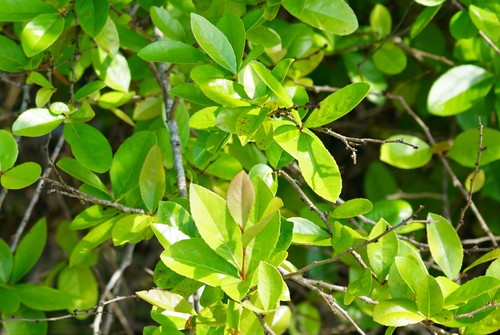
Dovyalis hebecarpa
(Gaerdner) Warb.
Ceylon gooseberry
iNaturalist· cc-by-nc
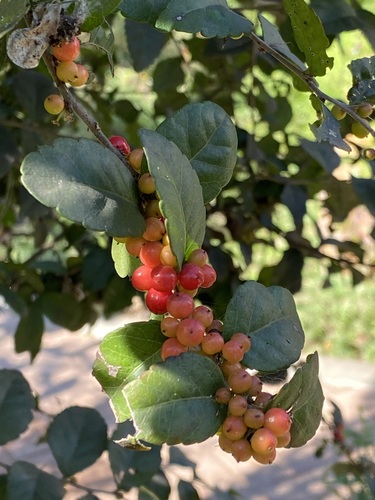
(c) Maribel Armenteros, some rights reserved (CC BY-NC), uploaded by Maribel Armenteros
iNaturalist· cc-by-nc
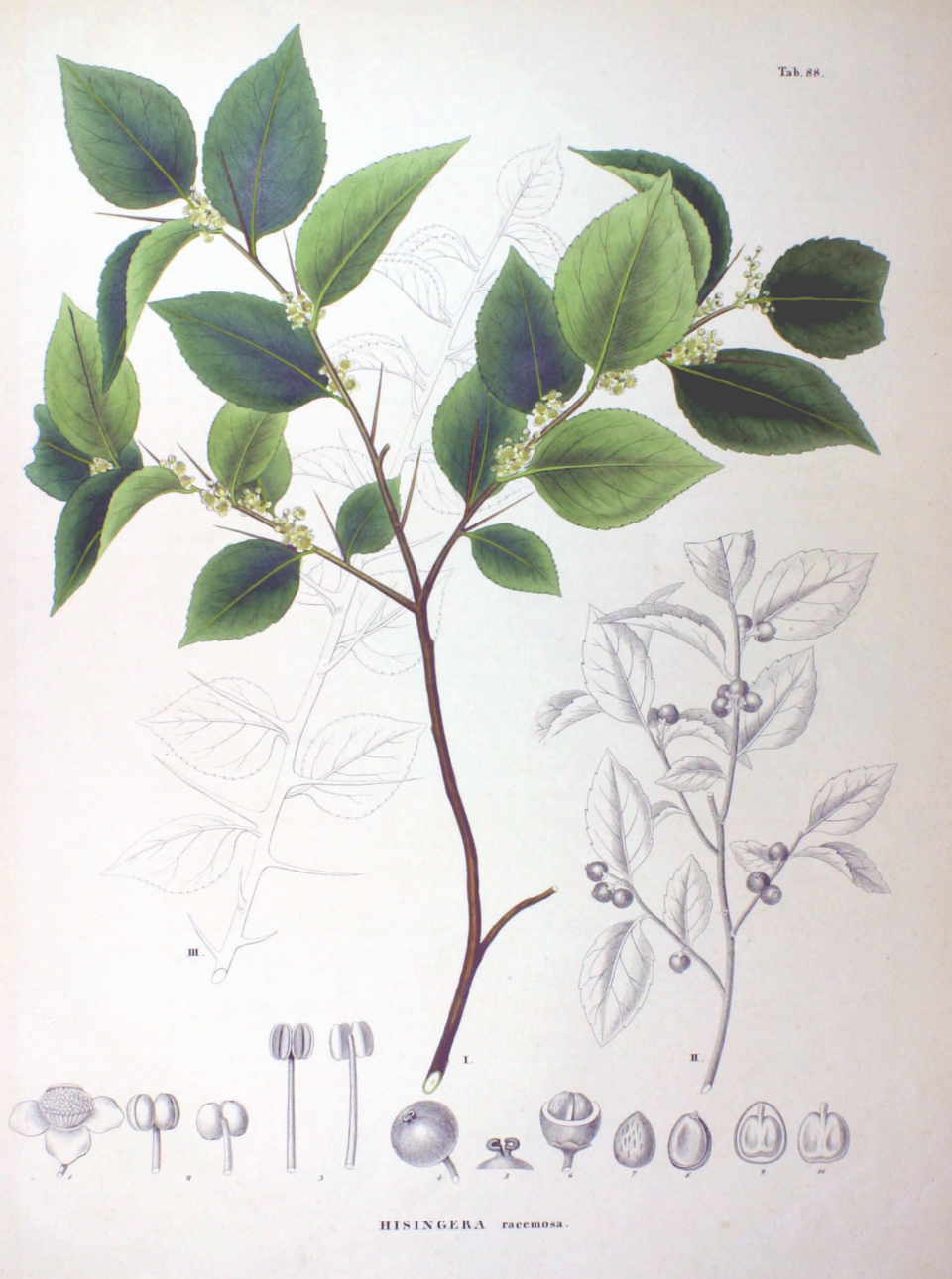
(c) Mario, some rights reserved (CC BY-NC)
Summary
Source: WikipediaDovyalis hebecarpa, with common names Ceylon gooseberry, ketembilla, and kitambilla, is a plant in the genus Dovyalis, native to Sri Lanka and southern India. The fruit are often eaten fresh, or made into jam. Some cultivars have been selected for being thornless (making harvesting easier) and for larger fruit. The tropical apricot, or ketcot, is a hybrid between D. hebecarpa and D. abyssinica that was developed in Florida in 1953 and is also cultivated for its fruit.
Description
A large shrub. It grows 5-7 m high. It has many branches. There are long sharp spines on young plants. The leaves are velvety and pale green. They are 10 cm long. They have a wavy uneven surface. The stalks and veins are red. Plants are separately male and female. The flowers are green. They are in the axils of leaves. The fruit is small, dark purple and sour. They are 2 cm across. The skin is brown and velvety when ripe. The pulp is deep red and acidic.
Edible Uses
The fruit can be eaten fresh despite being acidic, and are used in drinks, preserves, and jam. They are also used to flavor meat and fish.
Traditional Uses
The fruit can be eaten fresh but are acidic. They are used in drinks and preserves. They make good jam. They are used to flavour meat and fish.
This uses section is brief — help expand it
Medicinal Uses
No medicinal uses mentioned in data.
Distribution
A tropical plant. It grows in the tropical lowlands. It is native to India and Sri Lanka. It is a tropical plant. Plants can tolerate both dry and wet soils. Good moisture levels are important for good fruit development. It occurs naturally in Sri Lanka. It grows to 1,300 m above sea level. It does not do well in the humid tropics. It suits hardiness zones 10-12.
Where It Grows
Africa, Asia, Australia, Brazil, Caribbean, Central America, China, Colombia, Cook Islands, Cuba, Dominican Republic, Fiji, Haiti, Hawaii, Honduras, India*, Indonesia, Israel, Mediterranean, Middle East, Myanmar, North America, Pacific, Philippines, Puerto Rico, SE Asia, Singapore, South America, Sri Lanka*, St Lucia, USA, West Indies,
Cultivation
Plants are grown from seed. They can also be grown from cuttings. Because trees are male or female it is often best to graft buds of appropriate male and female trees onto the one rootstock.
Propagation
Seed - best sown in individual pots. Layering. Graft or shield-bud desirable varieties on to seedling rootstocks.
Production
Plants can grow very quickly under ideal conditions. Both male and female trees are needed. Trees produce large quantities of fruit. Trees can produce several crops throughout the year.
Other Information
It is a cultivated fruit tree.
Notes
There are about 22 Dovyalis species. Also put in the Flacourtiaceae family.
Nutrition
| Part | Moisture | kJ | kcal | Protein | Vit A | Vit C | Iron | Zinc |
|---|---|---|---|---|---|---|---|---|
| Fruit | 82.8 | 264 | 63 | 1.2 | 105 | 98 | 1.2 | — |
Synonyms
Also Known As
Aberia, Ceylon plum, Groselha-do-ceilao, Jung-pung, Ketembilla, Kitambilla, Kitembilla, Naywe-po, Pohon beri seilon, Quetembilla
References (39)
- Ambasta, S.P. (Ed.), 2000, The Useful Plants of India. CSIR India. p 182
- Arora, R. K., 2014, Diversity in Underutilized Plant Species - An Asia-Pacific Perspective. Bioversity International. p 68
- Barwick, M., 2004, Tropical and Subtropical Trees. A Worldwide Encyclopedic Guide. Thames and Hudson p 156
- Burkill, I.H., 1966, A Dictionary of the Economic Products of the Malay Peninsula. Ministry of Agriculture and Cooperatives, Kuala Lumpur, Malaysia. Vol 1 (A-H) p 871
- Coronel, R.E., 1982, Fruit Collections in the Philippines. IBPGR Newsletter p 6
Show all 39 references Hide references
- Darley, J.J., 1993, Know and Enjoy Tropical Fruit. P & S Publishers. p 131
- H. G. A. Engler & K. A. E. Prantl, Nat. Pflanzenfam. 3(6a):44. 1893
- Etherington, K., & Imwold, D., (Eds), 2001, Botanica's Trees & Shrubs. The illustrated A-Z of over 8500 trees and shrubs. Random House, Australia. p 267
- Etoh, T. & Sundaresan, 1985, Food Plants in Fiji and Their Utilization. Kagoshima Univ. Res. Center S. Pac, Occasional Papers, No. 5. p. 145-164.
- Facciola, S., 1998, Cornucopia 2: a Source Book of Edible Plants. Kampong Publications, p 117
- Flowerdew, B., 2000, Complete Fruit Book. Kyle Cathie Ltd., London. p 162 (As Aberia gardneri)
- Food Composition Tables for use in East Asia FAO http://www.fao.org/infoods/directory No. 840
- Hibbert, M., 2002, The Aussie Plant Finder 2002, Florilegium. p 89
- Hu, Shiu-ying, 2005, Food Plants of China. The Chinese University Press. p 563
- Jardin, C., 1970, List of Foods Used In Africa, FAO Nutrition Information Document Series No 2.p 133
- John, L., & Stevenson, V., 1979, The Complete Book of Fruit. Angus & Robertson p 287
- Kiple, K.F. & Ornelas, K.C., (eds), 2000, The Cambridge World History of Food. CUP p 1749
- Little, E. L., et al, 1974, Trees of Puerto Rico and the Virgin Islands. USDA Handbook 449. Forestry Service. p 486
- Lorenzi, H., Bacher, L., Lacerda, M. & Sartori, S., 2006, Brazilian Fruits & Cultivated Exotics. Sao Paulo, Instituto Plantarum de Estuados da Flora Ltda. p 602
- Lyle, S., 2006, Discovering fruit and nuts. Land Links. p 187
- Macmillan, H.F. (Revised Barlow, H.S., et al) 1991, Tropical Planting and Gardening. Sixth edition. Malayan Nature Society. Kuala Lumpur. p 298
- Martin, F. W., et al, 1987, Perennial Edible Fruits of the Tropics. USDA Handbook 642 p 28
- Miguel, E., et al, 1989, A checklist of the cultivated plants of Cuba. Kulturpflanze 37. 1989, 211-357
- Morton, J. F., 1987, Fruits of Warm Climates. Wipf & Stock Publishers p 311
- Plants of Haiti Smithsonian Institute http://botany.si.edu/antilles/West Indies (As Doryalis)
- Recher, P, 2001, Fruit Spirit Botanical Gardens Plant Index. www.nrg.com.au/~recher/ seedlist.html p 2
- Reis, S. V. and Lipp, F. L., 1982, New Plant Sources for Drugs and Foods from the New York Botanical Garden herbarium. Harvard. p 195
- Roa, J. A. G. & Boada, D. S. G., 2018, Fundación para el Fortalecimiento de la Fruticultura y Plantas Alimenticias no Convencionales en Colombia.
- Smith, A.C., 1981, Flora Vitiensis Nova: A New flora of Fiji, Hawai Botanical Gardens, USA Vol 2 p 640
- Staples, G.W. and Herbst, D.R., 2005, A tropical Garden Flora. Bishop Museum Press, Honolulu, Hawaii. p 336 (Drawing)
- Sukarya, D. G., (Ed.) 2013, 3,500 Plant Species of the Botanic Gardens of Indonesia. LIPI p 247
- Tankard, G., 1990, Tropical fruit. An Australian Guide to Growing and using exotic fruit. Viking p 110
- USDA, ARS, National Genetic Resources Program. Germplasm Resources Information Network - (GRIN). [Online Database] National Germplasm Resources Laboratory, Beltsville, Maryland. Available: www.ars-grin.gov/cgi-bin/npgs/html/econ.pl (10 April 2000)
- van Wyk, B., 2005, Food Plants of the World. An illustrated guide. Timber press. p 181
- Verheij, E. W. M. and Coronel, R.E., (Eds.), 1991, Plant Resources of South-East Asia. PROSEA No 2. Edible fruits and nuts. Pudoc Wageningen. p 329
- Wiersema, J. H. & Leon, B., 2013, World Economic Plants. A Standard Reference CRC Press. 2nd Ed. p 254
- World Checklist of Useful Plant Species 2020. Royal Botanic Gardens, Kew
- Young, J., (Ed.), 2001, Botanica's Pocket Trees and Shrubs. Random House. p 327
- Zeven, A. C. & de West, J. M. J., 1982, Dictionary of cultivated plants and their regions of diversity. Wageningen. p 73