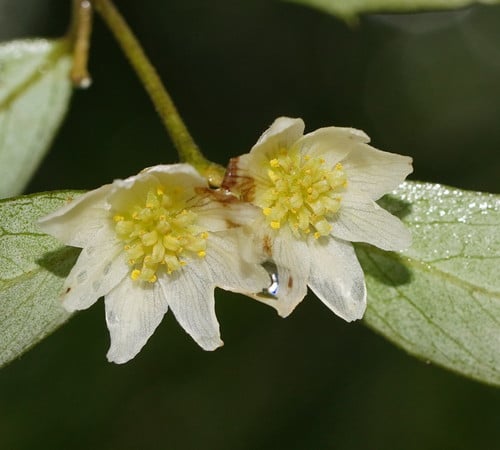
Doryphora sassafras
Endl.
Yellow sassafras, New South Wales sassafras
iNaturalist· cc-by-nc
(c) vavilovian_mimic, some rights reserved (CC BY-NC), uploaded by vavilovian_mimic
iNaturalist· cc-by-nc
(c) vavilovian_mimic, some rights reserved (CC BY-NC), uploaded by vavilovian_mimic
iNaturalist· cc-by
(c) prossington, some rights reserved (CC BY)
Summary
Source: WikipediaDoryphora sassafras, commonly known as sassafras, yellow sassafras, golden deal or golden sassafras, is a species of flowering plant in the Southern Sassafras Family Atherospermataceae and is endemic to eastern Australia. It is a shrub to tree with elliptic or egg-shaped leaves and contrasting white flowers which occur in autumn and winter.
Description
A medium sized tree. It grows 20-30 m tall and spreads 5-10 m wide. The trunk is straight. The bark is grey and finely scaly. Young shoots are soft and silky. The leaves are simple. They are arranged opposite one another. The leaves are 7-10 cm long by 1-2 cm wide. The leaves are dark green above and paler underneath. The leaves have coarse teeth around the edge. The leaves have a sarsaparilla like odour when crushed. Flowers are 2-3 cm across and white. They have silky hairs. The flowers are often in groups of 3. The fruit is 0.6-2 cm long and oval. They are brown and split on one side to expose the small fruit inside.
Edible Uses
The leaves are used to make tea.
Distribution
It grows in warm temperate places. It grows naturally in Queensland, New South Wales and Victoria in Australia. It grows in moist forest and rainforest. Plants grow well in cool mountainous regions. They need deep, well drained soil which is rich in humus. It suits hardiness zones 8-11. Arboretum Tasmania.
Where It Grows
Asia, Australia*, Indonesia, SE Asia, Tasmania,
Cultivation
Plants can be grown from fresh seed.
Notes
There are 2 Doryphora species. They grow in Australia.
Synonyms
References (10)
- Bodkin, F., 1991, Encyclopedia Botanica. Cornstalk publishing, p 356
- Cribb, A.B. & J.W., 1976, Wild Food in Australia, Fontana. p 174
- Etherington, K., & Imwold, D., (Eds), 2001, Botanica's Trees & Shrubs. The illustrated A-Z of over 8500 trees and shrubs. Random House, Australia. p 267
- Hibbert, M., 2002, The Aussie Plant Finder 2002, Florilegium. p 88
- Ic. Gen. Pl. T. 10. 1838
Show all 10 references Hide references
- Lazarides, M. & Hince, B., 1993, Handbook of Economic Plants of Australia, CSIRO. p 84
- Lord, E.E., & Willis, J.H., 1999, Shrubs and Trees for Australian gardens. Lothian. p 15
- Low, T., 1992, Bush Tucker. Australia’s Wild Food Harvest. Angus & Robertson. p 34
- Sukarya, D. G., (Ed.) 2013, 3,500 Plant Species of the Botanic Gardens of Indonesia. LIPI p 247
- Williams, J.B., Harden, G.J., and McDonald, W.J.F., 1984, Trees and shrubs in rainforests of New South Wales and Southern Queensland. Univ. of New England, Armidale. p 103