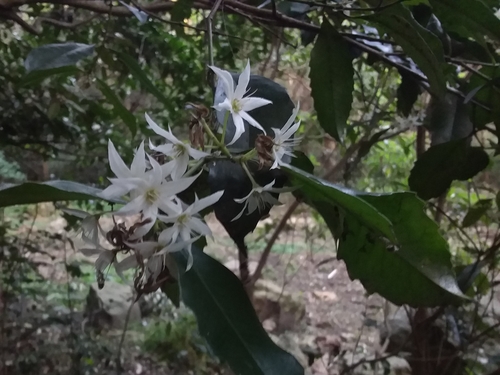
Atherosperma moschatum
Labill.
Sassafras, Southern Sassafras, Black Sassafras
iNaturalist· cc-by-nc-sa
(c) Reiner Richter, some rights reserved (CC BY-NC-SA), uploaded by Reiner Richter
iNaturalist· cc-by-nc-sa
(c) Reiner Richter, some rights reserved (CC BY-NC-SA), uploaded by Reiner Richter
iNaturalist· cc-by-nc
(c) Pete The Poet, some rights reserved (CC BY-NC)
Summary
Source: WikipediaAn evergreen tree reaching 30 m tall by 10 m wide. Dioecious, requiring both male and female plants for seed production. Remains in leaf year-round and is hardy to UK zone 9. Adapts to light sandy, medium loamy, and heavy clay soils with good drainage preferred. Tolerates very acidic to neutral pH and grows in semi-shade or full sun with preference for moist soil.
Description
A large tree. It grows to 45 m tall. Often it has a cone shaped crown with spreading drooping branches. Oil glands in the bark and leaves give a distinctive smell. The bark is white and grey and smooth. The leaves are oval or sword shaped. They taper to a point and have teeth along the edge. Leaves occur in pairs opposite one another. Leaves are green and shiny on top and pale underneath. They are 2-10 cm long by 1.5-2.5 cm wide. The flowers occur on the under side of branches and point downwards. Male and female flowers are often on separate trees. The flowers are 2 cm across. The fruit is dry and black and like a knob.
Edible Uses
Edible Parts: Edible Uses: Tea A pleasant tasting tea is made from the fresh or dried aromatic bark. Some caution is advised in its use, see the notes on toxicity at top of the page.
Traditional Uses
The bark is used to flavour drinks. The bark, fresh or dried can be used for tea. The leaves can be used to make tea.
This uses section is brief — help expand it
Medicinal Uses
Antiasthmatic Antirheumatic Aperient Cardiac Diaphoretic Diuretic Laxative Tonic VD Antiasthmatic, antirheumatic, aperient, cardiac, diaphoretic, diuretic, laxative, tonic. A powerful poison, it is useful in treating rheumatism, syphilis and bronchitis.
Known Hazards
The bark contains a potential carcinogen. Another report says that the whole plant might be poisonous.
Distribution
A cool temperate plant. It grows in rainforest. It grows in cool, damp valleys. It grows as an understorey tree from sea level to the alpine zone in Tasmania. They are frost hardy. It suits hardiness zones 8-10. Arboretum Tasmania.
Where It Grows
Australia*, Tasmania*,
Cultivation
Requires a rich well composted lime-free soil in full sun or semi-shade. Succeeds in acid and neutral soils. Plants are not very hardy in Britain, requiring greenhouse treatment in most areas, but they succeed outdoors in a woodland garden in the milder areas of the country. Another report says that plants are fairly hardy when grown in a sheltered position. A tree at Edinburgh Botanical Gardens is 3 metres tall and flowers annually, whilst there are trees 6 metres tall in Cornwall. Plants can tolerate short-lived frosts to about -5°c if they are well sited and sheltered from cold drying winds. Plants come into flower when they are quite young. All parts of the plant are aromatic. The flowers diffuse a sweet perfume whilst the nuts have a musk-like fragrance similar to nutmegs. Dioecious, male and female plants must be grown if seed is required.
Propagation
Seed - we have no details for this species but suggest sowing the seed in early spring in a warm greenhouse. When they are large enough to handle, prick the seedlings out into individual pots and grow them on in the greenhouse for at least their first winter. Plant them out into their permanent positions in late spring or early summer, after the last expected frosts. Cuttings of half-ripe wood, July/August in a frame.
Other Uses
Essential Wood An essential oil is obtained from the plant, it is used medicinally. Wood - tough, close grained, fairly soft, low in tannin. Used for cabinet making, turnery etc. Special Uses Scented Plants
Production
It is slow growing. It flowers early in spring.
Notes
CAUTION: It has been reported informally that sassafras tea may be associated with colon cancer. It is apparently about 1/16th as cancer causing as normal beer. There is only one Atherospermum species.
Also Known As
Plum nutmeg
References (32)
- Bircher, A. G. & Bircher, W. H., 2000, Encyclopedia of Fruit Trees and Edible Flowering Plants in Egypt and the Subtropics. AUC Press. p 47
- Bodkin, F., 1991, Encyclopedia Botanica. Cornstalk publishing, p 117
- Brickell, C. (Ed.), 1999, The Royal Horticultural Society A-Z Encyclopedia of Garden Plants. Convent Garden Books. p 154
- Cameron, M., (Ed.) 1981, A Guide to Flowers & Plants of Tasmania. Reed p 38
- Collier, P., 1992, Rainforest Plants of Tasmania. Plant Identikit. Society for growing Australian Plants. Tasmania. p 24
Show all 32 references Hide references
- Collier, P., 1995, Alpine Wildflowers of Tasmania. Plant Identikit. Society for growing Australian Plants. Tasmania. p 24
- Cribb, A.B. & J.W., 1976, Wild Food in Australia, Fontana. p 172
- Cronin, L., 1989, The Concise Australian Flora. Reed. p 161
- Cundall, P., (ed.), 2004, Gardening Australia: flora: the gardener's bible. ABC Books. p 205 (As Atherosperma moschatum)
- Curtis, W.M., 1993, The Student's Flora of Tasmania. Part 3 St David's Park Publishing, Tasmania, p 590
- Elliot, W.R., & Jones, D.L., 1982, Encyclopedia of Australian Plants suitable for cultivation. Vol 2. Lothian. p 252
- Etherington, K., & Imwold, D., (Eds), 2001, Botanica's Trees & Shrubs. The illustrated A-Z of over 8500 trees and shrubs. Random House, Australia. p 107
- Facciola, S., 1998, Cornucopia 2: a Source Book of Edible Plants. Kampong Publications, p 45
- Hedrick, U.P., 1919, (Ed.), Sturtevant's edible plants of the world. p 85
- Heywood, V.H., Brummitt, R.K., Culham, A., and Seberg, O. 2007, Flowering Plant Families of the World. Royal Botanical Gardens, Kew. p 52
- Hibbert, M., 2002, The Aussie Plant Finder 2002, Florilegium. p 36
- Kirkpatrick, J.B. & Backhouse, S., 1985, Native Trees of Tasmania. p 51
- Lazarides, M. & Hince, B., 1993, Handbook of Economic Plants of Australia, CSIRO. p 28
- Lord, E.E., & Willis, J.H., 1999, Shrubs and Trees for Australian gardens. Lothian. p 12
- Low, T., 1992, Bush Tucker. Australia’s Wild Food Harvest. Angus & Robertson. p 34
- Maiden, J. H., 1889, The Useful Native Plants of Australia (including Tasmania). The Technology Museum of NSW, Sydney. p 9
- Morley, B.D., & Toelken, H.R., (Eds), 1983, Flowering Plants in Australia. Rigby. p 40
- Nicholson, N & H., 1994, Australian Rainforest Plants 4, Terania Rainforest Publishing. NSW. p 13
- Nov. Holl. pl. 2:74, t. 224. 1806
- Phillips, R. & Rix, M., 2002, The Botanical Garden Vol. 1. Trees and Shrubs. MacMillan. p 64
- Ryan, S., 2008, Dicksonia. Rare Plants Manual. Hyland House. p 9
- Tasmanian Herbarium Vascular Plants list p 15
- Whiting, J. et al, 2004, Tasmania's Natural Flora. Tasmania's Natural Flora Editorial Committee PO Box 194, Ulverstone, Tasmania, Australia 7315 p 218
- Williams, J.B., Harden, G.J., and McDonald, W.J.F., 1984, Trees and shrubs in rainforests of New South Wales and Southern Queensland. Univ. of New England, Armidale. p 101, 114
- Woolmore, E et al, 2002, King Island Flora: A Field Guide. p 59
- World Checklist of Useful Plant Species 2020. Royal Botanic Gardens, Kew
- Young, J., (Ed.), 2001, Botanica's Pocket Trees and Shrubs. Random House. p 112