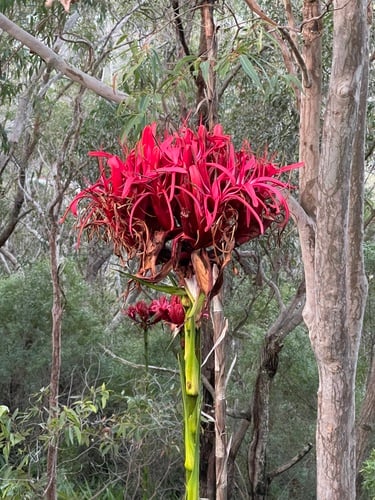
Doryanthes palmeri
W. Hill ex Benth.
Palmer spear-lily
iNaturalist· cc-by-nc
(c) Maurice, some rights reserved (CC BY-NC), uploaded by Maurice
iNaturalist· cc-by-nc
(c) Maurice, some rights reserved (CC BY-NC), uploaded by Maurice
iNaturalist· cc-by-nc
(c) Maurice, some rights reserved (CC BY-NC), uploaded by Maurice
Summary
Source: WikipediaDoryanthes palmeri, also known as the giant spear lily, is one of only two species of plant in the genus Doryanthes and the family Doryanthaceae, both being endemic to eastern Australia. It grows in a rosette and the leaves can reach the length of about 3 m (10 ft). The flowers arise in springtime on a stalk which may reach 5 m (16 ft) in height. A succulent perennial, its leaves are hairless and grow in the shape of a sword. The giant spear lily is listed as Vulnerable under the New South Wales Threatened Species Act (1995). Doryanthes palmeri is grown as an ornamental plant. It does not tolerate frosts, so in temperate zones it requires protection during the winter months. It requires a sheltered position in full sun.
Description
It is a large tussock forming lily plant. It grows 1-3 m high and spreads 1.5-6 m wide. The leaves are sword shaped or strap like. They are 3 m long and 20 cm wide. They are bright green. The flower stalk is 2-5 m tall. It has scattered small leaves. The flowers are about 6 cm long. They are reddish-brown. They are in heads at the top of the stalk. These heads can be 1 m long. The fruit is a dull greenish brown capsule. It is 7 cm long.
Edible Uses
The flower stalk is soaked in water then roasted and eaten. The roots and flowers are edible portions.
Traditional Uses
The flower stalk is soaked in water then roasted and eaten.
This uses section is brief — help expand it
Distribution
It can grow in warm temperate and temperate zones. It is damaged by drought or frost. It is best in light to medium, well-drained soils. It needs a protected, sunny position. It suits hardiness zones 10-12. Hobart Botanical Gardens. Melbourne Botanical Gardens.
Where It Grows
Asia, Australia*, Indonesia, SE Asia, Tasmania,
Cultivation
It can be grown from seed or by division of the clump.
Notes
There are 2 Doryanthes species.
Also Known As
Lili tombak merah
References (11)
- Cronin, L., 1989, The Concise Australian Flora. Reed. p 25
- Cundall, P., (ed.), 2004, Gardening Australia: flora: the gardener's bible. ABC Books. p 510
- Fl. austral. 6:452. 1873
- Greig, D., 1996, Flowering Natives for Home Gardens. Angus & Robertson. p 148
- Hibbert, M., 2002, The Aussie Plant Finder 2002, Florilegium. p 88
Show all 11 references Hide references
- Lawrence, R., 1969, Aboriginal Habitat and Economy. ANU Occasional Paper No 6.
- Leiper, G & Houser, J., Mutooroo. Plant Use by Australian Aboriginal People. Assembly press, Queensland.
- Lord, E.E., & Willis, J.H., 1999, Shrubs and Trees for Australian gardens. Lothian. p 96
- Morley, B.D., & Toelken, H.R., (Eds), 1983, Flowering Plants in Australia. Rigby. p 333
- Nicholson, N & H., 1996, Australian Rainforest Plants 3, Terania Rainforest Publishing. NSW. p 24
- Sukarya, D. G., (Ed.) 2013, 3,500 Plant Species of the Botanic Gardens of Indonesia. LIPI p 1103