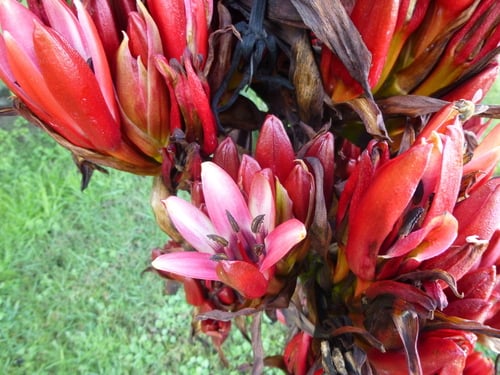
Doryanthes excelsa
Correa
Giant lily, Flame lily, Gymea lily, Illawarra Lily, Globe spear-lily
iNaturalist· cc-by-nc-sa
(c) Keith Martin-Smith, some rights reserved (CC BY-NC-SA), uploaded by Keith Martin-Smith
iNaturalist· cc-by-nc
(c) Benjamin Schwartz, some rights reserved (CC BY-NC), uploaded by Benjamin Schwartz
iNaturalist· cc-by-nc-sa
(c) Keith Martin-Smith, some rights reserved (CC BY-NC-SA), uploaded by Keith Martin-Smith
Summary
Source: WikipediaDoryanthes excelsa, commonly known as the gymea lily, is a flowering plant in the family Doryanthaceae that is endemic to coastal areas of New South Wales near Sydney. It has sword-like leaves more than 1 metre (3 ft) long and it grows a flower spike up to 6 metres (20 ft) high. The apex of the spike bears a large cluster of bright red flowers, each 10 centimetres (4 in) across. Its common name is derived from kai'mia (anglicised as Gymea) in the indigenous Dharawal language. The Sydney suburbs of Gymea and Gymea Bay are named after the lily.
Description
A large lily. It forms a large tussock. It grows 1-1.5 m high and spreads 2-3 m across. The leaves are long and broad and spear like. They are thick and bright green. They are 1.5 m long and 10 cm wide. The flowers are large and dark red. They occur in dense heads at the end of the plant. These are about 30 cm across. They are on very tall flowering stems up to 5 m tall. Each flower has 6 narrow segments 10 cm long and fused at the base. They are surrounded by deep red bracts. The fruit is a dry capsule. It is 20 cm long. The seeds are winged and reddish-brown.
Edible Uses
The flower spikes are cut into 30 cm lengths and roasted. The roots are roasted and processed into a cake.
Traditional Uses
The stems are cut 30 cm long and roasted. The roots are also roasted and made into a cake.
This uses section is brief — help expand it
Distribution
Temperate. It can grow in the tropics. It grows in sandstone areas. It occurs in light open forest. It needs well drained soils. It can grow in full sun or light shade. It can survive drought. Adelaide Botanical Gardens. It suits hardiness zones 9-11.
Where It Grows
Asia, Australia*, Britain, Europe, Indonesia, SE Asia,
Cultivation
It can be grown from seed or by division of the clump.
Production
Plants are slow growing. They take 5-10 years to flower.
Notes
There are 2 Doryanthes species. There is only one genus in the Dryanthaceae.
Also Known As
Bakung gimea
References (24)
- Blomberry, A.M., 1979, Australian Native Plants. Angus and Robertson p 90
- Bodkin, F., 1991, Encyclopedia Botanica. Cornstalk publishing, p 356
- Brickell, C. (Ed.), 1999, The Royal Horticultural Society A-Z Encyclopedia of Garden Plants. Convent Garden Books. p 377
- Cherikoff V. & Isaacs, J., The Bush Food Handbook. How to gather, grow, process and cook Australian Wild Foods. Ti Tree Press, Australia p 195
- Cribb, A.B. & J.W., 1976, Wild Food in Australia, Fontana. p 120
Show all 24 references Hide references
- Cronin, L., 1989, The Concise Australian Flora. Reed. p 35
- Cundall, P., (ed.), 2004, Gardening Australia: flora: the gardener's bible. ABC Books. p 510
- Elliot, W.R., & Jones, D.L., 1984, Encyclopedia of Australian Plants suitable for cultivation. Vol 3. Lothian. p 330 (Photo)
- Greig, D., 1996, Flowering Natives for Home Gardens. Angus & Robertson. p 147
- Grieg, D., 2002, A photographic guide to Wildflowers of South-eastern Australia. New Holland. p 29
- Harter, J.(Ed.), 1988, Plants. 2400 copyright free illustrations. Dover p 10.6
- Hedrick, U.P., 1919, (Ed.), Sturtevant's edible plants of the world. p 282
- Heywood, V.H., Brummitt, R.K., Culham, A., and Seberg, O., 2007, Flowering Plant Families of the World. Royal Botanical Gardens, Kew. p 366 (Family)
- Hibbert, M., 2002, The Aussie Plant Finder 2002, Florilegium. p 88
- Lazarides, M. & Hince, B., 1993, Handbook of Economic Plants of Australia, CSIRO. p 84
- Lim, T. K., 2015, Edible Medicinal and Non Medicinal Plants. Volume 9, Modified Stems, Roots, Bulbs. Springer p 40
- Lord, E.E., & Willis, J.H., 1999, Shrubs and Trees for Australian gardens. Lothian. p 96
- Low, T., 1991, Wild Food Plants of Australia. Australian Nature FieldGuide, Angus & Robertson. p 119
- Low, T., 1992, Bush Tucker. Australia’s Wild Food Harvest. Angus & Robertson. p 110, 174, 175
- Molyneux, B & Forrester, S., 1997, The Austraflora A-Z of Australian Plants. Reed. p 75
- Nash, D., 2004, Aboriginal Plant Use in south-eastern Australia. Australian National Botanic Gardens. p 9
- Ratcliffe D & P., 1987, Australian Native Plants for Indoors. Little Hills press. p 84
- Sukarya, D. G., (Ed.) 2013, 3,500 Plant Species of the Botanic Gardens of Indonesia. LIPI p 1011
- Trans. Linn. Soc. London 6:213, t. 23, 24. 1802