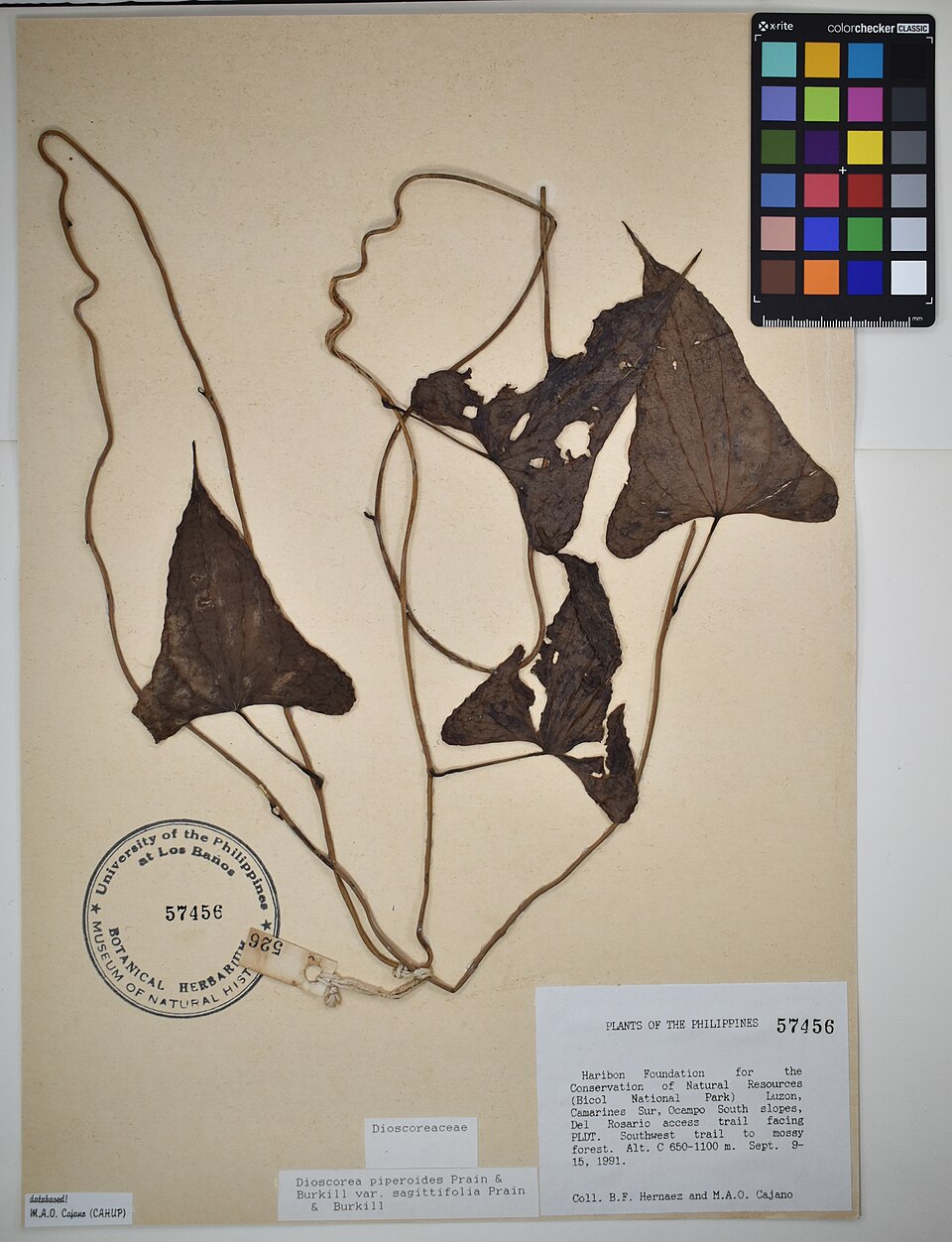
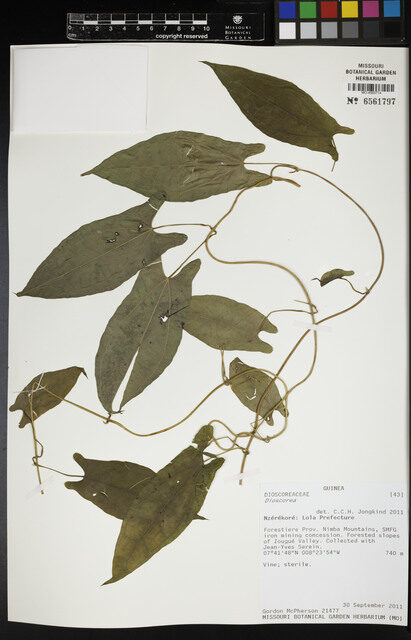
Dioscorea sansibarensis
Pax
Gudu-gudu, Zanzibar yam
iNaturalist· cc-by-nc-sa
(c) 106611639464075912591, some rights reserved (CC BY-NC-SA), uploaded by 106611639464075912591
iNaturalist· cc-by-nc-sa
(c) 106611639464075912591, some rights reserved (CC BY-NC-SA), uploaded by 106611639464075912591
iNaturalist· cc-by-nc
(c) Thomas CK Hall, some rights reserved (CC BY-NC)
Summary
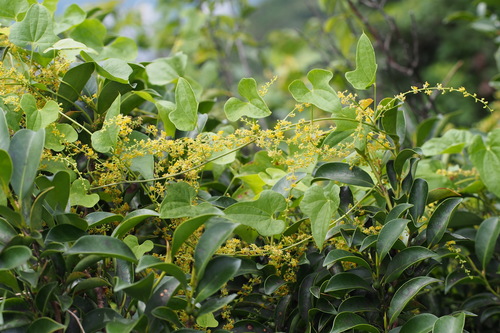
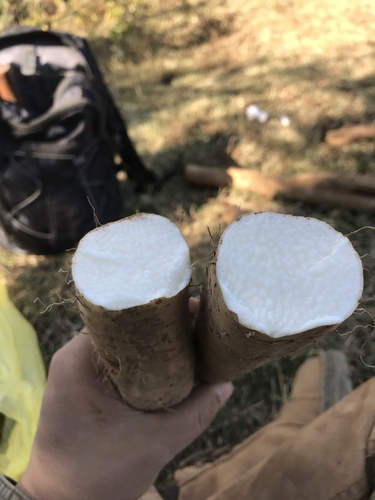
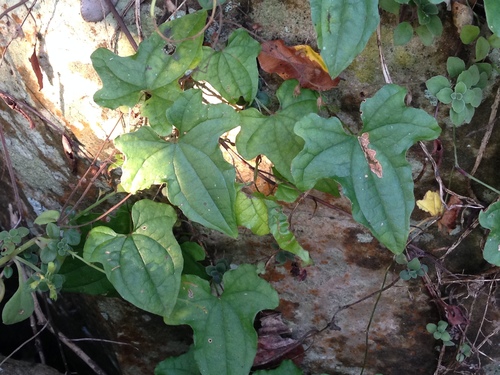
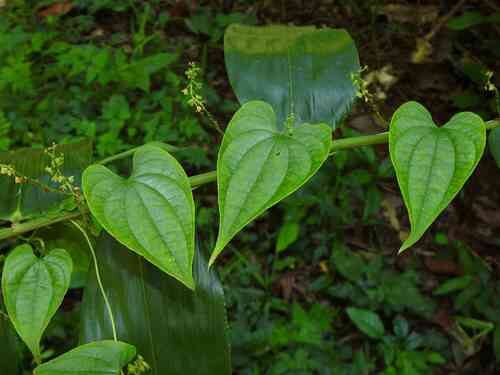
Source: WikipediaDioscorea sansibarensis is a species of flowering plant in the yam family known by the common name Zanzibar yam. It is native to Madagascar and to tropical Africa from Tanzania west to Guinea and south to Mozambique, and it is known elsewhere as an introduced species (including in southern Florida). Dioscorea sansibarensis grows from a tuber up to 40 centimeters wide. The vine may exceed 7 meters in length and can be 3 centimeters wide. It twines counterclockwise and can reach and grasp supporting trees before it produces its first leaf. The heart-shaped leaves are up to 46 centimeters long by 58 wide. The tip may taper into a tail-like extension. The bulbils are up to 6 centimeters wide and may be purplish. In parts of Africa this plant is thought to have magical properties. The tubers and bulbils are toxic.
Description
A yam. The vine is 6-25 m high. The tubers occur singly and are rounded. They are 50 cm across. They are near the soil surface. The stems twine to the left. It does not have spines or only blunt, flattened spines. The leaves are opposite. They taper to the tip. The edges of the leaves are thickened and often roll inwards. The young leaves have 3-9 deep lobes. There are usually bulbils along the vine. These are up to 5 cm across. They are round but vary in colour and texture.
Edible Uses
Tuber - cooked. Usually considered to be a famine food, and only eaten when all else has failed. The tuber is sometimes of great weight - as much as 30 kg has been recorded. The raw tuber is poisonous, but can be eaten if the poison is removed, usually by cutting up, boiling and washing.
Traditional Uses
Caution: The tuber contains alkaloids. It can contain a toxin which acts several hours after eating. The tubers are eaten.
This uses section is brief — help expand it
Medicinal Uses
The leaf-sap and a root-decoction are taken by draught for treating epilepsy.
Known Hazards
All parts of the plant, especially the wild form, are poisonous. The tuber has been used as an ordeal-poison, whilst both the tuber, and the bulbil, are used for poisoning wild animals such as pigs that can cause damage to crops. They are also used as a fish-poison. The tuber contains dioscorine, dihydrodioscorine and other unnamed alkaloids.
Distribution
A tropical plant. It grows in subsaharan Africa. It is usually close to water or in forest near rivers. It grows between 200-650 m altitude.
Where It Grows
Africa, Angola, Benin, Central Africa, Central African Republic, CAR, Comoros, Congo, Côte d'Ivoire, East Africa, Ivory Coast, Kenya, Madagascar, Malawi, Mozambique, Sao Tome and Principe, Southern Africa, Sudan, Tanzania, Uganda, West Africa, Zambia, Zimbabwe,
Cultivation
Some selection to reduce toxicity has been practised, to the extent at least that in some races toxicity is confined to the upper part of the tuber. The leaves contain glands filled with a fluid holding nitrifying bacteria. Bulbils are produced at the leaf-axils, dark purplish brown and usually larger than those of D. bulbifera. The bulbils are adapted for water dispersal - at first they sink in water, then float and on being left by receding water will germinate. They are toxic and inedible.
Production
Tubers can be 30 kg weight.
Other Information
It is commonly used in NW Madagascar. It is cultivated in some places.
Notes
There are about 650 species of Dioscorea.
Nutrition
| Part | Moisture | kJ | kcal | Protein | Vit A | Vit C | Iron | Zinc |
|---|---|---|---|---|---|---|---|---|
| Tubers | — | — | 3.7 | — | — | — | — | — |
Synonyms
Also Known As
Fanfanga, Ndranara, Ofaka, Ofimamy, Veoveo
References (20)
- Bot. Jahrb. Syst. 15:146. 1892
- Burkill, H. M., 1985, The useful plants of west tropical Africa, Vol. 1. Kew.
- Busson, 1965,
- Dalziel, J. M., 1937, The Useful plants of west tropical Africa. Crown Agents for the Colonies London.
- Grivetti, L. E., 1980, Agricultural development: present and potential role of edible wild plants. Part 2: Sub-Saharan Africa, Report to the Department of State Agency for International Development. p 47, p 24 (As Dioscorea macroura)
Show all 20 references Hide references
- IRVINE, (As Dioscorea macroura)
- Jardin, C., 1970, List of Foods Used In Africa, FAO Nutrition Information Document Series No 2.p 15 (Also as Disocorea macahiba)
- Jeannoda, V. H. et al, 2007, Les Ignames (Dioscorea spp.) de Madagascar: Revue d’Ecologie, Terre et Vie, Soci ́et ́e nationale de protection de la nature, 2007, 62, pp.191- 207.
- Jeannoda, V. H., 2016, Plants at risk of extinction: the case of some Madagascar wild yam species ( Dioscorea spp.) SOTWP-2016
- Lim, T. K., 2015, Edible Medicinal and Non Medicinal Plants. Volume 9, Modified Stems, Roots, Bulbs. Springer p 36
- Notizbl. Koenigl. Bot. Gart. Berlin 1:266. 1895 (As Dioscorea macroura)
- Peters, C. R., O'Brien, E. M., and Drummond, R.B., 1992, Edible Wild plants of Sub-saharan Africa. Kew. p 17
- Ruffo, C. K., Birnie, A. & Tengnas, B., 2002, Edible Wild Plants of Tanzania. RELMA p 279
- UPHOF, (As Dioscorea macroura)
- White, F., Dowsett-Lemaire, F. and Chapman, J. D., 2001, Evergreen Forest Flora of Malawi. Kew. p 97
- Wilkin, P., 2001, Dioscoreaceae of South-Central Africa. Kew Bulletin, Vol. 56, No. 2 (2001), pp 361-404
- Wilkin, P. et al, 2002, A New Species of Dioscorea (Dioscoreaceae) from Western Madagascar and Its Pollen Morphology. Kew Bulletin, Vol. 57. No. 4 (2002) pp. 901-909(As Dioscorea maciba)
- Wilkin, P. et al, 2007, A new edible yam (Dioscorea L.) species endemic to Mayotte, new data on D. comorensis R. Knuth and a key to the yams of the Comoro Archipelago. Adansonia ser. 3, 29(2): 215-228
- World Checklist of Useful Plant Species 2020. Royal Botanic Gardens, Kew
- Zeven, A. C. & de West, J. M. J., 1982, Dictionary of cultivated plants and their regions of diversity. Wageningen. p 126