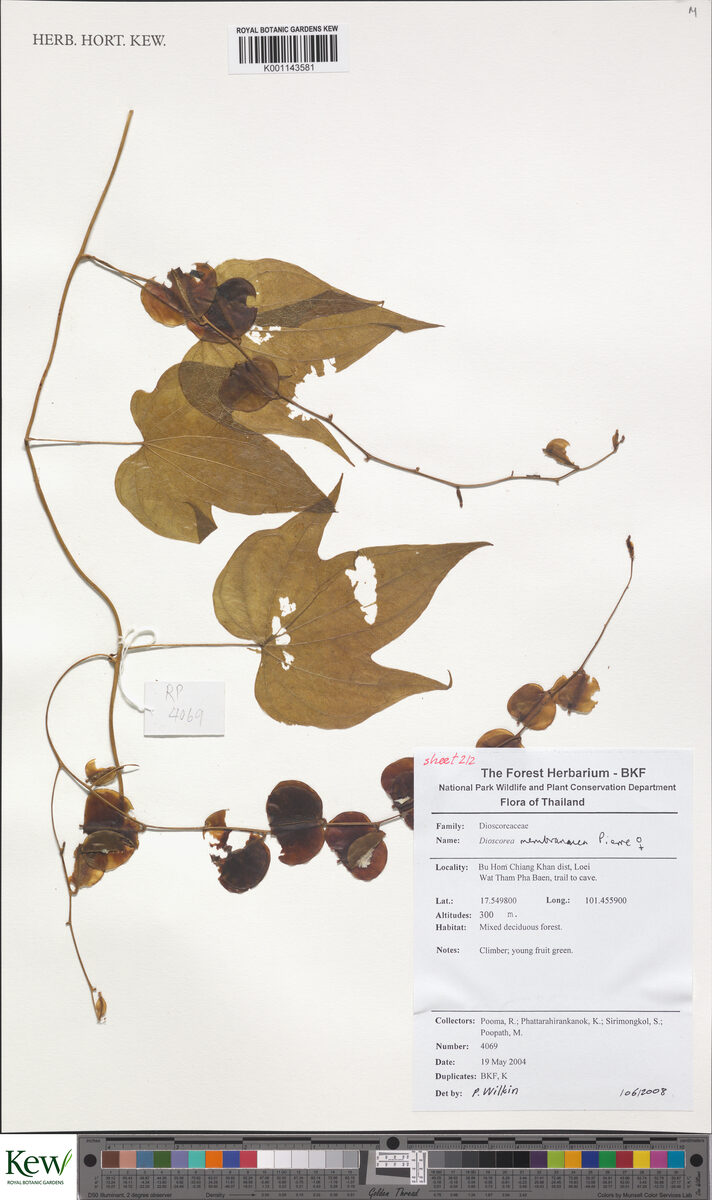
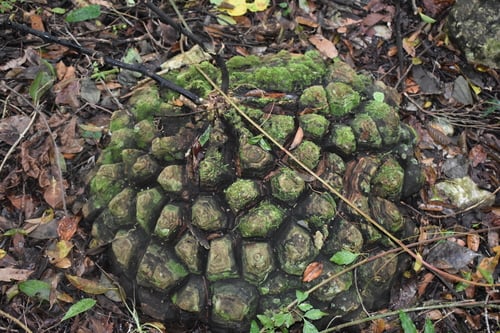
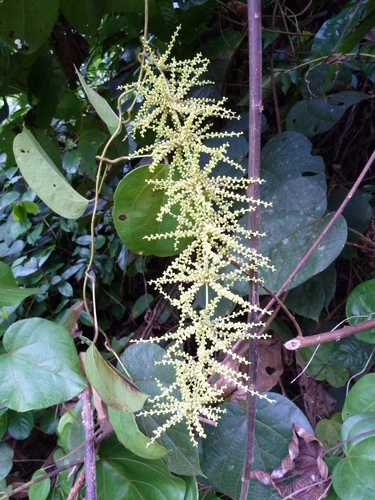
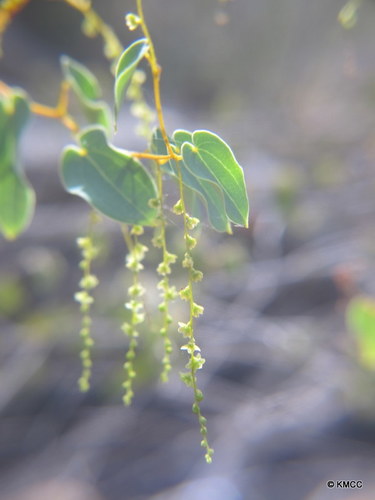
Dioscorea japonica
Thunberg
Japanese yam
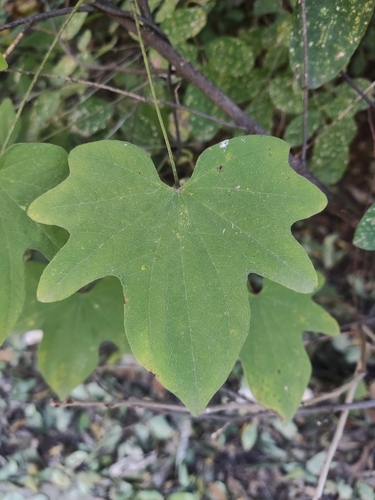
iNaturalist· cc-by-nc
(c) vitolina, some rights reserved (CC BY-NC)
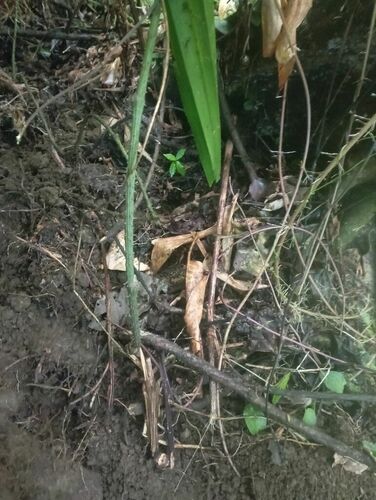
iNaturalist· cc-by-nc
(c) Stargazer, some rights reserved (CC BY-NC)
Summary
Source: WikipediaDioscorea japonica, known as East Asian mountain yam, yamaimo, or Japanese mountain yam, is a type of yam (Dioscorea) native to Japan (including Ryukyu and Bonin Islands), Korea, China, Taiwan, and Assam. Dioscorea japonica is used for food. Jinenjo, also called the wild yam, is a related variety of Japanese yam that is used as an ingredient in soba noodles.
Description
A yam. The stem twines to the right. The tubers are vertical and like a cylinder and 3 cm across. They are brown on the outside and white inside. The lower leaves are alternate and the higher leaves are opposite. They are elongated and irregular and 5-10 cm long by 2-5 cm wide.
Edible Uses
The tubers are cooked and have a very pleasant, mild flavour with a floury texture, making them a good potato substitute. The starch can also be used as a binding agent for other foods. Nutritionally, the roots contain approximately 1.9% protein, 20% carbohydrate, 0.1% fat, and 1% ash. Leaf tips and tubercles are also eaten cooked.
Traditional Uses
The tubers are cut in slices and boiled. They can be baked. They are grated and eaten with vinegar and added to soups. They can be used as a binding agent for other foods. Vine tips are eaten steamed or stir-fried. The bulbils are cooked and eaten.
Medicinal Uses
The tubers are prescribed in the treatment of diarrhoea, enteritis, enuresis, and spermatorrhoea. They are also dried, cut into shavings, and used as a tonic. Like most or all members of this genus, the roots contain diosgenin, which is widely used in modern medicine to manufacture progesterone and other steroid drugs employed as contraceptives and in treating genital organ disorders, as well as conditions such as asthma and arthritis.
Known Hazards
Edible species of Dioscorea have opposite leaves whilst poisonous species have alternate leaves.
Distribution
A temperate to subtropical plant. It grows in high mountains and on the edges of forests. In China it grows on mountain slopes and along river valleys between 100-1,200 m above sea level. It suits hardiness zones 4-10. In Sichuan.
Where It Grows
Asia, Australia, Brazil, Cape Verde, China, Indochina, Japan, Korea, Laos, SE Asia, South America, Taiwan, Thailand, USA,
Cultivation
We have very little information on this species and do not know if it will be hardy in Britain, though judging by its native range it could succeed outdoors at least in the mildest areas of this country. The following notes are based on the general needs of the genus. Easily grown in a fertile well-drained soil in a sunny position or light shade. Prefers a rich light soil. Plants produce tubercles (small tubers that are formed in the leaf axils of the stems), and can be propagated by this means. A climbing plant that supports itself by twining around the branches of other plants. Dioecious. Male and female plants must be grown if seed is required. Growth habit is a single or multiple shooting vine from a crown. Herbaceous.
Propagation
Sow seed in March to April in a sunny position in a warm greenhouse, barely covered. Germination takes 1–3 weeks at 20°C. Prick out seedlings once large enough to handle and grow on in the greenhouse for their first year, then plant out in late spring as new growth begins. Basal stem cuttings can be taken in summer. Divide in the dormant season only — never when in growth. The plant often produces several shoots; the top 5–10cm of root below each shoot can be potted up as a new plant, and the lower portion of the root can be eaten. Tubercles forming in the leaf axils are harvested in late summer to early autumn when approximately pea-sized and detaching freely. Pot up immediately into individual containers in a greenhouse or cold frame and plant out in early summer when actively growing.
Other Uses
None known. Grown in food forest systems.
Other Information
It is cultivated.
Notes
There are about 650 species of Dioscorea.
Synonyms
Also Known As
Jinenjo, Ri ben shu yu, Shan yao, Shan yu, Taiwanese yam, Yama-no-imo
References (20)
- Burkill, I.H., 1966, A Dictionary of the Economic Products of the Malay Peninsula. Ministry of Agriculture and Cooperatives, Kuala Lumpur, Malaysia. Vol 1 (A-H) p 834
- Chen, B. & Qiu, Z., Consumer's Attitudes towards Edible Wild Plants, Ishikawa Prefecture, Japan. p 23 www.hindawi.com/journals/ijfr/aip/872413.pdf
- Coursey, D.G., 1979, Yams, in Simmonds N.W.,(ed), Crop Plant Evolution. Longmans. London. p 70
- Ding Zhizun, Gilbert, M. G., DIOSCOREACEAE, shu yu ke, Flora of China,
- Duarte, M. C., et al, 2022, Diversity of Useful Plants in Cabo Verde Islands: A Biogeographic and Conservation Perspective. Plants 2022, 11, 1313 p 10
Show all 20 references Hide references
- Facciola, S., 1998, Cornucopia 2: a Source Book of Edible Plants. Kampong Publications, p 91
- Fl. jap. 151. 1784
- Hedrick, U.P., 1919, (Ed.), Sturtevant's edible plants of the world. p 274
- Hu, Shiu-ying, 2005, Food Plants of China. The Chinese University Press. p 323
- Hwang, H., et al, 2013, A Study on the Flora of 15 Islands in the Western Sea of Jeollanamdo Province, Korea. Journal of Asia-Pacific Biodiversity Vol. 6, No. 2 281-310
- Kay, D.E., 1973, Root Crops, Digest 2, Tropical Products Institute, London, p 190
- Kim, K. H., 2001, et al, Withanolides from the Rhizomes of Dioscorea japonica and Their Cytotoxicity. Journal of Agricultural and Food Chemistry. 59:6980-6984
- Larkcom, J., 1991, Oriental Vegetables, John Murray, London, p 121
- Lim, T. K., 2015, Edible Medicinal and Non Medicinal Plants. Volume 9, Modified Stems, Roots, Bulbs. Springer p 36
- Onwueme, I.C., 1978, The Tropical Tuber Crops. Wiley, p 11
- Plants for a Future database, The Field, Penpol, Lostwithiel, Cornwall, PL22 0NG, UK. http://www.scs.leeds.ac.uk/pfaf/
- READ,
- Recher, P, 2001, Fruit Spirit Botanical Gardens Plant Index. www.nrg.com.au/~recher/ seedlist.html p 5
- World Checklist of Useful Plant Species 2020. Royal Botanic Gardens, Kew
- Zeven, A. C. & de West, J. M. J., 1982, Dictionary of cultivated plants and their regions of diversity. Wageningen. p 36