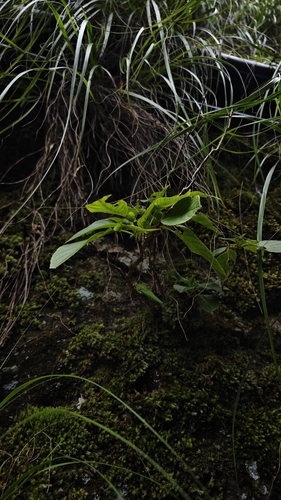
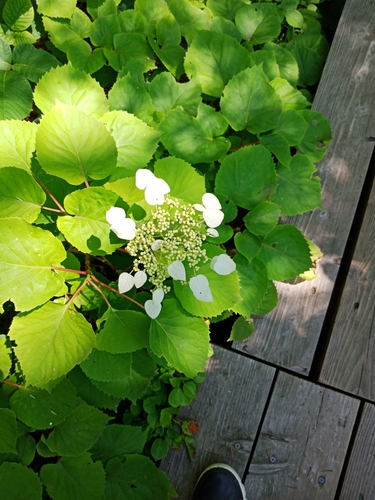
Deutzia scabra
Thunb.
Fuzzy deutzia
iNaturalist· cc-by-sa
(c) harum.koh, some rights reserved (CC BY-SA)
iNaturalist· cc-by-nc
(c) mnoel88, some rights reserved (CC BY-NC)
Summary
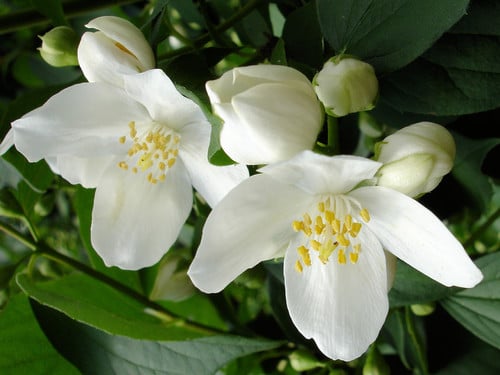
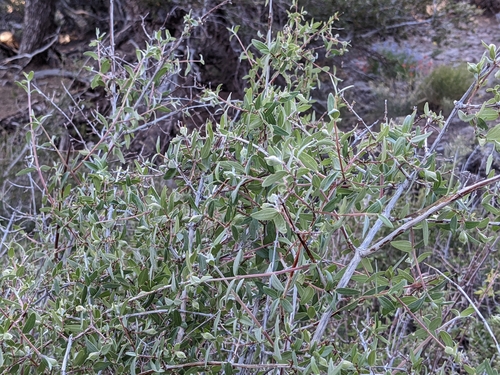
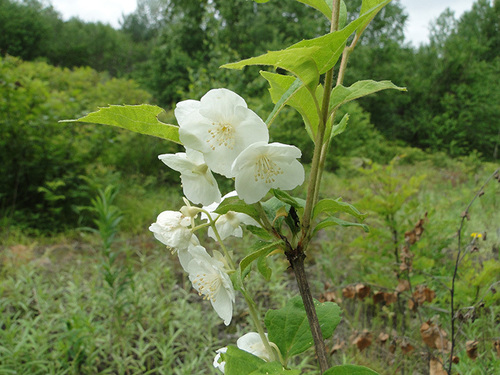
Source: WikipediaDeutzia scabra is a species of flowering plant in the hydrangea family (Hydrangeaceae) native to Japan and introduced to mainland east Asia, Europe, and North America. In its native Japan, it is found from the Kantō region, westward to the islands of Kyushu and Shikoku. Its natural habitat is along forest edges and rocky openings. It is tolerant of disturbance and can be found growing out of stone walls, along roadsides, and in other waste areas. Deutzia scabra is a deciduous shrub growing 1–2 meters in height. One way it differs from other Deutzia of Japan, is by its somewhat dimorphic leaves: those subtending the inflorescence being sessile and slightly clasping, while leaves lower down the stem are petiolate. It produces panicles of white flowers, blooming from May to July. The cultivar 'Candidissima' bears double flowers, and is taller than the species at up to 4 m (13 ft). It is a recipient of the Royal Horticultural Society's Award of Garden Merit. The pink flowered double 'Codsall Pink' has also received the award.
Description
A large upright shrub. It grows to 3 m tall. The canes are thick. They arch over. The leaves are dull green and rough textured. The flowers occur in white panicles. The flowers are white or pink tinted. They are bell shaped and at the ends of branches.
Edible Uses
Young leaves can be eaten when cooked. This is considered a famine food, used only when other options have been exhausted.
Medicinal Uses
None known.
Distribution
It is a temperate plant. It is cold hardy. It suits hardiness zones 5-9. Arboretum Tasmania.
Where It Grows
Asia, Australia, Austria, Britain, China, Europe, India, Japan*, Korea, Myanmar, Pakistan, SE Asia, Slovenia, Tasmania,
Cultivation
An easily grown plant, it tolerates most soils but prefers a moist well-drained fertile humus-rich soil with shade from the early morning sun when grown in areas with late frosts. Prefers a sunny sheltered position, it can be grown on a woodland edge. Tolerates a limey soil. Dormant plants are hardy to about -20°c. The young growth, however, is subject to damage by late frosts and so a suitable position with shelter from early morning spring sunshine is best. A very ornamental plant, it is the best and most reliable species in this genus for growing in Britain. A number of cultivars have been developed for their ornamental value. Flowers are produced on the previous seasons wood. Flowering can be increased by thinning the old shoots after flowering. A very polymorphic plant. Plants in this genus are notably resistant to honey fungus.
Propagation
Sow seed in February in a greenhouse, barely covering it. Germination is usually good and takes 1–3 months at 18°C. Prick seedlings into individual pots when large enough and grow on under glass through at least the first winter. Plant out in late spring or early summer after the last expected frosts. Half-ripe cuttings of 10–12cm with a heel can be taken from the end of June to July in a frame, with a good to high success rate. Ripe wood cuttings of 20–25cm with a heel can be rooted in a sheltered outdoor bed or in a cold greenhouse.
Other Uses
The wood is fine-grained and used for mosaic work and wooden nails.
Notes
There are 60 Deutzia species. It is used in medicine. Also put in the family Philadelphaceae.
Synonyms
Also Known As
Navadna dojcija, Soushu, Urine sparce
References (11)
- Ambasta, S.P. (Ed.), 2000, The Useful Plants of India. CSIR India. p 169
- Bodkin, F., 1991, Encyclopedia Botanica. Cornstalk publishing, p 336
- Cundall, P., (ed.), 2004, Gardening Australia: flora: the gardener's bible. ABC Books. p 490
- Etherington, K., & Imwold, D., (Eds), 2001, Botanica's Trees & Shrubs. The illustrated A-Z of over 8500 trees and shrubs. Random House, Australia. p 260
- Hibbert, M., 2002, The Aussie Plant Finder 2002, Florilegium. p 85
Show all 11 references Hide references
- Lord, E.E., & Willis, J.H., 1999, Shrubs and Trees for Australian gardens. Lothian. p 224
- Morley, B. & Everard, B., 1970, Wild Flowers of the World. Ebury press. Plate 99
- Nov. gen. pl. 1:19, 20, 21. 1781 (Fl. jap. 185, t. 24. 1784)
- Plants for a Future database, The Field, Penpol, Lostwithiel, Cornwall, PL22 0NG, UK. http://www.scs.leeds.ac.uk/pfaf/
- Valder, P., 1999, The Garden Plants of China. Florilegium. p 279
- Young, J., (Ed.), 2001, Botanica's Pocket Trees and Shrubs. Random House. p 321